Hello

Your subscription is almost coming to an end. Don’t miss out on the great content on Nation.Africa

Ready to continue your informative journey with us?

Hello

Your premium access has ended, but the best of Nation.Africa is still within reach. Renew now to unlock exclusive stories and in-depth features.

Reclaim your full access. Click below to renew.

Ruto
Caption for the landscape image:

How 2025 planted political seeds of the coming years

Scroll down to read the article

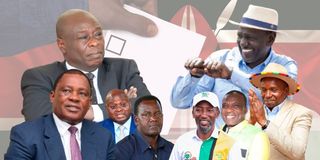
Former Deputy President Rigathi Gachagua, Democratic Party (DP) leader Justin Muturi, DAP–K candidate in Malava Seth Panyako, DP’s Mbeere North candidate Newton Karish, MP-elects Leonard Muthende (Mbeere North), David Ndakwa (Malava) Deputy President Kithure Kindiki and President William Ruto.  

Photo credit: Nation Media Group

Kenya is a great nation that fought for, found and is now losing its freedom; a nation which for two decades at least pretended to walk the path of democracy but is now stubbornly marching back to darkness, in a cloud of glib high-minded talk, a litany of buried scandals and a carpet of fresh corpses in its wake.

Progress is not linear; it is always three steps forward, one back. We can argue whether ours, which is one step forward and four in the direction of the past, is any progress at all. I don’t want to be a prophet of doom; I desperately want to believe that there are better days ahead for us. This year, 2025, is a massive canvas on which, writ large, are the messages of doom – or redemption – depending on our decision at the fork on the road. Here are my highlights.
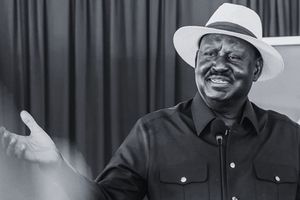
We are only now beginning to understand the true impact of the death of opposition leader Raila Odinga on October 15. This is the most consequential political event of this year, and it will shape not just next year but many years into the future.

Was Mr Odinga a one-man opposition? Was our quest for good governance anchored by a single man, the sun around which the other lily-livered opposition moons orbited? Does Kenyan democracy wilt in the face of a determined dictator because of the absence of Mr Odinga’s magic?

Mr Odinga was many things to different people: some thought he was a political harlot, only too willing to jump into the sack even with the worst of the lot, for his own political relevance and bulging pockets. What is not debatable is that he was a fearless, tireless and effective fighter for the people of Kenya and their democracy. He saved governments from collapse and was a guarantor of stability, just like he was the prime source of instability when he went to war.

Kenyan patriots

When the history of this epoch is written, he will rank at the very top of the pantheon of Kenyan patriots. Perhaps, a little late in life, Mr Odinga discovered that poverty is not a redeeming quality and took determined measures to remedy that. Of that, I know and will therefore say nothing.

The youth riots mid-year against the Finance Bill, and later the death of blogger Albert Ojwang changed Kenyan politics forever. First, it exposed a large, detribalised political force, one that is more fanatical and patriotic than any other since the Mau Mau.

You don’t see it; it slumbers in the deep. The government won a pyrrhic “victory” against it in two ways – by deploying the most brutal campaign of suppression in recent history, shedding the blood of 65 youths and arresting 1,500 – and thus planting seeds of inevitable future rebellion.

The second tactic was Mr Odinga’s counter-revolution – he mobilised his army of urban youth, some rumoured to be armed, against the Gen-Z. Mr Odinga truly wanted to avoid chaos, but he also wanted to avoid political castration – a youth takeover would have rendered him politically useless.

It was also an opportunity to strike a power-sharing deal with the Ruto administration. It wasn’t a doe-eyed move; it was hardcore statecraft. The Gen-Z still live – and now there is no Mr Odinga.

Our rather tepid “united opposition” led by Kalonzo Musyoka, Martha Karua, Fred Matiang’i and Rigathi Gachagua is the best hope of challenging, defeating or at least moderating the brash, arrogant and corrupt wielding of power by the present administration.

The group has few achievements under its belt so far, but this is the phase of bickering and betrayal in its development; it is early days. The sacking of Mr Gachagua as Deputy President removed the most hardcore buffoon in government and unleashed the most brilliant, indefatigable, eloquent opposition to the current government. If President Ruto loses the election in 2027, Mr Gachagua will have a lot to do with it.

On the economy front, the National Infrastructure and Sovereign Wealth Fund, in my understanding, changes how we organise development, especially industry, from private sector-led (which is more efficient at resource allocation) and puts it in the hands of government, in essence, the hands of one mega-Danube of thought at the core of power. It is a continuation of the marginalisation of the people, the recentralisation of power and the recreation of the imperial presidency.

Finally, the loss of Mbeere North and Malava by-elections by the United Opposition to UDA is a wake up moment for some of “the people are with us” opposition upstarts and a few of their rather washed-out allies. The government quite likely rigged the election and violated the law by using massive public resources in the field. But in the zero-sum game of power, what matters is not how you lost, it is victory. No one has ever got power by crying foul. Stop dreaming of power, earn it.

I ran out of space, but we are sailing into interesting waters. Hold tight.

Follow our WhatsApp channel for breaking news updates and more stories like this.