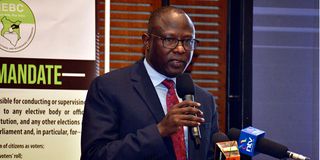
On Thursday evening, hours after opposition leaders walked out of a meeting with the electoral commission, President William Ruto offered a line meant to settle the matter.
“Wacheni kusumbua IEBC. Haipigi kura (Stop disturbing IEBC. It does not vote),” he told a crowd in Bungoma.
He is right. The IEBC counts. It keeps the register that decides who may vote. It procures the technology that carries results from polling stations to the national tally. It announces the figure that decides who governs and pretty much controls our national resources.
A commission that casts no ballot holds every instrument that determines if a ballot means anything. That is why the way it treats the people asking it questions matters much, especially in a country where institutions have been captured by the presidency.
Consider the record. On January 28, opposition leaders met the commission, and both sides agreed to form technical teams to review preparations for the 2027 General Election.
On February 12, the opposition submitted the names of its team. There was no response. On May 10, it wrote again, citing the January agreement. There was no response.
On June 24, former Attorney General Justin Muturi wrote on behalf of the United Opposition. There still was no response.
Then on November 19, the IEBC convened a consultative meeting on an agenda it had drafted alone. The demands that the People’s Coalition on Electoral Reforms, led by former Chief Justice David Maraga, had agreed that morning were absent – A clean-up of the register to remove duplicate, deceased and ineligible entries; constituency results to be made final, so that the national centre aggregates the 290 declarations rather than re-tallying them; a pilot of secure electronic voting for Kenyans abroad; and livestreamed turnout and livestreamed declarations at polling stations and constituency tallying centres.
Also missing was any plan for the Smartmatic contract, which expires on November 24, five days after the meeting and under nine months before the poll.
The opposition asked that the agenda be reworked with a team led by Maraga, offered to reconvene as early as the following week, and left.
It is easy to dismiss a walkout as unnecessary. The harder question is what else was available to people whose correspondence had gone unanswered since February.
Sitting through a meeting built to exclude your concerns does not register dissent. It lends your presence to a process you do not accept, and it allows the commission to report afterwards that stakeholders were consulted when they were ignored and their agenda items removed from the day’s programme.
Kenyans do not need to be told why these demands matter. They have lived the reasons. In September 2017, the Supreme Court annulled a presidential election because the commission failed to conduct it in accordance with the Constitution.
In August 2022, four of the seven commissioners disowned the presidential result on the day it was declared. Both crises turned on the same two questions: what happened between the polling station and the national tally, and who was allowed to see it.
The coalition’s demands answer those questions directly. They ask for nothing the Constitution does not already require. Article 86 obliges the IEBC to run a voting system that is simple, accurate, verifiable, secure, accountable and transparent, and to have results announced promptly at every polling station.
Final constituency results and livestreamed declarations simply turn that standard into something a voter can check rather than something a voter must take on trust.
Independent institutions are not sustained by the statutes that create them. They are sustained by pressure and the ability of the citizens to ensure that pressure is sustained in the direction of constitutionalism. The IEBC exists because its predecessor lost the country’s confidence in 2007, and Kenyans paid for that loss in lives.
An electoral agency earns its independence by being demonstrably open to scrutiny. It begins to lose that independence the moment any serious stakeholder concludes that letters go unanswered and agendas are settled elsewhere. Integrity is not a fixed possession of the commission. It has to be fought for, and it has to be fought for before the election, because afterwards the only remaining forum is a courtroom.
This should not be treated as an opposition cause. A register cleaned of the dead protects every candidate. Constituency results that cannot be altered at the centre protect the winner as much as the loser, because they make the outcome harder to dispute. A governing party confident of victory has more reason than anyone to want a count that no one can question. The President’s supporters should be asking the commission for these reforms as loudly as his opponents.
The commission still has time to show it is serious. It can reply to its correspondence. It can meet the Maraga team within the week. It can publish an agenda that includes the four demands and the technology transition, with dates attached to each. None of this requires new legislation.
It simply requires a decision. Kenyans can help that decision along. Ask your Member of Parliament where they stand on final constituency results. Ask your party whether it has written to the commission, and what it was told. Register, and check your details on the roll before the window closes. Institutions respond to the citizens who are watching them, and they drift when nobody is.
A vote is cast once. It is then handled by many hands, in many rooms, over several days. Every one of those rooms should be visible to the people whose decision is being counted.
The IEBC does not vote. Kenyans do. The least the commission owes them is a count they can watch, track and verify. Onward with the fight, Mr Maraga!