Literature has a habit of arriving early. Every five years, a panel at the Kenya Institute of Curriculum Development decides which stories a generation of teenagers will carry into adulthood. Whoever chose Kenya's recent set books deserves a medal, or a warning. They sat together and handed students a field guide to the State they would grow up under.
Consider Kigogo. Pauline Kea's Majoka shuts the Chapakazi market , the one place Sagamoyo earns its living, claiming it is filthy, while the land is quietly set aside for a hotel. Then he declares a month of independence celebrations. Traders with nowhere to sell are offered keki ya uhuru , a slice of independence cake. Sudi (haha!) the carver refuses it. These are crumbs, he says; the real cake was eaten somewhere else. When Tunu organises against the closure, Majoka sends hired thugs after her. When the television stations cover the protests, his answer is to switch them off.
Consider Fathers of Nations as well, the compulsory English novel of this examination cycle. Paul Vitta gathers 50 heads of state in Banjul, with motorcades and security cordons, to adopt a development plan twenty Nobel laureates have already written for them. Banjul treats the summit as an inconvenience, and the leaders treat it as a stage. In The Samaritan , the leaders of Maracas municipality try to kill a student-built app that exposes their negligence, when fixing the negligence would have cost significantly less.
Three texts, one central lesson. A weak leader manages how governance looks, because governing well is slow, unglamorous and photographs badly. Now, back home.
On 13 October, Formula 1 signed a ten-year agreement with Rwanda to host the African Grand Prix from the early 2030s, on a permanent circuit at Bugesera. Sports minister Nelly Mukazayire called it one step in a sports-led growth strategy Kigali has run for years. Cabinet has since approved a framework to raise investment around it. One can argue about Kigali's politics, but the planning is not in dispute: a decade-long commitment, a fixed asset, a financing plan and an industry to grow around it.
Fifteen days later, State House told Kenyans to expect a major announcement at 6pm.
Bayern Munich and Ajax will play a friendly in Nairobi on 5 January 2027 to open the new Raila Odinga International Stadium at Talanta. Ninety minutes of football, funded, the President said, by “corporate partners” nobody has yet named.
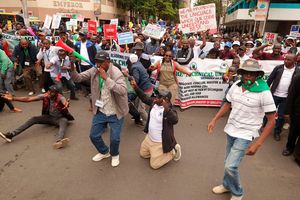
The friendly match (a one-off spectacle while neighbours announce lengthy agreements) fits a method this government has used from the start. In October, students at the Kaptumo KMTC campus were filmed waving the Sh1,000 notes they say they were handed to line the road for a presidential stopover. In August, local media reported that youths in Homa Bay were paid up to Sh4,000 to stone convoys and barricade roads ahead of an opposition rally; two AFP journalists were beaten that morning. AFP has since documented politicians hiring goons for as little as $4 a day, with police often looking the other way. The practice cuts across parties, but obviously only one party commands the police.
When the people will not come, they are paid to come. When the opposition draws a crowd, someone is paid to break it up. Every shilling spent manufacturing affection is a shilling that could have been spent actually earning it. Clear the pending bills owed to small suppliers. Stop taxing struggling businesses into the informal economy. Do that for four years and no student would need Sh1,000 to stand by a road. The crowd would come for free. Bought loyalty expires immediately the payoff is made, which is why the wantam chants keep following the paid crowds from one stop to the next.
The same short horizon runs through the contracts. The Treasury's draft 2027 Budget Policy Statement lists a Sh180.73 billion exposure if the State walks away from the 30-year concessions on the Rironi to Mau Summit highway: Sh93.38 billion on the China Road and Bridge sections and Sh87.35 billion on the Shandong section. The Treasury says this is a contingent liability, and not exactly an expected payment. Fine. This administration has already paid Sh7.3 billion to exit the previous Vinci deal on the same road, before a single kilometre was built. The same disclosures show the smart driving licence contract carrying Sh50.22 billion in exposure against a project worth Sh45 billion. Leaving the deal costs more than the value of the deal itself. How does this even make sense?
Majoka would recognise all of it. The market closed, the cakes handed out, the thugs dispatched, and the cameras managed. What he never grasped, and what Kea made sure every Form Four student would, is that Sagamoyo was watching the whole time.
So is Kenya. Crazy Kennar captured the mood better than most analysts in his skit on how African presidents are received by their people. When the sketch reached Kenya, the crowd was ready to send the president home even if he built heaven on earth. It is a comedian's exaggeration, and like the best ones, it is mostly accurate.
So let the spectacles come. Bayern in January. AFCON in June. More roadside crowds with crisp notes in their pockets. None of it changes the arithmetic of August 2027. A stadium opening does not refund a tax. A friendly match does not account for the young people still missing since the 2025 protests.
The set books told us how this story ends. The leader who confuses applause he paid for with support he earned is always the last to find out. Wantam started as a slogan. By now it reads like a forecast.