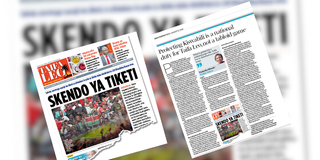
Last week’s article, “Protecting Kiswahili is a national duty for Taifa Leo, not a tabloid game”, sparked diverse reactions from readers, including a response from the newspaper’s Lead Editor.
The article faulted the unnecessary anglicisation of Kiswahili in the headline “Skendo ya Tiketi” (ticket scandal), warning that Taifa Leo risked undermining the very language it champions.
In the spirit of fairness and dialogue, we publish here some of the responses received—and invite more views from our readers.
I read with great interest the article in which Prof Kithaka wa Mberia took issue with our headline, “Skendo ya Tiketi”.
I hold tremendous respect for Prof Mberia, having been his student in the 1990s at the University of Nairobi. The professor belongs to the school of thought that advocates linguistic purity, seeking to preserve language from what are considered undesirable variations.
For a long time, Taifa Leo was derisively disregarded for using textbook language rather than journalese. This perception arose from the editorial emphasis on standard Kiswahili.
However, insights from focus group discussions revealed that the rigidity of standard Kiswahili was discouraging a significant number of potential readers. For example, would a buyer in the market ask for “parachichi”, the standard Kiswahili term, or opt for the more widely used “avokado”?
Consequently, it was agreed that the paper be segmented in such a way that most sections would adopt standard Kiswahili, while a few columns — such as Dondoo za Hapa na Pale and the splash (main headline) — would employ a more relaxed register.
Unlike a textbook, which has a specific target audience, a newspaper like Taifa Leo serves a highly diverse readership. In striving to meet the needs of each segment, an editor will inevitably use language that seasoned scholars like Prof Mberia may find less palatable.
– Gilbert Mogire, Lead Editor, Taifa Leo
Prof Mberia was too harsh on Taifa editors
The Public Editor’s article, “Protecting Kiswahili is a national duty for Taifa Leo, not a tabloid game” provoked my reflections on the place of Kiswahili as Kenya’s official and national language.
As a Kiswahili scholar with a journalism bent, I have used the Taifa Leo space for a long time to champion the interests of the language through my weekly column “Mizani ya Hoja”( Scales of Ideas). I occasionally write commentaries in the Saturday Nation and Sunday Nation to lament on the government’s failure to establish Baraza la Kiswahili la Kenya (National Kiswahili Council).
Due to what can be interpreted as political unwillingness, Kenya has refused to establish the council, going against Article 137 of the East African Community Treaty that provides that Kiswahili shall be promoted, developed and used as a lingua franca of the community.
Tanzania leads other East African Community members, having established Baraza la Kiswahili la Tanzania as early as 1967. Uganda has made tremendous progress in establishing Baraza la Kiswahili la Uganda.
With the National Kiswahili Council of Kenya in place, matters related to the mainstreaming, strengthening and implementing of the country’s policy pronouncements on Kiswahili shall be given the seriousness they deserve.
I agree with the Public Editor’s argument about Taifa Leo’s obligation to protect Kiswahili as a national language—largely anchored on the observations of Prof Kithaka Wa Mberia, a reputable linguist. Reacting to the Taifa Leo splash, Prof Mberia observed that the editors ought to have used the word “kashfa” instead of “skendo” to denote scandal. Prof Mberia said the Taifa Leo writer portrayed incompetence or laziness (in thinking?), for not knowing that Kiswahili has a known word—kashfa—for scandal.
However, Prof Wa Mberia may have read only the headline and not delved into the main text, which not only used the word “kashfa”, but also its synonym “sakata”. The use of these words in the main story rules out Prof Mberia’s harsh judgment.
In my view, the word “skendo” was used intentionally, maybe to achieve punchiness in the headline or to achieve clarity in communication. In Swahili journalism, sometimes the editor focuses more on how the readers would perceive the meaning of a word in context.
Be that as it may, this debate should push the Kenyan government to fast-track the establishment of Baraza la Kiswahili la Kenya, which shall no doubt influence policy on how Kiswahili is used and standardised.
– Enock Matundura, Kiswahili literature at lecturer at Chuka University
Taifa Leo should avoid tabloid expressions
I commend the Public Editor for highlighting the responsibility of Taifa Leo in protecting Kiswahili. Indeed, Kiswahili is more than a language; it is a vessel of culture, unity and national identity. A newspaper of Taifa Leo’s stature should, therefore, avoid tabloid expressions that compromise the purity of the language.
The use of “Skendo ya Tiketi” instead of “Kashfa ya Tiketi” is a perfect example of where the paper falls short. Readers naturally absorb what is printed as correct usage, and such slang terms risk misleading learners and lowering the linguistic standards we strive to uphold.
As Kiswahili teachers, we remind authors and editors to consult authoritative resources, such as the TUKI English-Swahili dictionary, a work that took lexicographers at the Taasisi ya Uchunguzi wa Kiswahili 14 years to compile. The dictionary exists to guide the correct and professional Kiswahili usage.
Taifa Leo must rise above tabloid tendencies and safeguard Kiswahili by using proper, dignified and standard forms.
Article rightly spoke to students’ struggles
I read the piece (on Taifa Leo and Kiswahili) with a lot of interest. You are very right to highlight the struggles of students battling sheng at home and on the streets and Kiswahili sanifu (proper) in school.
I was one of them. Growing up in Eastlands (Nairobi) and attending day school from Form One to Form Six, this struggle was real. At home (with my siblings), we would speak sheng. Then I would hit the road and in the matatu and bus it would still be sheng. Getting into class, we would leave all that behind and engage in good Kiswahili.
I fought my way all through, graduating with a Bachelor of Education degree in Religion and Kiswahili.