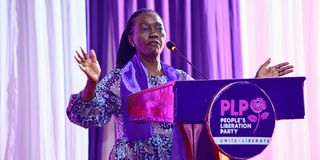
On September 26, 2025, I attended, and watched, the unfolding of the inaugural National Delegates Conference of the People’s Liberation Party (PLP) held at Ufungamano House in Nairobi. Addressing nearly 1,000 delegates attending the meeting, Martha Karua, the party’s leader, announced her candidature for the Kenyan presidency in 2027, the second time she will be seek the seat following her first bid in 2013.
“Kenya has only two tribes: men and women,” the 'Iron Lady' of Kenyan politics declared, shifting the axis of the 2027 context from ethnicity to gender.
In the 2027 battle for the soul of Kenya, gender is poised to trump ethnic mobilisation, potentially leading to a peaceful democratic transition. Notably, all elections in Kenya fought along ideological divides rather than political tribalism have led to peaceful transfer of power. This is true of “nationalism” (Kenyans-versus-the British) in 1963, clash of generations (Kibaki-versus-Uhuru) in 2002; and class, the dynasties versus hustlers narrative, in 2022. But is the country ripe for a female President?
Obviously, all the five Kenyan Presidents — Jomo Kenyatta, Daniel arap Moi, Mwai Kibaki, Uhuru Kenyatta, and William Ruto — have been males. In Kenya’s political field, she is the strongest if not the only female candidate.
Since January 2025, the eminent lawyer-cum-politician has embarked on transforming the PLP into a juggernaut with the national appeal and capacity to fight for and win the 2027 presidential election freely and fairly.
In late February, she led her team to officially rebrand the National Rainbow Coalition-Kenya (NARC-Kenya), formed nearly 20 years ago, to the People’s Liberation Party (PLP). The aim, Karua said, was to align the party with a progressive, people-centred agenda focused on unity, transparency, and accountability. A new-look PLP would be better position to attract the vote of the younger generation, particularly Gen Z.
Speaking ahead of the party’s official launch on Thursday, Karua explained that NARC-Kenya, had become less familiar to younger voters. The transition to PLP is meant to revitalise its appeal and reaffirm its commitment to democratic ideals. The Special Delegates Conference revamped to squarely face the challenges of a highly competitive and turbulent political marketplace.
The stated purpose of the forum was to adopt the revised Party Constitution to set the state for the expansion of political capacity and leadership that reflects the face of Kenya, with a footprint in Kenya’s 47 counties. The party is open for business. It has an expanded executive with a Party Leader, three Deputies (programmes, strategy, mobilization); structures or leagues catering for the specialised interests of the youth, women, people leaving with disabilities and professionals from all walks of life, and think tanks fit for the 21st century knowledge-based party formation.
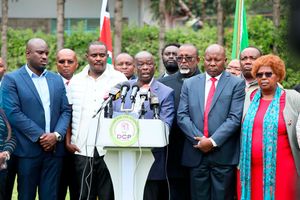
The top leadership of the United Opposition — Wiper party’s Kalonzo Musyoka, DCP’s Rigathi Gachagua, DAP-K’s Eugene Wamalwa, and DP’s Justin Muturi — were also invited to this key event in reshaping opposition politics ahead of the 2027 elections. Conspicuously absent in the conference was the Uhuru Kenyatta-led the Jubilee Party (JP), which was also holding a parallel delegates conference in a bid to resuscitate the once dominant, and now a pale shadow of its past.
In November 2024, the Wiper party, DAP-K and Narc-Kenya/PLP pulled out of the Azimio Coalition as its leader, Raila Odinga, joined a broad-based government with the ruling United Democratic Party (UDA)/Kwanza Coalition. Jubilee has decided to “remain” in Azimio, which Wiper leader rightly declared dead last year. The leaders reassured supporters that only one of them will face Ruto. They will agree on a scientific formula that will produce a single flag-bearer.
In the emerging united opposition architecture, Karua has an equal chance as any of her male counterparts to be nominated as the coalition’s presidential candidate to face William Ruto on August 10, 2027. "If elected, I will serve for only one term," She said. While advancing the ideals of unity, peace, freedom and justice, the post-2027 political order Karua envisions one-term limit for leaders, anti-corruption measures, and people-centered economic empowerment.
As Karua eyes the Kenyan presidency, the African Continent is electing more and more women as presidents. The footprint of women as presidents in Africa is becoming an indelible feature. These include Namibia’s first female President, Netumbo Nandi-Ndaitwah, inaugurated on March 21, 2025; Ethiopia’s Sahle-Work Zewde (2018 –2024), Liberia’s Ellen Johnson Sirleaf (2006 – 2018); and Malawi’s Joyce Hilda Banda (April 2012 – May 2014).
Several women have served as acting or interim presidents during periods of transition, some of whom have gone on to ascend presidency, including Tanzania’s Suluhu Hassan (2021 – Present) who assumed the presidency following the death of President John Magufuli. In Central African Republic, Catherine Samba-Panza (2014 –2016) served as Acting Head of State following the resignation of rebel leader Michael Djotodia. Mauritius’s Agnès Bellepeau acted as President during crucial transitional periods between presidents in July 2012, and again in 2015.
In Gabon, Rose Francine Rogombé assumed power in the June 2009 – October 2009 hiatus following the death of President Omar Bongo until the election of a new president. Burundi’s Sylvie Kinigi was acting president during a critical period following the assassination of President Melchior Ndadaye (October 1993 – February 1994).
Currently, five women are serving their nations as prime ministers on the continent, including Victoire Tomegah in Togo, Rose Raponda in Gabon, Robinah Nabbanja in Uganda, Najla Romdhane in Tunisia, and Saara Kuugongelwa-Amadhila in Namibia. Across the continent, eight women served as Prime Ministers between 1993 and 2014.
Finally, the number of African women trying their hand in President is on the rise. In 1997, Charity Ngilu challenged Daniel Moi during the 1997 elections. President In Tanzania, Suluhu Hassan is vying for Presidency in the upcoming general elections on 29 October 2025.
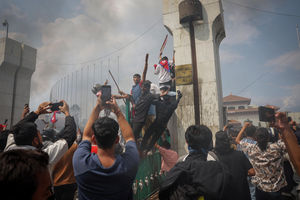
In the wake of abductions, disappearances and killing of Gen-Z during protests, demand for soft power at the helm of power is on the rise. The tears of the mothers. “A mother can’t kill or abduct children.” These truisms was echoed by speaker after speaker.
If the United Opposition finally settles on Karua as the 2027 Presidential standard bearer, Kalonzo Musyoka, Eugene Wamalwa, justin Muturi, and Mithika Linturi will back her candidature.
Peter Kagwanja is a former Government Advisor, Chief Executive at the Africa Policy Institute (API).