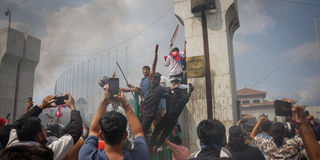
The Gen-Z, they say, may be techno-savvy, but they bear the unsavory reputation of being lazy and with terrible work ethics. But this generation, born between the late 1990s and the early 2010s, has not dithered to take a strong stand on corruption.
The wave of protests in Nepal, France, Indonesia, Philippines and Kenya this year, reveal the Gen-Z as the most revolutionary generation in the 21st century. They are the white knights in the crusade for a new moral order.
The now increasingly globalised Gen-Z protects heralds the return of earlier people-led revolutions like the American, French Russian and Chinese Revolutions. But from where is this revolutionary generation getting its inspiration, ideology and purpose?
Certainly, in Nepal and Indonesia, the Gen Z is taking inspiration from the One Piece anime, a Japanese anime television series, that premiered in the late 1999. Protesters are inspired by the compelling story of friendship and the universal message of challenging corrupt systems, oppressive governments and decadent power elite and fighting for personal and collective dreams, freedom and for a better future. Across Asia, Europe and potentially Africa, youth protesters are raising the One Piece Straw Hat flag to fight corruption, censorship, and elite power.
Unlike in Indonesia and Nepal, the Straw Hat flag has not been used as a banner of protest. Instead, the youth protesters have carried the Kenyan flag. But the One Piece flag is also growing popular with the Gen Z. Last year, the Kenyan media outlet, Pulse, highlighted an anime event indicating Gen Z's interest in anime and related events in the country. And last month, Nairobi hosted its first Anime Convention, attended by thousands of youths.
The most recent and deadliest of these Gen Z-led riots is the Nepalese revolt, which started on Monday and is still smouldering. Since February, public and student-led anti-government demonstrations, organised by the All-Indonesian Students' Union (BEM SI), together with individual students' unions, have rocked Indonesia. The on-going September 10, 2025 Movement or the "Block Everything" Action in France, also Gen Z-led has brought this global winter of protest to Europe.
In Africa, youth-led protests have also rocked Kenya since June last year, with the Gen Z rage taking a turn in June-July this year where nearly 40 people were killed. Undoubtedly, the most successful Gen Z protests were the Quota Reform Movement and Non-Cooperation Movement that of these Gen-Z led protests occurred in Bangladesh last year from July 1 to August 5. Across the world, this ‘warrior’ generation is burning with fire and fury. They signify "People power, deemed as greater than the people in power."
These people-led revolutions are resistance against rampant corruption, extravagant lifestyles of the power elite, unemployment, assault on democratic values and slide to authoritarianism. In Nepal, a digital grievance sparked by the government’s decision to burn 26 media platforms ostensibly to curb hate speech and misinformation quickly became a festering generational revolt.
Nepalese Prime Minister KP Sharma Oli.
The Gen Z saw this as a gagging order signifying the return of authoritarianism. Nepal’s GenZ were up in arms against a long list of betrayal and policy failures, including corruption, nepotism and unemployment. In France, the September 10 Gen Z protest are protesting public budget cuts and the corrupt behaviour and extravagance of the elite. In Indonesia, the protests erupted over a proposed $3,057 monthly housing allowance for parliament members, ten times Jakarta's minimum wage—one of the highest in Indonesia.
2025 marks the first anniversary of the last years Bangladeshi protests, which rose against authoritarianism, human rights abuse, economic depression, and efforts by the regime to retain the hated job quota system. On August 5, the Bangladeshi revolution received constitutional acknowledgment with the announcement of the July Declaration. In Kenya, the GenZ took to the streets to protest the 2024 proposed Finance bill in Parliament, high taxes, corruption and public display of opulence by the power elite.
The Gen-Z has deployed a slew of methods, including demonstrations, protests, civil disobedience, civil resistance, online activism, hacktivism, mass mobilisation, riots, looting, vandalism and arson. Draconian responses by the government to peaceful protests have turned resistance viral and violent. In Nepal, protests became violent after over 30 people were killed and hundreds injured.
Success in these protests has varied. In Nepal, protesters forced Prime Minister K. P. Sharma Oli to resign, set ablaze multiple government buildings and political offices (including the parliament, Singha Durbar and presidential residence buildings), led to dissolving of the House of Representatives, the lifting of the social media ban and the appointment of Sushila Karki as is interim Prime Minister.
The youth protesters are avowedly faceless and leaderless, complicating dialogue to reach a sustainable end to political crises. In Nepal, dialogue has involved the Gen-Z, the army chiefs and the president. This has helped in the appointment of the acting prime minister.
Kenya has reasons to fret the likelihood of a Nepal-style revolution. Since June last year, Nairobi has reneged on all the promises and the power elite is more decadent and extravagant, the system falling deeper into decay.
In the French Revolution (1789-1799), revolutionary upheavals toppled the monarchy, established a fragile republic and set the stage for the rise of a military leader, Napoleon Bonaparte. The Gen Z protests are creating environments where militaries are rising as brokers of protests. With growing military interventions, these people-led protests have led to democratic recessions. Last year, the Defence Forces (KDF) was controversially deployed to assist in quelling protest activities alongside the police. In Nepal the military stepped in the restore order and fill a vacuum left by the resigned civilian rulers. Nepal may not be under the military, but it is under military oversight.
Finally, Gen Z protests are becoming geopolitically complex. There is a hidden hand of geopolitics in the Gen Z protests, begging the question whether protests are organic or they are simply nudged by external forces seeking to reshape the geopolitical future of target countries.
In Nepal, Prime minister Sharma Oli was seen as pro-China who deepened ties with Beijing. As a clear counterweight to Chinese influence in Nepal, the US has renewed Millennium Challenge Corporation (MCC) compact with Nepal, injecting $500 million. In this winter of increasingly globalised people’s protests, governments have to return to ethical governments focused on the interests of citizens rather than those of the power elite.