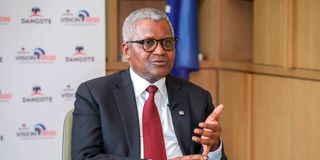
What do Nigerian billionaire Aliko Dangote’s Dangote Group companies, Kenya’s telco biggie Safaricom, KCB and Equity Bank have in common? Each is creating, across borders, the integrated market that African states have promised for 60 years but struggled to deliver.
Decades of summits by the continent’s Big Men and African commissions, from the 1980 Lagos Plan of Action to the African Continental Free Trade Area (AfCFTA), have produced protocols and treaties. These companies, by contrast, produce things you can see, touch, sit on, or make money from: refined fuel, payment systems and branch networks that customers use across borders.
Of the four, Dangote’s endeavours are the most ambitious and extensive. It is not just a company extending its tentacles beyond Nigeria; it is a network taking shape across the continent. The hub is Lagos, Nigeria’s chaotic and creative commercial capital. The Dangote refinery there, now refining 700,000 barrels of crude oil a day, is set to double to 1.4 million by 2029. Earlier in the year, on the back of disruptions caused by the US attack on Iran, it briefly made Nigeria the world’s largest exporter of jet fuel. That reversed a trend where Africa exported crude to Europe and Asia, then imported it back as petrol, diesel and aviation fuel.
From the Lagos hub, a ring is forming. On September 30, Dangote broke ground in Lamu on Kenya’s coast for a $16 billion refinery slated to refine 700,000 barrels a day, larger than any currently operating in Europe.
Up in the Horn of Africa, a $660 million Dangote pipeline from Djibouti is planned to carry fuel into Ethiopia, alongside a $4 billion fertiliser complex in Gode in southeastern Ethiopia. In Namibia, a $2.5 billion Dangote hub is to be connected by a planned 1,700-kilometre pipeline to five landlocked southern African nations. Egypt has also been on the phone with Dangote about a Mediterranean node.
Plotted together, a pattern emerges. Lagos sits on the Atlantic, Lamu on the Indian Ocean, Djibouti on the Red Sea, a possible Egyptian location in years to come, and pipelines snaking into Ethiopia and the landlocked states of southern Africa. A private network is developing that owns refining capacity, cement and fertiliser factories, and the routes along which a chunk of Africa’s fuel travels.
The Lamu refinery, we were told, is to be financed about 70 per cent by debt, with the remainder from shareholders. Kenya has been offered a 10 per cent stake worth about $500 million, and East African governments a combined 30 per cent. Ethiopia and Rwanda have reportedly already picked up tickets. Meanwhile, a few days ago, Uganda went knocking on Dangote’s door for a refinery in its Albertine oilfields, saying its plant could complement Lamu. However, in August, Uganda signed a memorandum of understanding with Tanzania and energy trader Vitol for a separate refinery in Tanga. In other words, regional governments are hedging.
Where governments have cooperated, energy has been the common platform. Already, a power line runs from Ethiopia through Kenya to Tanzania, and a Dar es Salaam–Mombasa gas pipeline has been proposed.
Not to be too selfish, there is action on the continent’s west coast too. After many missed timelines, leaders of the West African economic bloc ECOWAS signed an agreement for a gas pipeline of nearly 6,000 kilometres across 13 countries, from Nigeria to Morocco and on to Europe. The final investment decision has not yet materialised, though.
Kenya’s regional champions have followed a similar script, on a smaller scale, though in services rather than infrastructure. Safaricom’s Ethiopian venture, which dragged down its earnings, has taken a bright turn. It reported that, in the half-year to September, the unit grew service revenue by 71.6 per cent and cut its losses by 96.5 per cent.
In the financial sector, KCB and Equity have become East Africa’s two strongest lenders. KCB has been ranked 15th in Africa, with Equity 16th. Both operate subsidiaries across the region, from Tanzania, Uganda and Rwanda to DR Congo and South Sudan.
The shared characteristic is that all four treat East and Central Africa, and in Dangote’s case the continent, as a single market, whatever the varying pace of official state integration (mention needs to be of other East African players like Bidco and East African Breweries).
The difference lies in what they own. Safaricom and the banks sell services that partly depend on roads, ports and power lines built by others. Dangote is building and owning the physical infrastructure itself, including planned electricity and roads.
For Kenya, Lamu places it at the eastern end of that network. It also gives Lamu port, opened in 2021 as the gateway to the Lamu Port–South Sudan–Ethiopia Transport Corridor, a big anchor customer.
The path forward is getting clearer. African integration, long sought through treaties, is increasingly being built by companies looking for cross-border profits. The biggest player now has a foothold on Kenya’s coast.
The author is a writer, journalist and curator of the Wall of Great Africans. X: @cobbo3.