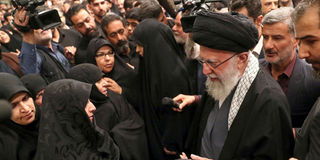
On February 28 2026, the United States and Israel launched massive bombing attacks on Iran, striking alleged nuclear facilities, military command centres, and naval instalments of the Revolutionary Guard.
The raid led to the death of Supreme Leader Ali Khamenei, prompting immediate Iranian retaliatory strikes across the Persian Gulf. Mansoureh Khojasteh Bagherzadeh, the widow of the Supreme Leader, also died on March 2, 2026, from injuries sustained during the initial strikes on Tehran.
In Bahrain, missiles struck the US Navy’s Fifth Fleet headquarters. In the United Arab Emirates, two air bases were hit. In Saudi Arabia, drones targeted an Aramco refinery and offshore oil platforms, although Iran denied responsibility. Tehran’s stated justification is that these states host American military assets used in the offensive.
For the Gulf monarchies, however, the conflict has exposed a fundamental domestic vulnerability now under scrutiny: their near-total reliance on a small number of highly exposed desalination plants (which remove salt and minerals from seawater to produce freshwater for drinking and agriculture).
These countries possess few natural freshwater sources. In the UAE, desalination provides nearly 100 per cent of municipal water, while Saudi Arabia relies on it for more than 70 per cent of its urban supply. The plants are coastal and therefore high-value targets. A sustained strike on a facility such as Saudi Arabia’s Ras Al-Khair, which produces over 1 million cubic metres of water per day, would leave millions without drinking water within days. This existential risk is driving a quiet but determined externalisation of Gulf water and food security into Africa.
To reduce the domestic water risks, Gulf monarchies are relocating water-intensive agriculture to Africa. By cultivating crops such as alfalfa and wheat on African soil, they conserve their own depleted aquifers and shield food supplies from the direct consequences of a Middle Eastern war.
In Senegal, this strategy is represented by African Agriculture Inc., an American-listed company with strong supply links to Saudi and Emirati dairy industries. By producing alfalfa for export, the project effectively siphons Senegal’s freshwater to sustain cattle in Riyadh and Dubai.
Growing one kilogramme of alfalfa requires between 800 and 1,000 litres of water; when tens of thousands of tonnes are exported, it amounts to a significant transfer of a scarce African resource to the Gulf. African Agriculture draws water from the Senegal River at one-hundredth of the cost faced by foreign competitors, a price that takes little account of looming water stress in Dakar.
This logic of externalised survival also underpins vast land leases for carbon credits. In the past two years, the Dubai-based Blue Carbon has secured rights to approximately 25 million hectares across Africa, an area nearly the size of Uganda. This includes eight million hectares in Tanzania, roughly eight per cent of its total land area. The carbon credits generated by these forests enable Gulf states to offset emissions from desalination plants and industrial centres, helping secure their economic position in a global market shaped by Net Zero commitments.
Yet ownership of farms means little if export routes are uncertain. This explains the intensifying competition between Dubai’s DP World and Chinese firms for control of African ports. DP World’s 30-year management contract for the Dar es Salaam port, alongside its strategic interest in Kenya’s Mombasa and Lamu ports, is intended to guarantee a priority corridor for Gulf-bound supplies.
The geopolitics of the Horn of Africa completes the picture. Ethiopia, landlocked yet agriculturally productive, could become the Gulf’s principal breadbasket. However, it lacks direct access to the sea and relies on the Djibouti route for 95 per cent of its trade. Reports suggest that the UAE and Israel support Ethiopia’s ambitions for access to a Red Sea port, a move that challenges Eritrea’s control over Assab and Massawa.
For the UAE, an Ethiopian port would secure agricultural supply lines. For Israel, it would provide a strategic foothold to counter Iranian naval activity in the Bab el-Mandeb Strait. Ethiopia’s recent shift towards Somaliland for naval facilities and port access at Berbera, backed by Emirati investment, signals that the Red Sea’s political geography is being reshaped to serve the security needs of the Arabian Peninsula.
In Kenya, the domestic implications of this Middle Eastern security strategy are increasingly evident in large-scale land initiatives. The Nairobi government’s Climate Change (Carbon Markets) Regulations 2024 have sped up the process for foreign firms to lease large tracts of communal land. Blue Carbon has already signed a framework deal covering millions of hectares in Kenya.
Meanwhile, the Northern Rangelands Trust has established conservancies spanning over 42,000 square kilometres, nearly 8 per cent of Kenya’s land area, often with funding linked to Gulf conservation and carbon offset objectives.
The US-Israel assault on Iran is not merely a Levantine conflict; it is accelerating a new contest for African resources. By securing vast tracts of land and the ports required to move their produce, Gulf states are seeking to ensure that even if the Persian Gulf becomes a sustained combat zone, their water supplies and food chains remain intact. Africa is becoming the terrain on which the most critical logistics of the Middle Eastern conflict are anchored.
—The author is a journalist, writer and curator of the Wall of Great Africans. X@cobbo3