With the death of its charismatic founder, Raila Odinga, on October 15, 2025, the Orange Democratic Movement (ODM) seems to be in crisis; or is it?
The party appears fractured by a deep disagreement over its relationship with President William Ruto’s government, initiated by Raila in the wake of the 2024 Gen Z uprising, and whether it enters the 2027 election within or outside that framework.
This fracture is defined by four camps, but today we consider two. One, the pro-cooperation faction led by politicians like Governor Gladys Wanga, the party chairperson, favours maintaining the government arrangement initiated by Raila.
Then there is the radical opposition and reformist faction, led by secretary-general Edwin Sifuna and supported by Raila’s daughter, Winnie Odinga, MP Babu Owino, and Siaya County Governor James Orengo. This group wants ODM to return to its roots as a radical opposition party, fearing that cooperation with Ruto will tarnish the party’s reformist legacy and alienate its core base ahead of the 2027 elections.
As a political party, ODM is an intriguing creature. It is Kenya’s and East Africa’s most successful party outside power, more specifically the presidency, and since its first parliamentary contest in 2007, it has held more than 20 per cent of parliamentary seats in every election cycle. Its most successful season was 2007, when it won nearly 45 per cent of the seats.
However, despite some breathless headlines over its current wrangles, ODM has been defined precisely by these upheavals, which appear to be one of the sources of its renewal. On reflection, the greater surprise would have been if the current storm had not happened.
After the party was formed in 2005 to oppose the draft constitution in the referendum, which it won, it was roiled by a rift in 2007 between Odinga and Kalonzo Musyoka. Musyoka left.
In 2010, William Ruto, a key member of the “Pentagon” (ODM’s top leadership collective), effectively exited during the Grand Coalition government formed after the 2008 post-election violence. Ruto led a mass exodus of the Rift Valley bloc to form the United Republican Party (URP), which eventually partnered with Uhuru Kenyatta for the 2013 election.
Musalia Mudavadi, Raila’s deputy and another member of the Pentagon, walked away before the 2013 elections, forming the United Democratic Forum (UDF).
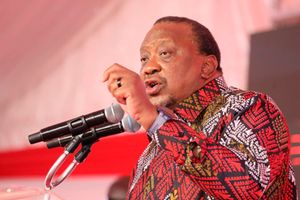
ODM party leaders at Sameta grounds in Kisii County during the 'Linda Ground' event on January 25, 2026.
Photo credit: Ruth Mbula | Nation Media Group
In 2016, Ababu Namwamba, then secretary-general, resigned. However, while some exited the stage, others entered from the right, enabling the party to renew itself with infusions of new blood.
ODM now seems to be in the third stage of the political hierarchy of conflict. The first, political division, is usually internal, for example, over constitutional reform or economic policy.
The second, party split, is when internal divisions lead to a faction breaking off to form a new party, as Musyoka, Ruto and Mudavadi did. In marriage, this is equivalent to separation.
The third is breakup, when the party completely disintegrates or undergoes a transformation in which the old identity vanishes. In marriage, this is divorce. Many parties in Kenya have ended that way; will ODM too?
There are many things that are different about Kenya today. To name a few, since 2003, the politics of Central Kenya, the Mountain Region, had been about protecting its stake and privileges. The Mountain was like a dog with a bone in its teeth and fought to safeguard it. The impeachment of then-Deputy President Rigathi Gachagua changed all that.
To undercut President Ruto, Gachagua built a grievance-driven politics, very unlike the Mountain region, and he seems to have succeeded. He has reframed the question of the bone. Now, the narrative is that the bone Central Kenya has between its teeth is dry and needs some meat on it. This could sharpen the question of redistribution in 2027.
Secondly, there has been a maturation of a kind of techno-youth politics, first expressed in the Gen Z protests of June 2024. What will they do in 2027?
Raila had ceased to be an ideologically driven politician in 2017 and became a master pragmatist. However, the language coming from the Sifuna-Babu faction of ODM suggests ideological re-immersion in ways it has not in the party’s politics for a long time and harks back to the 1990s “Young Turks” democracy activists – James Orengo, Kiraitu Murungi, Gitobu Imanyara, Anyang’ Nyong’o, Paul Muite, Mukhisa Kituyi, and Raila Odinga.
Their singular success was eventually forcing the repeal of Section 2A of the Constitution in 1991, making Kenya a multi-party State again.
However, Ruto’s UDA is not like Daniel arap Moi’s Kanu. Today, it appears internally cohesive and settled, benefiting from having stuck the knife into Gachagua’s back very early, allowing waters to calm and managing the fallout well before the elections.
It would not be surprising if all this and the return of redistributive politics pushed Sifuna and his comrades towards a sharper ideological pivot, and therefore a breakup, and an easier cohabitation with Gen Z activism if it evolves into a political movement.
The author is a journalist, writer and curator of the Wall of Great Africans. X@cobbo3