The tournament was dogged by accusations of host bias, reaching its flashpoint in the final when Senegal briefly walked off in protest at a late penalty awarded to Morocco. What followed was uglier still. Senegal's victory unleashed a torrent of vile online racism and xenophobic abuse aimed at its players, echoing earlier incidents where Nigerian footballers were reportedly subjected to monkey chants.
Yet none of this diminishes the fact that this was an Afcon of another order, a scale of African football organisation not witnessed before.
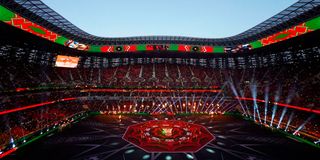
For decades, Afcon was a logistical nightmare, testing the stamina of fans as much as the skill of players. Morocco broke that mould, treating the tournament as a rehearsal for the 2030 World Cup and proving that African infrastructure can compete with the best in Europe or Asia. There were no stories of teams stuck in traffic for hours or fans stranded at remote airports.
Billionaire Patrice Motsepe, President of the Confederation of African Football (CAF), was visibly moved. His praise was gushing: “The Africa Cup of Nations in Morocco was the most successful edition in the tournament’s history. The level of football was wonderful, as were the infrastructure, stadiums, and services. It has raised the bar significantly.”
The numbers tell us this is a tournament maturing into a global commercial platform. This edition generated an unprecedented Sh24.8 billion (US$ 192.6 million) in total revenue, a 90 per cent leap from the previous year, making it the most profitable in African footballing history. Sponsorship alone brought in Sh6.2 billion (US$126 million), anchored by title partner TotalEnergies and supported by Orange, Visa, Tecno, Puma and Unilever, among others.
Meanwhile, homegrown names such as Royal Air Maroc and natural mineral water brand Sidi Ali ensured the event retained a local heartbeat.
While stadiums weren’t always overflowing, the glaringly empty seats at non-host matches were minimal. Morocco’s proximity to Europe led to a massive influx of the African diaspora. Furthermore, the local Moroccan public has a deep-seated football culture. Stadiums were consistently packed, creating a vibrant, wall-to-wall atmosphere that translated beautifully on television, boosting the tournament’s brand.
The tournament spilt out of the stadiums into the medinas and plazas. What Morocco did better than almost everyone else before was the fan zones. They were not just patches of dirt with a screen, but high-tech festivals featuring Moroccan arts, music and food.
The defining image of this Afcon was the Al Boraq high-speed train. It solved Africa’s age-old travel nightmare with clinical precision. Consider the geography: Tangier to Casablanca is roughly 320 kilometres. By road, it is a four-hour grind. By Al Boraq, it is a breezy two hours and 10 minutes. Rabat, the capital, sits neatly between, just an hour from either end. Fans could lunch in Casablanca, catch a midday match in Rabat, and return to Tangier’s Mediterranean breeze by nightfall without breaking stride.
This is the standard Afcon 2027, hosted by the “Pamoja” trio of Kenya, Tanzania, and Uganda, must reach to rival Morocco.
The distance from Nairobi to Arusha is about 270 kilometres, comparable to the distances between Tangier and Rabat. Today, that journey means hours of bone-shaking roads in places and the slow navigation of border checks at Namanga. In Morocco, the train was the artery that kept the tournament alive. For “Pamoja”, goodwill alone will not suffice. They must stitch Nairobi, Kampala and Dar es Salaam together with more than hospitality.
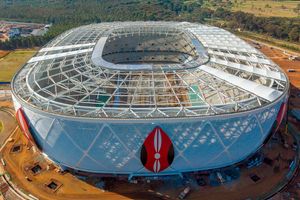
An aerial view of the under-construction 60,000-seater Talanta Stadium in Nairobi on January 23, 2026.
Photo credit: Sila Kiplagat | Nation Media Group
First, the “last mile” must be solved. Flying between Nairobi and Entebbe is not enough. The journey from the airport to the stadium must be seamless. Dedicated Afcon lanes are needed on the perpetually clogged streets of Kampala and Nairobi. If a fan spends four hours stuck in traffic on the way to Namboole or Kasarani, the Moroccan magic evaporates.
Modern Afcons are won or lost in the VVIP boxes and media tribunes. Kenya and Uganda must ensure stadium renovations go beyond cosmetic facelifts. High-speed 5G must blanket every corner, and hospitality suites must be fit to entice the global corporate elite. Tanzania’s Benjamin Mkapa Stadium offers a head start.
The most significant hurdle for 2027 is the border. Morocco’s triumph was contained within one nation. “Pamoja” is a three-headed challenge. To match 2025, a Single Afcon Visa is essential. A fan should be able to board a bus in Dar es Salaam and wake up in Nairobi without a three-hour grilling at Namanga. If immigration clogs the arteries, the tournament falters.
East Africa holds what Morocco does not: the raw, chaotic and beautiful energy of the Swahili coast and the Great Lakes. Morocco was clinical; Pamoja must be vibrant: a cultural safari, immersing fans in the region’s spirit.
To meet Motsepe’s “raised bar”, therefore, the 2027 hosts must also see this as an infrastructure and diplomatic undertaking. Morocco showed Africa can deliver luxury and efficiency. East Africa must show it can provide seamlessness and soul, while steering clear of the tribalism and xenophobia that scarred Morocco’s final moments.
The author is a journalist, writer and curator of the Wall of Great Africans. X@cobbo3