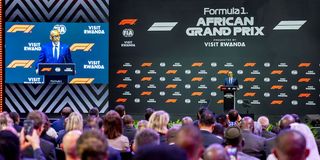
On Tuesday, Formula 1 signed a ten-year agreement to race in Rwanda . The African Grand Prix will run from the early 2030s on a purpose-built circuit in Bugesera, 40 kilometres south of Kigali, beside the new international airport. It will be the first Grand Prix on the continent since Kyalami in 1993.
Stefano Domenicali, Formula 1's president and chief executive, said the sport had always meant to return to Africa "in the right way, with the right partner." Asked why Rwanda and not the other African countries that had expressed interest, he was blunter: "We are in a world where a lot of people love to talk and a lot of people love to work." The determination of the president and his team, he said, made Formula 1 comfortable that this was a long-term journey.
That sentence belongs on the wall of every Nairobi boardroom where any national strategy has been launched.
Formula 1 had options. South Africa has an existing circuit and a long motorsport history. Morocco hosted a championship race in 1958. Rwanda has no track and has a small market. What it had was one plan. The airport, the circuit, the hotels and the commercial district are being delivered as a single project under the Rwanda Development Board. The venue is designed for 100,000 spectators and year-round use as a concert and exhibition site. Formula 1 is betting less on a circuit than on a government that has already shown it can deliver large events on schedule. In the past two years Kigali has hosted the FIA General Assembly and the UCI Road World Championships, the first ever held in Africa.
Global capital as well, is making the same bet. Rwanda's 2025 Foreign Private Capital census recorded inflows of $1,098.5 million in 2024, up 23.9 per cent from $886.9 million the year before. Foreign direct investment alone rose 21.8 per cent to $872.9 million. Financial services led with $299.1 million, followed by manufacturing at $267.1 million. These are small numbers by Kenyan standards. But they are also consistent ones, built on a decade of reforms to investment law, business registration and industrial policy.
The financial centre rankings tell the same story. In the Global Financial Centres Index published in September 2025, Kigali rose seven places to 65th globally and third in Africa. Nairobi fell five places to 105th. The Nairobi International Financial Centre was conceived first. The Kigali centre moved from concept to operation faster, with simpler entry thresholds and fewer authorities to satisfy. Firms that once defaulted to Nairobi are now deciding that it’s easier to deal with government policies an hour and a half’s flight from JKIA. Nairobi has the bigger economy behind it but Kigali has an easier path in front of it.
You can actually stretch this difference in posture from one simple factor. Who gets hired to run ministries and State departments? Rwanda recruits professional civil servants through competitive, examination-based processes, publishes its shortlists and pass marks, and runs much of the system online. Technical portfolios have repeatedly gone to people with verifiable records: statisticians, career diplomats, legal scholars, former private-sector executives. Performance contracts, known as imihigo, tie officials to published targets. The system has its political loyalty tests but its operating assumption is still that competence is the price of entry.
Kenya's Constitution requires the public service to reflect the country's diversity. Given the history, that requirement is necessary. In practice, the language of balance has often been used to cover patronage, delay competitive processes and allocate posts by coalition mathematics. The National Cohesion and Integration Act says no public body may draw more than a third of its staff from one ethnic community. The Auditor-General's report for the year to June 2023 found that 3,467 of Bomet County's 3,566 employees, 97 percent, came from one community. Nandi stood at 96 per cent and Elgeyo Marakwet at 95 per cent. The National Cohesion and Integration Commission's own 2023 audit found 29 communities sharing one per cent of county jobs.
Investors typically notice small things as these. They do not need a perfect democracy. They need predictable rules, enforceable contracts and officials who can be held to a standard. Investors can very reliably price risk. They cannot price a rule that will change with the next reshuffle. Kenya still has the larger market, the deeper stock exchange, the port at Mombasa and a far bigger pool of skilled workers. But it also has overlapping regulators, frequent policy reversals and a high political cost to enforcing rules against the network of politically connected interests. Each of those raises the effective price of every deal signed in Nairobi.
It's important to note that none of this necessarily requires romanticising Kigali. Rights groups have raised concerns about the Formula 1 deal, and the Democratic Republic of Congo had urged the sport to walk away over Rwanda's role in the conflict in eastern Congo. Whether the gains from the African Grand Prix are broad or concentrated will decide how the partnership is judged in the long run.
The narrower point, however, is harder to dismiss. When an international organisation or a private investor can choose between potential partners, it increasingly picks the one that has laid the groundwork for competent execution.
Kenya's advantages remain decisive on paper but these do not produce the institutional habits that convert them into sustained inflows. Capital is not leaving Kenya. Likely not anytime soon as our economy and her people are rather resilient. But it has started to price the difference between meritocracies and whatever it is we have in this country.