Democratic theory says all three branches of government – Executive, Legislature and Judiciary are co-equal. That’s largely true, but not completely. The branches are formally independent of one another. Checks and balances put them in eternal vigilance over one another.
In certain areas, however, every branch enjoys advantages over the others. In matters specific to each, the particular branch is superior to the others. When the sum total of all their powers are calibrated, the Executive is clearly the first among equals. This is democratic theory and practice. However, elites in intelligent democracies have long known that successful democratic theory and practice isn’t a zero-sum game among the three branches.
Democracy, as British imperialist Winston Churchill said, is the worst form of government, except for all others. The “others” include monarchy, dictatorship, military, leadership by lineage and inheritance and kleptocracy. Political democracy isn’t perfect, but is better than most because it’s in theory based on the supposed will of the majority through universal elections or forms of plebiscite. In common parlance, we like to talk of “free” and “fair” elections. Of course that’s balderdash because so-called democratic elections can never be free or fair because of money in politics, the power of biases such as ethnicity, race, religion, levels of education and other vectors of identity.
Pure system of government
That’s why Churchill was right. Democracy isn’t about the equality of the vote, the candidate, the voter – but about the appearance of fairer competition. That’s why in a democracy, a born prince – like Uhuru Kenyatta – could easily ascend to Kenya’s political pinnacle without any compelling logic about his person. He was born a Kenyatta of the Agikuyu. Because of that, he started life with massive advantages – an elite American education, domiciliary in Kenya’s largest ethnic cousinages and ungodly wealth. He “inherited” the presidency. We see similar phenomena in other countries, including in East Africa. President William Ruto self-made – he assumed power by the dint of his abilities.
This soliloquy is about two points I want to make. The first is that democracy isn’t a pure system of government that is somehow sacred and beyond fault, or reproach. No – it’s a flawed system the purpose of which is to manage politics and its contradictions so that the highest number of citizens can have a decent life. Democracy allows different interests in a country to manage conflict without pogroms. It postpones open conflict until elites go mad and forget the larger purposes of the state.
Civil war and state collapse happen when elites forget how to compete for power, or share it. Then all is lost, consuming everyone in a conflagration.
My second point is that Kenyan elites must put country first for without it, even they are dust. Which brings me to the current season. Democracy is rancorous, noisy and loud. I also admit that the Executive is the biggest price in an election, because it’s the alpha and omega of the state. The Executive is in charge of the country’s coffers, with the oversight of the Legislature and certain other constitutional institutions.
Biggest price in a democracy
The state coffers are the biggest price in a democracy. That is why political parties fight to control the Executive and the Legislature because that’s where the bacon is divided and “eaten”. This explains why certain regions of Kenya are more developed than others. Their elites have held political and economic power for long and established the grid of the country’s development structure and legacy.
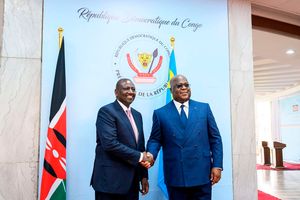
The Executive is where the people have deposited the largest share of coercive powers, the instruments of foreign policy and the defence of the country and state. Police and intelligence powers lie there. The president, who sits at the pinnacle of the state, is Kenya’s spokesperson. He is the country’s face to the world. It’s he who knows where risks to Kenya’s sovereignty lie. If Kenya is attacked by foreign powers or non-state actors, he takes responsibility. This is not unique to Kenya. It’s true of all democracies. The president, and not the chief justice or the speakers of the Legislature, must stay awake at night. He must be vigilant at all times because he’s the repository of the country’s existence.
I get the sense that in the current din of elections, these basic facts about statehood are lost in translation. Some toxic politicians talk as though they don’t care whether President William Ruto succeeds or fails. They mistake the fight for power with the de-legitimation of the current occupant of State House. Elites must stop thinking like squirrels who only see what’s at the ground level. They need to see far. Over the horizon. Let’s fight for power, but not forget that we have a country to keep.
Makau Mutua is SUNY Distinguished Professor and Margaret W. Wong Professor at Buffalo Law School, The State University of New York. @makaumutua