This week, a collective sadness descended upon us. We lost Raila Amolo Odinga. Former Prime Minister, freedom fighter, and one of the most consequential political figures Kenya has ever known.
I felt it deeply. Because for better or worse, Raila Odinga was no ordinary politician. To my mother, Wangari Maathai, he was a comrade. A friend. A fellow believer in the power of conviction and the sacredness of our forests.
They admired each other’s courage, patience and commitment to a course. And while many of us will continue to remember his masterful political instincts, I will also forever remember something profoundly courageous: his leadership in the conservation of the Mau Forest.
It was Raila Odinga who, during his tenure as Prime Minister, took one of the boldest political risks of his career to protect Kenya’s largest water tower.
At a time when conservation was politically unpopular and fraught with tension, he chose principle and demonstrated inclusive consultation and leadership.
He personally led a consultative process, meeting over 300 representatives from civil society, government, and community organisations a KICC for a public forum. He understood that public participation was not a formality but rather the most potent pathway to consensus, even in the most complex and contested spaces.
Out of the KICC consultations came the Prime Minister’s Taskforce on the Conservation of the Mau Forest Complex. To this day, their report remains one of the most comprehensive compilation of the history and status of the Mau Forest in Kenya’s history. And unlike many others, it was not shelved.
It was approved by Parliament, endorsed by Cabinet, and implemented through an Interim Coordinating Secretariat housed in his own office.
That report laid the foundation for the recovery of over 21,000 hectares of forest and oversaw the first non-violent eviction of 2,500 families (an effort grounded in dignity, dialogue, and the belief that conservation must never come at the cost of humanity). My mother pointed to this example often to remind us that, potentially, our most important allies in conservation can be the very government we challenge. It was a thread that bound them together: the understanding that our forests are lifelines for all Kenyans.
Raila Odinga’s legacy is layered, profoundly political, yes, but also deeply personal and undeniably national. His passing has stirred something raw in all of us. What we are experiencing is not just grief in the conventional sense. As a piece I read attributed to Clinical Psychologist Mwari Muthaura crisply expressed: “This is disenfranchised grief. That when someone like RAO dies, it touches something primal in our collective psyche. It reminds us of the wounds we carry, the battles we’ve fought, the betrayals we’ve endured, and the futures we long for. That this isn’t politics. It is about identity, belonging and legacy. It marks the closing of a chapter of our nation's history that he carried on his back”.
Lifelong fight for a better Kenya
We, at the Wangari Maathai Foundation, pay tribute to Raila Odinga’s courage and his lifelong fight for a better Kenya. May we honour his legacy by refusing to lose hope in who we can still become. Let us carry forward the courage he modeled.
In just two days, on October 20, we will mark Mashujaa Day. It is a day to honor the heroes who have shaped our nation’s journey. This year, the day will feel heavier. It has been a year of emotional highs and lows, of heightened activism, mourning and reckoning, and of rediscovering what it means to be Kenyan.
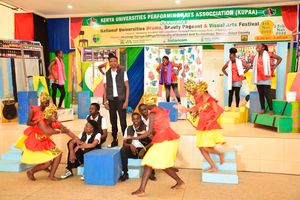
And in that spirit, I hope we will expand our definition of heroism. Let us celebrate not only those who shaped our politics and policies, but also the artists, musicians, poets, and thespians who have carried our spirits through the lows. It is they who have buoyed us, who have reminded us, through songs, plays, and poetry, that we are resilient, that we have a higher purpose, and that the soul of this nation is worth fighting for.
We know how it feels when we listen to Juliani’s Utawala , Eric Wainaina’s Daima , or Kanji Mbugua’s Kama Si We , or after a brilliant performance by a production by Too Early For Birds or John Sibi-Okumu. They all demonstrate how storytelling can preserve memory, heal wounds, and define what it means to be a Kenyan hero.
This Mashujaa Day, let us honour them too. Let us celebrate their quiet courage, their creative fire, and their unyielding spirit that continues to shape our nation. May we recommit to building a Kenya worthy of their sacrifice. Have a powerful and reflective Mashujaa Day.
Ms Mathai is the MD for Africa & Global Partnerships at the World Resources Institute and Chair of the Wangari Maathai Foundation