Treasury Cabinet Secretary John Mbadi a week ago gave us a lesson in Kenyan history, consisting of bold revisions and rewrites.
“It is Jaramogi and Tom Mboya who brought independence in this country! They went to Lancaster House and used all their English, exhausted every argument to secure a win. Ignore Mau Mau ‘nonsense’ —all Kikuyus wanted was their land back,” he is reported to have said.
It is true the Mau Mau – formally the Land and Freedom Army – wanted all African land back, but they wanted freedom even more. It is not true that the Mau Mau were all Kikuyu – there were other tribes in it too, though the Kikuyu were the majority. And better at claiming the credit.
It is true that the British, with their Lancaster bombers and machine guns, won the battles in the forest against natives armed only with machetes, home-made guns and maniacal courage. It is also true the British won the fight to choose the rulers of independent Kenya; by slaughtering the hardliners in the forest, they cleared the way for the home guards to take power. But the Land and Freedom Army won the war of independence. No question about it.
If you have driven from Sagana, past Naromoru, Nanyuki, Timau and Kisima, all that land reminds you, because of its mild weather, green fields disappearing into the mists of rolling hills, and especially the Timau-Kisima areas where British farms still survive, of the English countryside. They would have been mad to abandon such beautiful land because someone spoke English to them.
The Land and Freedom Army won by economically exhausting the colony. The war in Kenya cost the British government, already weighed down by post-war debt, £55 million, a huge amount 70 years ago. Far from contributing to the Treasury as nice little colonies were meant to, Kenya became a strategic liability. Secondly, the Mau Mau, with their long hair, burning wild eyes and maniacal courage, struck terror into the hearts of settlers, many who lived isolated in their large farms. The proper, eloquent Lancaster English is that the armed rebellion shattered the status quo, it destroyed the concept of White Highlands and convinced many settlers that a permanent stay was too risky. They packed up and left.
Mau Mau fighters surrender a pistol.
Photo credit: File | Nation Media Group
The British government’s reaction to the rebellion was brutal, resulting in such atrocities as the Hola massacre in 1959, causing an uproar in the House of Commons. The brutality of the crackdown against the Mau Mau changed British public opinion. The British public became convinced that colonial rule could not be sustained without brutality, something people were no longer willing to support. Britain was also under international pressure from the United States and the Soviet Union to free its colonies.
Here in Kenya, there was continued agitation for independence by trade unions, which were freer to organise than political parties. The unions were led by people like Tom Mboya whose eloquence and intelligence is well remembered. On the other hand, the political parties, KANU and KADU, were also well organised and united in their push for an end to colonial rule. They provided structured avenues for negotiation with the colonialists. Quite apart from combat, the Mau Mau rebellion set in motion a complex set of events that culminated in the “wind of change” making landfall in our own land.
The colonial government estimated that 11,503 Mau Mau fighters were killed in action. However, historians – especially David Anderson and Caroline Elkins – have concluded that the actual battle casualties were in the 20,000 and 25,000 range. The British hanged 1,090 Mau Mau, the highest number of judicial executions in a single conflict in the history of the British empire. Officially, the colonial government said it had jailed 80,000 people, many of them suspected of harbouring Mau Mau sympathies. The consensus among historians is that the colonial number is nonsense: the number of those held in gulags was between 160,000 and 320,000. Some 1.1 million people, almost the entire Kikuyu, Embu and Meru population, were kicked out of their homes and forced into “fortified villages”, living under guard and strict curfews. Thousands died of disease and malnutrition.
A little side story. Mr M’Ikiara Wa Nyonta was born in 1908 in what used to be Katheri sub-location, present day Meru County. He served in the Kings African Rifles from 1940 to 1945. At one time, he was deployed to guard Emperor Haile Selassie of Ethiopia. Having lived in a free African country, he was among many veterans of World War II who felt that if the British would not listen to English and give us freedom, then they would try something sterner. He was among the founders of the Mau Mau and, as General Ruku, was Regional Commander for the Meru region and Vice-Chairman of the Mau Mau War Council. It is highly likely the British killed him in 1957 in Mt Kenya Forest.
His family was stripped of their land, and did not get even a spoon of soil after independence. His younger son served for a time in the National Youth Service. His eldest son, who lives on a postage-stamp sized plot donated by relatives, is now elderly, bedridden, blind, deaf and wholly dependent on his unemployed son.
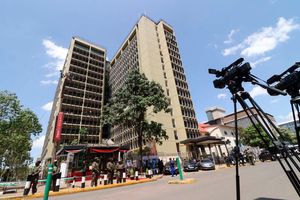
Truly, truly, that is how nonsense looks like from the sixth floor of Treasury Building.