“It was the best of times, it was the worst of times, it was the age of wisdom, it was the age of foolishness.” Charles Dickens knew something about institutional folly. It was the Dickensian season down Meru way this past week.
There is a particular variant of political stupidity that dresses itself up in the bright, loud colours of development, builds big shiny things, cuts ribbons and poses for photographs with wide fake grins, and leaves communities to pay the catastrophic bill for decades.
The decision by the Meru County government to surrender 100 acres of Imenti Forest to the national government – to be cleared for a State Lodge, an airstrip and a golf course – is a platinum card-carrying member of that category.
It is, by every measurable scientific and economic standard, an act of monumental, documented, irreversible self-destruction.
A century ago, the Mt Kenya ecosystem stretched across an estimated 4,779 square kilometres of largely intact montane forest. A lot of it is now forever lost, in some instances as much as one-fifth of its cover being destroyed in a single decade.
Excising another 100 acres from a forest already under siege is not a marginal concession; it is a deadly wound to a patient already in intensive care.
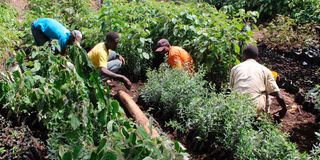
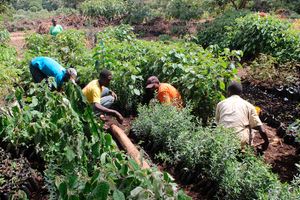
Community members tend for a tree nursery at Kithoka in Imenti forest in Meru County.
Photo credit: David Muchui | Nation Media Group
Greenpeace Africa sounded the alarm in September 2025, warning that the directive to take the forest appeared to have come from President William Ruto himself.
Nine months later, the threat had advanced through official channels, with the principal secretary for Forestry issuing formal concurrence on May 6, 2026, for the first excision, framed as road infrastructure, while senior officials were simultaneously reported touring Kambakia Forest to identify sites for the airstrip, golf course and State Lodge.
Governor Mutuma M’Ethingia has framed this project as a catalyst for Meru’s tourism and agricultural future. The question he has not answered is: what future?
The Mt Kenya Forest is the primary engine of Meru’s climate and hydrology. It feeds the Tana River and the Ewaso Nyiro. It drives the rainfall patterns upon which over 80 per cent of Meru’s agriculture depends. And it is already failing.
According to the Meru Municipality Climate Risk Profile (2026), produced by the county’s own planning authorities, Kathita River, Meru’s primary municipal water source, is drying up. Mount Kenya’s glaciers, once a year-round reservoir, have lost 95 per cent of their ice cover.
Community groups in North Imenti have watched this unfold in real time. The Kiamiriru Mpuri Environmental Conservation Group has already rehabilitated 20 water catchment areas destroyed by upstream forest loss.
Their chairperson, Zippora Matumbi, describes rivers that once ran year-round becoming seasonal, groundwater disappearing, and soil erosion accelerating with every cleared hectare.
Research using 20 years of Landsat satellite imagery confirms that rising temperatures and erratic rainfall are already “reducing forest resilience” across the entire Mt Kenya ecosystem. This is Meru today, with the forest partially intact.
The shortsighted governor insists the State lodge and golf course will “unlock the region’s economic potential”. But consider the broader arithmetic.
Trillion Trees, working alongside BirdLife International and Nature Kenya, estimates that the Mt Kenya ecosystem delivers ecosystem services worth approximately $220 million a year – in water purification, climate regulation, soil retention, carbon sequestration and biodiversity.
The forest provides drinking water to over two million people and underpins Meru's tea, miraa, coffee, dairy and horticulture sectors. When the Kathita River dries, when seasonal rivers multiply, when the rains fail - who will be using your golf course?
Conservation is not an obstacle to prosperity. It is the condition for it. Meru has Meru National Park, the Tana River and the mountain itself, assets that could anchor serious, lasting ecotourism if the county’s leadership had the brains to protect rather than sell them. The forest, properly managed, is a functioning economic infrastructure.
This proposal also sits on shaky legal ground. Greenpeace Africa has warned that excising gazetted public forest for luxury development may violate both the Forest Conservation and Management Act and Kenya's Constitution. No completed, independent Environmental Impact Assessment has been made public.
Kenya is simultaneously pursuing an ambition to raise national tree cover to 30 percent. Against that backdrop, the spectacle of senior officials touring a gazetted indigenous forest to find the best spot for a golf course is contemptuous – of science, of law and of the survival of the communities.
Meru County is not a small county. A few minutes outside Meru town are thousands of hectares of the most beautiful landscapes in the world, ideal for presidential retreats and world-class golf courses.
Take your hobbies and lodges there. But if it’s a fight you are looking for, you found it.