The 2027 African Cup of Nations (Afcon) East Africa (EA) Pamoja bid book comprises 162 pages.
It is, in fact, a grouping of three 54-page booklets, each representing the contributions of Kenya, Tanzania, and Uganda to convince the Confederation of African Football (CAF) that they can co-host the 36th edition of Africa’s greatest football showpiece.
Taking away the cover pages, list of abbreviations, the executive summary, table of contents, chapter titles, and three blank pages, the bid book’s content shrinks to 131 pages, 32 of which feature grids of images and texts hyping the region’s luxury hotels and popular tourist attractions.
However, their presentation depicts a lack of creativity and sophistication by the Football Kenya Federation (FKF), Federation of Uganda Football Associations (Fufa), and Tanzania Football Federation (TFF).
So much so that Charles Onyango-Obbo and Julius Barigaba, in an October 2023 article for the Daily Nation, said the EA Pamoja bid book “reads more like a tourism promotion and investor brief than a sports pitch.”
The bid book further dedicates six pages to discussing how the region’s intellectual property, immigration, tax, and employment laws will ensure protection of CAF’s and their partners’ interests.
It promises CAF exemption from direct and indirect tax while guaranteeing them protection from “ambush marketing” and other practices that could infringe on their intellectual rights.
On immigration, the bid promises CAF that the region “enjoys flexible and co-operational immigration policies that allow visitors to enjoy all seven nations upon receipt of a visa from any of the members of the EA.”
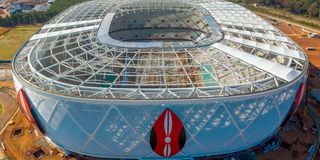
An exterior view of the under-construction 60,000-seater Raila Odinga Talanta Stadium in Nairobi, which will be one of the venues of the 2027 Africa Cup of Nations tournament.
Photo credit: Sila Kiplagat | Nation Media Group
“EA Pamoja Bid will dedicate special counters to all CAF delegations, including their commercial affiliates, media representatives, and media rights holders and affirm that they shall be provided visas and other permits to work, stay, and travel without any restrictions,” the bid book further guarantees CAF.
One of the bids EA Pamoja defeated was a three-volume 569-page document prepared by Botswana with a tournament logo to boot. Understandably, Botswana complained of being cheated after CAF announced on September 27, 2023 that Kenya, Tanzania, and Uganda had won the rights to co-host 2027 Afcon.
Reports by Botswana media detailed the country as having spent P61 million (Sh566 million) to put together the bid book after contracting South African firm Ruben Reddy Architects. Botswana were confident in their bid book’s persuasiveness because Ruben Reddy Architects had prepared the winning bids for the 2010 Fifa World Cup in South Africa, and the 2018 Fifa World Cup in Russia.
"East Africa’s winning 2027 Africa Cup of Nations bid did not cost an arm and leg after the three contesting countries, Kenya, Tanzania, and Uganda, opted against using a consultant to produce their bid book. The collaborative bid was reportedly cost-effective, with the figure put at just over P10 million (about Sh93 million) for the campaign to win the rights to host the 2027 competition,” read an October 27, 2023 article on mmegi.bw, an English-language national newspaper in Botswana.
Ultra-modern Talanta City Stadium
The EA Pamoja bid also beat bids from Algeria (who withdrew before voting), Egypt, Nigeria and Benin (joint bid), and Senegal.
“We did not win the right to host Afcon by fluke. We deserve every chance. Our bid was the best on the table. I want to pay special tribute to our three presidents for championing the Pamoja bid. The passion will be manifested in the preparations to host this tournament. Also, the three (sports) ministers have worked well with the three football federations,” Ababu Namwamba, Kenya’s then Sports CS, said on September 29, 2023 after landing at the Jomo Kenyatta International Airport from Cairo, Egypt, where Kenya, Tanzania, and Uganda had presented their bid to the CAF Executive Committee.
On its own, the EA Pamoja bid made a determined attempt to sound persuasive. For instance, “committed” is used 25 times across the bid book’s nine chapters. Other words like available (78 times), benefit (29), experience (54), infrastructure (74), sponsor (32), and support (59) get frequent mentions.
One of the commitments is that the Presidents of the three East African countries – Kenya’s William Ruto, Samia Suluhu of Tanzania, and Yoweri Museveni of Uganda – pledge “to maintaining peace and stability required for staging this historic tournament in the East African land.”
Yanga FC fans attend the team’s pre-season celebrations at the Benjamin Mkapa Stadium in Dar es Salaam in 2024.
Photo credit: File | Nation Media Group
That commitment will be strongly tested next year as Kenya goes to elections on the backdrop of contentious polls that took place in Tanzania in October 2025 and in Uganda in January 2026.
Tanzania’s and Uganda’s polls, to a varying degree, were marked by internet shutdowns, arrest of opposition politicians and their supporters, and killing of protesters by security agents.
Kenya, Tanzania, and Uganda are also grappling with rising cases of police brutality, making a mockery of the EA Pamoja bid's account of the three countries’ commitment to an enviable human rights record. On sporting matters, the EA Pamoja bid expressed a strong desire to “make Afcon 2027 an unforgettable event and thus set high standards to challenge the next hosts.”
As far as challenging the next Afcon hosts is concerned, Morocco’s hosting of Afcon 2025 set high standards for Kenya, Tanzania, and Uganda to match.
Morocco, co-hosts of the 2030 World Cup with Spain and Portugal, dazzled Africa with world-class stadiums, training facilities, hotels, and transport infrastructure.
Fans outside Prince Moulay Abdellah Stadium in Rabat before the final match of the 2025 Africa Cup of Nations between Morocco and Senegal on January 18, 2026.
Photo credit: Reuters
Morocco’s railway system facilitated fast and easy movement of fans, journalists, and tournament staff during Afcon 2025, raising the bar high for East Africa.
The EA Pamoja winning bid did advertise the region’s roads, rail, and air transport but was silent on the connectivity of rail transport in the region. Each country boasts of a railway network, but there is no inter-country connectivity.
The state of road safety in East Africa, particularly in Kenya, is a matter of concern. According to Kenya Police reports, 294 people lost their lives to road accidents in the first 21 days of 2026 compared to 276 for the same period in 2025.
Some of the accidents occurred along the Nairobi-Nakuru highway, which links Kenya’s capital to Eldoret, an Afcon 2027 host city.
Renovation of Eldoret’s Kipchoge Keino Stadium has yet to start while the refurbished Moi International Sports Centre and Nyayo Stadium in Nairobi still need to be worked on to meet Afcon standards.
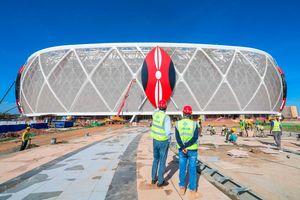
Encouragingly, the building of the ultra-modern 60,000-seater Talanta Sports City Stadium in Nairobi is nearing completion. The football and rugby stadium will be the flagship venue for 2027 Afcon for Kenya.
Interestingly, though, Talanta Stadium, which will be renamed Raila Odinga International Stadium, was not among the stadiums Kenya presented in the EA Pamoja bid book. Kenya only presented MISC, Nyayo, and Eldoret’s Kipchoge Keino Stadium. The Raila Odinga International Stadium, for all its stunning beauty, is a Sh44 billion afterthought.
Construction work at the 60,000-seater Talanta Stadium in Nairobi on January 23, 2026.
Photo credit: Sila Kiplagat | Nation Media Group
Still, the remarkable progress on the construction of the Raila Odinga International Stadium and similar projects in Tanzania (Samia Suluhu Stadium in Arusha) and Uganda (Fufa Stadium in Hoima and Akii Bua Stadium in Lira) gives every confidence that EA Pamoja is on course to deliver world-class stadiums for 2027 Afcon. The big question, particularly for Kenya, will be whether all training facilities will be ready.
Training facilities in Kenya earmarked for 2027 Afcon are Absa Sports Club, Kasarani Annex, Police Sacco Stadium, Ulinzi Sports Complex, and Kenya Utalii College Sports Club in Nairobi; and 64 Stadium, Eldoret Polytechnic, Eldoret Showground, and University of Eldoret, in Eldoret.
Of these facilities, only Kasarani Annex, Police Sacco Stadium, and Ulinzi Sports Complex can be said to be up to the required standards, having been used during last year’s 2024 African Nations Championships (Chan) that Kenya, Tanzania, and Uganda co-hosted.
Whether EA Pamoja bid’s victory was secured through high-level diplomatic lobbying or CAF’s sentimental desire to finally award hosting rights to the historically overlooked East African region, it does not matter now.
Africa, and the world, is coming to East Africa in 2027, and the region has 17 months, and counting, to deliver.