Hello

Your subscription is almost coming to an end. Don’t miss out on the great content on Nation.Africa

Ready to continue your informative journey with us?

Hello

Your premium access has ended, but the best of Nation.Africa is still within reach. Renew now to unlock exclusive stories and in-depth features.

Reclaim your full access. Click below to renew.

kibera floods, drought, climate change, cop27, climate crisis
Caption for the landscape image:

Nairobi must prioritise sewerage before it pours

Scroll down to read the article

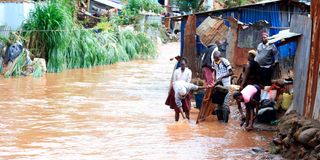
Families rendered homeless by floods in Kibera, Nairobi.

Photo credit: FILE

It has rained in Nairobi way before time. Floods have been synonymous with Kenya before the country came into being. Nyando floods are legendary.

The Coastal strip braces itself every year because of the history of floods, especially in Mombasa, Tana River and parts of Lamu.
We did not start talking about floods today, nor will it end with the current floods. ‘Sirkal saidia (Government help!)’ is a cry that rang across the country in one of the worst floods to ever hit Western Kenya. If we are to put aside the time of British rule, we are looking at 60+ years of self-rule, where the plight of Kenyans who lived along rivers, plains and swampy areas was ignored for years.

Flash floods in the 90s swept a whole train into a river near Mtito Andei as the Ngai Ndethya bridge buckled under the weight of heavy rains, killing those on board, including tourists.

Many Kenyans have lost their lives to floods every rainy season. They are just numbers on a statistics sheet to the government and not human beings, and that is the problem. If the government considered those who died as brothers, sisters, mothers, fathers and essentially family, close or extended, then perhaps something more lasting would have been formulated to avert loss of lives. As most flood victims in Kenya are from underprivileged neighbourhoods, they don’t seem to matter. They get buried and forgotten.

Sewage system

The governor of Nairobi, suggesting that three years is not enough to sort out sewage problems in Nairobi, is wrong. The county has stood in the same place for yonks. It being a county is just a governance system coming with a change of clothes and people, but the system is the same. Neither the county administration nor the central government has ever thought to prioritise a sewage system in one of the top cities in Africa with a bulging population.

The central government and counties pursued style over substance in their approach to developing the city. The efforts of dotting the landscape with amazing houses and apartments and forgetting the crucial element of sewers just go to show that the focus has been on chasing wealth at any cost rather than concentrating on key infrastructure, such as robust sewage systems, to lay the foundation of a well-managed city.

Having a functioning sewage system is a mark of civility and brings dignity to communities and the country at large. Poorly planned towns and slums with no sewage are what simply lead to open sewers and reliance on ‘flying toilets’ synonymous with slums with no toilets, hence the perennial public health problems such as cholera outbreaks in Kenya. A sewage system is both a matter of public health and extended life expectancy. Cholera is one of the contributors to early deaths in Kenya, and it surely follows any flooding season.

Given the history Kenya has had with heavy rains and floods, there should have been a masterplan yesterday in every major town for a proper sewage system that every home and business can tap into. Floods did not start three years ago. It has been with us every step of the way in every rainy season. Passing the buck is what our politicians know best and what leads to stagnation in key development phases such as getting a sewage system in place.

It has been more than 20 years since former President Daniel arap Moi got stuck in floods at the centre of Nairobi, precisely on Kenyatta Avenue. If the problem of flooding affects the President too, one would think the sewage system would have been prioritised to get people and the President moving seamlessly in any weather, but alas!

Long term plans

Kenyan politicians are good at following each other like sheep to campaign and focus on re-election rather than have long-term plans for the citizens. Hence, when a major problem, such as floods, hits, everyone is caught on the back foot, including politicians. Incidentally, one of the things that makes for a great politician is developments such as sewage systems that give dignity to the electorate. It was proven in Turkey, and I am sure it can work for Kenyan politicians too.

The sewage system in the UK is over 150 years old—built after the ‘Great Stink’ in London in the 1800s—and still serves the city, bar some limited repairs. The intention was to end contagious diseases such as cholera that still plagues Kenya and mainly Nairobi. Perhaps Kenya should have asked for help from the UK to build a sewage system in Nairobi rather than a new town railway hub. That is more of a priority given the catastrophic results of perennial floods in the city.

Perhaps Governor Johnson Sakaja is right in passing the buck. It has to end now, and the country needs to be on a journey of establishing a sewage system to last all sewage systems. It is needed now!

Follow our WhatsApp channel for breaking news updates and more stories like this.

Ms Guyo is a legal researcher, [email protected], @kdiguyo