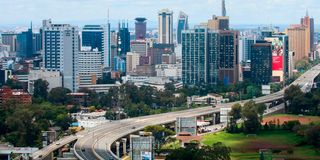
Sometime back, National Assembly Minority Leader Junet Mohamed and I were about to land at Jomo Kenyatta International Airport from a trip abroad. As Nairobi came into view, we could see the city’s bright lights in the night as the plane maneuvered to land.
The ever ebullient and witty Mr Mohamed exclaimed that we were about to land in the “London of Africa.” It was not immediately clear whether the son of Mohamed was stating a fact, expressing a wish, or making a joke.
On reflection, I convinced myself that the mere fact that he was comparing Nairobi to London was enough flattery to make any Kenyan proud whether fiction, wish, jingoistic braggadocio, or fact. He had laid down a marker.
Last week, President William Ruto talked about the state of Nairobi. He was without saying so measuring it in the pantheon of great cities around the world. The President lamented the deterioration of the city’s infrastructure and pledged that the national government will help Nairobi become the pride that it must be.
Let me state the bottom line upfront. The president embodies the will of the people and symbolises its sovereignty which resides in all the citizenry. Ideally, the national and county governments should be on the same page on matters of development and the execution of the country’s laws. That is how the constitution intends the system to work.
Those in the executive must be the disciples of the president in carrying out his duties under the constitution. The counties must work in conjunction with the national executive to make the aspirations of the people come true. Those who can’t, or won’t, answer this call of the constitution have no place in the government of the people.
I digress. Let me come back to Nairobi. Nairobi wasn’t always a mess. In my youth, I remember a more orderly and clean metropolis. There was admirable public transport. City buses plied the streets without menace or blaring horns. Nairobi taxis rivalled those of any city of good order. But then things fell apart. Nairobi wasn’t planned as a city of a billion people, if I may exaggerate.
The population has increased to a factor of infinity with little to no planning. The city’s infrastructure has collapsed under the weight of overpopulation and lack of vision by city and national leaders. Transport, sewer, water, and electric needs have been overrun. Cartels in cahoots with officials and unscrupulous business interests are cannibalising the city.
Many things in Nairobi happen by accident, or without rhyme or reason. If we don’t arrest the mess, all of Nairobi will become a slum with devastating consequences for Kenya. It doesn’t matter how many expressways we built if we don’t address basic planning concepts. The expressways will simply pass above the filth below.
Those expressways will simply be roads to damnation, not progress, or development. We must make hard decisions. We will not please everyone because we can’t. We must apply the law equally or we all go to hell in a hand-basket. We can’t keep on defending every abominable activity by calling it a “hustle.” I say to hell with some hustles. Not every hustle should be lawful or permissible everywhere.
Let me pick out a few glaring problems. The transport sector is a bloody mess. Our city roads are impassable because of congestion and unlawful behaviour. The matatu industry seems totally unregulated. Vehicles scream on the roads at high speed menacing everyone and breaking every traffic rule in the book.
The noise pollution, not to mention the macabre colours and language scare even the crows. It’s like a picture of hell in living colour. These vehicles and the boda boda move against the traffic as they weave in out without regard to safely or rules.
Mayhem is aplenty. Then the pathetic tuk tuk has invaded the city. How can any sane city license such abominations? Many have no license plates as they creek down the roads belching the filthiest of fumes.
Who makes decisions on licensing these contraptions which pass for public transport? How many of them are there? Do they have insurance? Why should tuk tuk and boda boda be in our major cities? We need a national conversation. We can’t become a great city or a first world country if we are retrogressing in our infrastructure. We can’t have kiosks cooking and selling food in the middle of the streets. No.
Makau Mutua is SUNY Distinguished Professor and Margaret W. Wong Professor at Buffalo Law School, The State University of New York. He’s Senior Advisor on Constitutional Affairs to President William Ruto. @makaumutua.