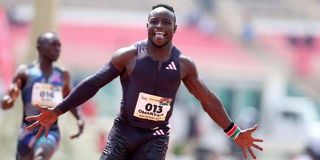
Ferdinand Omanyala, Kenya's sprinting star, is a man running against time, tradition, and a nation's expectations. Fans grumbled when he clocked 10.03 seconds in the 100 metres at the International Josko Laufmeeting in Andorf, Austria, on 9 August—winning the race but missing the sub-10 mark again.
The criticism feels harsh. The real miracle is not that Omanyala hasn't consistently smashed records; it's that he has become a 100-metre icon in a country that excels in long-distance running. Since independence, Kenya's Olympic haul has told a lopsided story: 38 golds, 41 silvers, and 35 bronzes—nearly all in middle and long-distance events. Sprinting medals in the 100 or 200 metres? None. Omanyala's 9.77-second 100 metres in 2021, the fastest ever in African, stands out as a stark outlier.
Middle and long distance running are Kenya's "specialisation trap" or "competence trap"—terms economists use for the situation where a country, individual, or company leans on a strength, becoming inward-looking and neglecting other areas. It’s a cycle where success in one field attracts investment, coaching, and public attention—leaving other sports to wither.
So at high-altitude camps in Rift Valley, runners like Daniel Simiu Ebenyo (5000/10,000m) and Philemon Kiplimo Kimaiyo (marathoner with a 2:04:01 personal best in 2025) train daily alongside dozens of elite peers, basking in sponsorship, media attention, and institutional support.
Meanwhile, sprinting and football get scraps and, until recently, crumbling infrastructure. It's as if Kenya were a Finnish company, Nokia—once the world's most exciting mobile phone maker in the late 1990s and early 2000s, but so focused on feature phones that it missed the smartphone revolution. Its insularity led to a decline as Apple and Samsung raced ahead.
Tradition can also shape a country's sporting palate, as seen in Brazil's samba-soaked obsession with football or India's cricket craze. Ethiopia is even more single-minded, its medals almost entirely from long-distance running.
Brazil's five football World Cups dwarf its modest record in volleyball or swimming, while India's cricket billions eclipse hockey and athletics. This leaves Omanyala running a lonely race. He has few peers in Africa to sharpen his edge. Usain Bolt thrived in a fierce Jamaican sprinting ecosystem; Omanyala faces sparse local rivalries.
Other African athletes have boosted their careers by relocating to the intense sprint hubs of the US—the likes of Bernard Lagat or Tegla Loroupe—but that leap would be hard for Omanyala, a family man anchored in Nairobi.
Yet there is a significant change underway. Football in Kenya is shifting the story. The ongoing African Nations Championship (CHAN), where Harambe Stars have enjoyed a winning streak, has turned Kasarani Stadium into a cauldron of noise and colour the country has rarely seen.
President William Ruto, reading the mood shrewdly, has promised unprecedented bonuses—Sh1 million per player for each group-stage win, Sh500,000 for a draw, Sh2.5 million for the Zambia match, and up to Sh600 million if Kenya wins the title—plus housing incentives deep into the tournament. The emotional investment in football may outshine even athletics.
Kenya's football fever, however, was club-driven—Gor Mahia, AFC Leopards—and powered by the magnetism of the English Premier League and other European leagues beamed into homes and bars. With elections looming, Ruto has made a political reading years in the making: a football-happy nation might show its gratitude when it walks into the voting booth in 2027. Hosting CHAN, bidding to co-host the Africa Cup of Nations with Tanzania and Uganda, and upgrading stadiums are all signs of populist politics intertwined with economic foresight.
It may all overshadow athletes like Omanyala even further. That would be a pity, because his story has a heartbeat beyond tracks and politics. His father, Dishon Omanyala, a Bungoma farmer, believed in his son's sprinting dreams despite deep hardship. Ferdinand once sold bananas to fund his training; Dishon quietly ensured he had gear and bus fare. It was his father's quiet faith that pushed him from rugby into athletics at the University of Nairobi, against the grain of Kenya's distance-running tradition.
To truly stand out, Omanyala may need to step beyond the stopwatch and into the broader spotlight. Could he become a style icon like the late Florence Griffith-Joyner—"Flo-Jo"—the American sprint queen who made track glamorous with her nails, outfits, and charisma? He could use his platform for something continental: perhaps leading a pan-African campaign against cancer or for youth education. Imagine a movement—"Run Against Cancer", "Sprint to School"—with Omanyala front and centre, blending sport with social change.
So, here's a toast to the man. Critics who jeer his 10.03-second run in Andorf miss the bigger triumph. They are wrong to demand sub-10 seconds whenever he takes to the track, when he has already rewritten Kenya's sprinting narrative. But they are right to expect more. Kenya deserves a broader, richer sporting legacy.
—The author is a journalist, writer, and curator of the "Wall of Great Africans". X@cobbo3