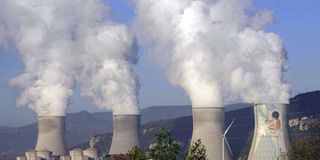
A 1,000 MW nuclear power plant at a place called Lwanda Kotieno in Siaya County — within 10 years? It sounds like a pipe dream. In fact, it borders on being a big joke.
Where are we going to get the capacity and discipline to manage the complex safety issues that come with nuclear power? Where is the fiscal space for such grand ideas? Where will the money come from?
I was recently invited by the newly appointed chairman of the Nuclear Power and Energy Agency, Professor Larry Gumbe, to a discussion on the merits, seriousness, and level of preparedness behind the plans to build Kenya’s first nuclear power station.
A professor of mechanical engineering and former department chair, Prof Gumbe brings with him a wealth of knowledge to the assignment, having read and written extensively on the subject.
I enjoy and value one-on-one conversations and engagements with newly appointed top policymakers because they offer a first-hand opportunity to gauge whether the new appointee possesses deep domain knowledge of the pressing and urgent issues surrounding their role.
Such interviews offer a window — a front-row seat — to observe, weigh, and form an opinion on whether the public official in question has a strong grasp of the essentials and a deep appreciation of the challenges of the day.
What strikes you in a debate with Prof Gumbe is his extraordinary understanding and deep knowledge of the history, evolution, trends, and contemporary global safety issues surrounding nuclear power.
He is firmly convinced that nuclear energy is the only safe and cost-effective way to generate the large amounts of electricity Kenya needs to keep pace with exponentially growing demand and to re-energise the country’s industrialisation dream.
He fluently cited official statistics on Kenya’s electricity generation potential from its major sources — hydro, geothermal, natural gas, wind, and solar — and pointed out the huge gaps that must be filled if the country is to meet its industrialisation targets.
He had at his fingertips official data on Kenya’s installed electricity capacity and household consumption. He argued that, when you compare Kenya’s figures with those of other middle-income countries such as Malaysia, the inescapable conclusion is that nuclear power is a necessity for Kenya.
The man has fire in his belly. But where is the evidence that we have the capacity to handle nuclear safety?
He revealed that Kenya has been collaborating with the International Atomic Energy Agency (IAEA), as well as with Korea, Russia, and the USA, on training, safety, and technology transfer.
Prof Gumbe disclosed that the latest review by the IAEA showed that Kenya has completed the first phase of the nuclear milestones and is currently progressing to phase two — demonstrating its commitment to meeting the necessary conditions for a safe and secure nuclear power programme.
Within East Africa, Rwanda and Uganda are also at different stages of implementing nuclear power programmes. Uganda aims to commission its first 1,000 MW power plant at a place called Buyende by 2031. Rwanda is planning to build a demonstration plant, targeting full operational testing by 2028.
So, at what stage is Kenya with its own plans? The plan is for Kenya to have its first nuclear plant — with a capacity of 1000 MW — operational by 2034. Three candidate sites have been identified in Kilifi, Kwale, and Siaya counties.
Where is the human capital? The answer: Kenya has trained 20 nuclear engineers at the King’s Institute in South Korea. Prof Gumbe argued that human resources are not a major problem, noting that the University of Nairobi’s engineering department has been running a nuclear engineering programme for more than a decade.
And what about the money? The government is considering a Public-Private Partnership (PPP) model, likely involving Chinese or Korean partners.
That discussion with Prof Gumbe left me reflecting on recent remarks made by the President of Vietnam Gas, Mr Dona Chau, following his meeting with both President William Ruto and Prime Cabinet Secretary Musalia Mudavadi.
This is what he said: “I met with Prime Cabinet Secretary Musalia Mudavadi and President William Ruto in Nairobi. They spoke with energy about Kenya’s future — investment, infrastructure, public housing,” he wrote on his LinkedIn page.
He drew this comparison: “Vietnam: 100 million people, over 70 GW of power. Kenya: 50 million people, only 4 GW.”
The point here is this: Kenya must overhaul its approach to service delivery. Institutions tasked with implementing game-changing ideas must not be afraid of confrontation or bold decisions.
What this country needs is a proper, well-thought-out plan to turbocharge the economy — to snap it out of years of stagnation and return it to the high growth rates we witnessed during the early years of former President Mwai Kibaki’s administration.