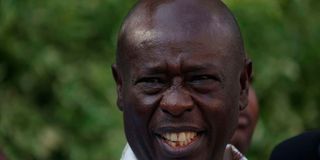
I’ve said before that embattled former Deputy President Rigathi Gachagua is a dead man walking, metaphorically speaking. Every time I’ve used that expression, his camp has hollered and hissed.
This week, the High Court sitting in Nairobi vindicated me. With a slow and painful guillotine, a three-judge bench administered the political death penalty to Mr Gachagua. The jurists put Mr Gachagua in a situation where resurrection cannot happen. Mr Gachagua’s political heart’s electrical activity flat-lined on the High Court’s electrocardiogram. What the court did this week is to lustrate Mr Gachagua. This means that barring a miracle – and these don’t happen anymore – he can’t run for President.
The judges rejected virtually every ground raised by Mr Gachagua in his Hail Mary to overturn his impeachment. It’s worth noting that his most substantive grounds were thrown out, including his claims of bias, lack of public participation, and unconstitutionality. The court threw him a bare bone on procedural unfairness and gave him Sh50 million to wipe his tears as it sent him home. As a legal matter, Mr Gachagua was sent packing empty handed. You can tell when a petitioner’s lawyers are gasping for air. Mr Gachagua’s legal team fulminated and thrashed about in court with dramatic gestures and rhetorical flourishes. It was all for naught. In the end, the feigned anger and self-righteousness failed to move the honourable court.
It’s important to appreciate what an impeachment is, and isn’t. Because of this key distinction, it’s critical for lawyers to understand that litigating against an impeachment isn’t a regular or garden variety legal proceeding. The gravity of this observation multiplies in weight when the question involves the impeachment of a deputy president, the second most powerful office in all the land. It’s not rocket science that such an issue raises serious questions about state security and the stability of the state. The courts must perforce take judicial notice that they aren’t simply sitting in judgement on the impeachment of a mere governor, or her deputy. No – the impeachment of a Deputy President implicates the sovereignty of the republic. Judges must resort to highfalutin legal theory.
Permanent political death
It’s true, as the court correctly held, that it has the power review impeachments. But in doing so, the court cannot substitute its judgment for that of the political braches absent some egregious violation. To overturn the impeachment of a deputy president would have far reaching political ramifications. It’s a nuclear option in law akin to annulling a presidential election. The structure and normativity of the constitution does not envisage dictation to the executive after an election forcing the President to work with a deputy bent on paralysing the state, or perpetually undermining the President through the most dastardly violations of the constitution and his oath of office. No – the device of impeachment is provided to remove such a DP, of whom Mr. Gachagua was the textbook definition.
Courts the world over are mindful of the political doctrine question and of separation of powers. It’s not to say the courts should turn a blind eye to unconstitutional illegalities. No – but it’s to say that judicial deference is due to the political branches on matters so intimate to them that judicial overreach could create a constitutional crisis. Let us imagine that the court reinstated Mr. Gachagua into the DP’s office. Though theoretically such a remedy is possible, how could he work with President William Ruto as his principal assistant? The law may be an ass but it’s not that stupid. Such an outcome would fracture the executive and therefore the state and could lead to serious political instability.
That’s why the reliefs available to Mr Gachagua even if the court had found serious infractions wouldn’t have included reinstatement. That was among the implicit reasons the court found the installation of Deputy President Kithure Kindiki constitutional. Courts are institutions of stability, not instability. It is why Mr Gachagua should spare the country more drama and not vex the courts with an appeal. The Court of Appeal should even take away the Sh50 million awarded as damages because it sets a bad precedent. There should be no place for civil damages in an impeachment case. But knowing Mr Gachagua’s stubborn nature, he will appeal for political nuisance. He wants to weaponise the courts as a political platform for lawfare against President Ruto.
Finally, Mr Gachagua cannot now be a candidate for elections in 2027. He’s permanently barred from running for any political office in Kenya, even as an MCA. This bar has no timeline. It’s a permanent political death. He’s been sent on a permanent political leave in a timeless capsule. The biggest beneficiary of Mr Gachagua’s decapitation is Wiper’s Kalonzo Musyoka, though how that materialises is unclear. For now, Kenyans can rest assured that Mr Gachagua has henceforth lost his bite.
Makau Mutua is SUNY Distinguished Professor and Margaret W. Wong Professor at Buffalo Law School, The State University of New York. @makaumutua