I am generally a free speech absolutist unless the speaker engages in hate or defamatory utterances. Where the matter is judicial and there is a tie between the speaker and the censor, I always call the game for the speaker. That’s because speech is the heart of democracy. Expressive rights to assembly, association, protest, and movement are all in a bundle of speech norms.
But obviously the right to free speech isn’t unlimited. As every first year law student should know, you can’t shout “fire” in a crowded theatre. And in many countries, hate speech, especially of the racial and ethnic typology, is criminalised. We are in the silly season, and am seeing a lot of toxic speech that must be curbed.
Even if you are a Gen Z, you ought to know what happened in Rwanda in 1994 within a span of three months between April 7 and July 19. In one of the most savage civil wars in the modern period within 100 days, the Tutsi and some moderate Hutu were systematically killed by Hutu militias. Between 500,000 and 700,000 Hutu, mostly men, were wiped out. It is estimated that up to half-a-million women were raped. I remember in 2004 watching the movie Hotel Rwanda – a depiction of the genocide -- with my three boys. The four of us left the movie theatre completely traumatised. We sobbed many times as we watched the movie. We wondered about the evil that men do.
You first dehumanise “the other” to prepare for genocide. In Rwanda, the Hutu militias called the Tutsi “inyenzi” or cockroaches that had to be “crushed.” Tutsis were depicted as vermin that had to be eliminated and terminated for the good of the Hutu. That’s how the militias beat society into a frenzy to commit the most unspeakable atrocities.
Neighbour turned against neighbour and hacked them to death in the most savage ways, including cutting babies from the wombs of pregnant mothers. All genocides are demonic, but the Rwandan one stood out in its brutality. To this day, I still get chills thinking about it. Here in Kenya, we had our own brush with genocidal violence after the 2007 stolen elections.
Speech, while at the heart of the democratic life, can be weaponised to destroy democracy itself. Examples abound without number. Usually charismatic but demagogic and genocidal leaders stoke the embers of extremism and violence through speech. Think of the man who is commonly known by one name only – Hitler. With his propaganda chief Joseph Goebbels, Hitler orchestrated in Germany’s Third Reich the most virulent forms of anti-Semitism leading to the murder of six million Jews. The 1964 movie, ‘Judgement at Nuremberg’, tells a chilling tale of the Nazi extermination campaign.
He and the Nazis used the media, the arts, and culture to orchestrate the Holocaust. With the exception of the enslavement of Black Africans, never before had such toxic and effective propaganda been deployed by a state against a people.
What’s my point? Young states, or states in embryo like Kenya, ought to be wary of public figures and politicians who traffic in hate tropes, ethnic bigotry, and outright bilious propaganda. These public figures think it’s alright to say and do anything in their untrammeled greed to capture power. They think the unthinkable. They say the unspeakable. They advocate the most chilling ideas.
They are elites who have amassed tons of wealth through their association with the state. Yet they are so angry and vituperative. They seek power to loot even more. To do so, they demonise their political opponents as enemies of the people and the republic. They dehumanise those who don’t support them. They are completely untethered.
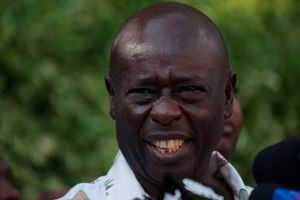
I will give you one pithy example. If a person picks on himself every day and twice on Sundays, who I am not to use him as a piñata? He’s the textbook definition of a piñata! At a press briefing in Western Kenya last week, DCP’s Rigathi Gachagua used the foulest language I’ve heard from a senior adult this year – perhaps even for the last decade. He called the most repulsive anatomical parts by name and described their most disgusting malfunctions in such vivid detail I thought he had smoked something. I cannot even repeat the words he used in this column. Yet he spoke to national media where he was flanked by Wiper’s Kalonzo Musyoka .
Filthy and unfiltered mouths can plunge Kenya into chaos. In Rwanda, it was Radio Television Libre de Mille Collins (RTLM), or Radio Genocide, which was used to incite violence and spread anti-Tutsi propaganda. Listening to some leader, I could not help but think of RTLM.
Public figures need to think before they open their mouths and spit out bilious toxins. Words can destroy a country as they did Rwanda. The National Integration and Cohesion Commission needs to grow some teeth and bite.
Makau Mutua is SUNY Distinguished Professor and Margaret W. Wong Professor at Buffalo Law School, The State University of New York. On X: @makaumutua