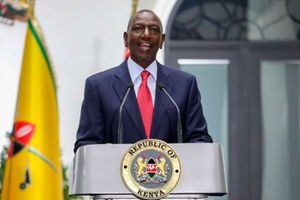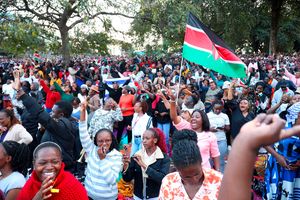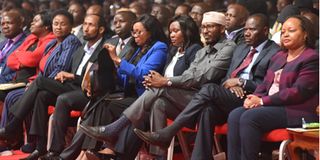
Governors during the Biennial Devolution Conference at Eldoret Sports Club in Uasin Gishu County on August 17, 2023.

This is a sequel to yesterday’s Saturday Nation argument on the Senate’s emerging use of Parliamentary Budget Office (PBO) criteria to rank counties. There is a serious intellectual problem with defining “development” as what can be photographed, depreciated and entered in an asset register, while treating investment in people as recurrent consumption. The PBO performs an important oversight role, but its framework risks teaching counties the wrong lesson: build more concrete, spend less on people, and rank better.
That would be an unfortunate triumph of accounting over economics. Kenya’s budgeting system is programme-based, linking resources to policy objectives, programmes, outputs and outcomes — not merely objects purchased. Yet counties must allocate at least 30 per cent of their budgets to development expenditure. The problem begins when “development” becomes synonymous with physical assets.
A road is an asset, but it wears out. A hospital needs maintenance. A vehicle depreciates. Even a new school begins ageing when children enter it. Education behaves differently. A child who learns to read does not become less literate with time. A nurse can become more valuable with experience. A teacher who masters mathematics can teach successive generations. Engineers, doctors, entrepreneurs and artisans accumulate knowledge, judgement and networks. Human capital compounds. There is an economic irony here: almost everything government calls “capital” depreciates, while its most important capital can appreciate.
A newly recruited doctor cannot economically be equated with one who has 20 years’ experience. The latter has accumulated knowledge and institutional memory. Treating the first doctor’s training as recurrent while celebrating the hospital in which both work is like celebrating the chicken coop while forgetting the chicken.
The same logic applies to medicines. Drugs are recurrent because they are consumed. But their social return survives consumption. A treated child returns to school; a mother saved in childbirth returns to her family and economic activity; a worker cured of disease returns to work. The medicine disappears. Its economic benefit does not. There is another practical problem: counties do not start from the same point, and some may already have reached sensible limits on investment in concrete.
Consider parts of Central Kenya, where fertility has fallen sharply, in some places to around two children per woman from roughly four a generation ago. The consequence is visible: declining enrolment and the closure or consolidation of some primary schools.
Central economic truth:
In such counties, the challenge is increasingly quality, not quantity. Why build another classroom when existing ones are underused? Yet a ranking that rewards physical development can perversely encourage precisely that.
Suppose a county has adequate classrooms but children are dropping out because their parents cannot afford fees, uniforms, transport or learning materials. Economically, bursaries and scholarships may be the intelligent investment. But if these are classified as recurrent and worsen a county’s ranking while a new building improves it, the scoreboard tells the county to solve yesterday’s problem.
This ignores diminishing marginal returns. The first classroom in a village may transform lives. The tenth empty classroom may simply transform the asset register. The PBO and public-sector accounting standards should nudge counties towards prudent, durable investment—but not physical assets for their own sake. Their purpose should be to improve outcomes, not manufacture a particular expenditure mix.
History demonstrates why this matters. Post-war Germany and Japan suffered enormous destruction of physical capital, yet their educated populations, technical skills and institutions enabled extraordinary reconstruction. The lesson is simple: destroy a factory and educated people can build another; destroy the educated class and a factory becomes a monument to yesterday.
America understood this paradox after the Second World War. It prosecuted Nazi leaders at Nuremberg while recruiting German scientists and engineers under Operation Paperclip. Wernher von Braun and others later played major roles in the American space programme. Their expertise helped put the first humans on the Moon, while technologies developed around the programme generated wider scientific and industrial spillovers.
This is the central economic truth: nations compete not merely for machines and buildings, but for minds.
Human-capital investment
Education is therefore not a bill that disappears at year-end. It is an investment whose returns compound across generations. The World Bank identifies human capital—knowledge, skills and health—as foundational to productivity, earnings and economic growth.
There is even a biblical lesson. Solomon’s greatest asset was not his palace but wisdom. Joseph saved Egypt not by building monuments but through knowledge, planning and human capability.
African wisdom says: “If you want to go fast, go alone; if you want to go far, go together.” A county that builds roads without building minds may travel beautifully for one kilometre, then discover nobody knows where to go.
The practical danger is clear. If governors learn that education spending makes their counties look “recurrent-heavy” and pushes them down the league table, rational politicians will respond rationally: they will build what the scoreboard rewards.
Kenya should therefore establish a distinct human-capital investment category, under which demonstrable investments in education quality, teacher development, vocational training, strategic medicines, bursaries and other productivity-enhancing interventions receive capital-investment recognition.
County rankings should measure outcomes—learning, health, skills, employment, productivity and welfare—not merely depreciable assets.
Otherwise, we risk committing the ultimate accounting error: measuring the depreciation of buildings while failing to measure the appreciation of people.
Dr Kang'ata is the governor of Murang’a County; Email: [email protected]