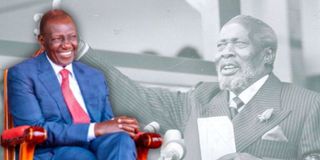
William Ruto has an image problem. He is approaching the 2027 elections burdened by the killing of Gen Z protesters, abductions, corruption claims, anger over taxation and the cost of living crisis.
These are not merely failures of communication. Yet, as in Jomo Kenyatta’s day, State House appears to have concluded that better image-making is part of the solution.
Government ministries have reportedly been instructed to showcase the administration’s achievements, with a special unit established to drive the campaign. A government has a duty to inform citizens. The problem begins when public information becomes presidential propaganda funded by taxpayers.
Ruto’s strategists may believe they are constructing a new communications machine for 2027. History suggests they are merely modernising an old Kenyatta blueprint.
After Tom Mboya’s assassination, President Jomo Kenyatta faced a similar crisis. His government turned ministries, civil servants, the state broadcaster and taxpayers’ money into an image-making machine. Mboya’s murder, on July 5, 1969, was more than a national tragedy.
Mzee Jomo Kenyatta and Tom Mboya share a joke at the 1962 independence conference in London.
Photo credit: File | Nation Media Group
The powerful Cabinet minister and international figure was a counterweight to the increasingly dominant Kiambu group around Mzee Kenyatta. His death released tensions accumulated since independence.
Kenyatta’s government feared that Jaramogi Oginga Odinga’s Kenya People’s Union could capitalise on the outrage and expand beyond its Nyanza base.
Mzee Kenyatta summoned a crisis Cabinet meeting, where ministers decided that the Treasury should finance a campaign to popularise the government, promote its achievements and restore Mzee’s image as the nationalist father of the nation.
The decision was recorded as Cabinet Minute 120 of 1969 and classified top secret. Its implementation was entrusted to three powerful civil servants: John Michuki, Permanent Secretary at the Treasury; Philip Ndegwa, Permanent Secretary in the Office of the President; and Peter Gachathi, Permanent Secretary for Information and Broadcasting.
The programme deployed state resources for Kenyatta and Kanu against KPU, erasing the distinction between government information and party propaganda. It suppressed dissent on Voice of Kenya, withdrew reporters from Parliament, produced films promoting the government and gathered information on foreign correspondents for the Special Branch. Censorship and propaganda worked together.
On July 13, Minister of State Mbiyu Koinange briefed Ndegwa on Cabinet Minute 120. The next day, Ndegwa wrote a “Secret” letter to Michuki. Gachathi would prepare the programme and its budget. About six weeks later, Gachathi produced his plan.
His first target was Today in Parliament, a Voice of Kenya programme reporting National Assembly debates. As MPs became increasingly critical, radical contributions were edited out. Gachathi eventually abolished the programme.
“We spoke and you are hereby instructed to ensure this programme is removed with immediate effect,” Gachathi wrote to Director of Broadcasting R.A. Koske on August 14. “By a copy of this letter, the Chief Press Officer is similarly instructed not to send reporters to Parliament.”
By withdrawing reporters, Gachathi was attempting to prevent criticism by MPs from reaching the public. Five days later, Tinderet MP Jean-Marie Seroney demanded Gachathi’s dismissal, itself a long shot.
“Unless he is dismissed, the House will be asked to approve a motion seeking dissolution of the Ministry of Information and its incorporation in the Ministry of Home Affairs as a department,” Seroney warned.
“It appears the PS has appointed himself the spokesman for the government by trying to dictate to the press. Civil servants have no right to interfere in the running of this House.”
Kericho East MP C. Kiprotich added: “Anybody trying to curb our free press should go to a mental hospital for treatment.”
The protest revealed a struggle between parliamentary accountability and civil servants who treated information as an instrument of executive power. Michuki appeared to drag his feet at the Treasury. With the money unreleased, pressure mounted on Gachathi, apparently from Kiambu political mandarins, to implement Cabinet Minute 120.
“I would now like to impress upon you the absolute necessity for pushing ahead with the implementation of the following proposal which I consider urgent,” Gachathi wrote to Michuki.
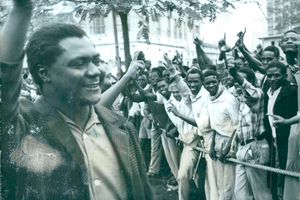
Delegations were by then pouring into Kenyatta’s Gatundu home to pledge loyalty, creating an appearance of spontaneous support that the secret campaign would reinforce ahead of the December 1969 elections. Gachathi proposed strengthening the operation with seven mobile cinema units.
“We urgently need to strengthen our mobile units by adding seven vehicles for which a skeleton staff of an information assistant, a driver and an operator will be recruited,” he told Michuki.
Then vice president Jaramogi Oginga Odinga and president Jomo Kenyatta.
Photo credit: File
“Secondly, eight mobile information units are required to be used for the purposes of taking information on government policies and achievements to the people in the countryside. These should be fully equipped with the public address system and will be particularly useful during the general elections campaign. The estimated cost is 52,000 Kenya pounds.”
The phrase “particularly useful during the general elections campaign” gave the game away. Taxpayers were being asked to finance equipment intended to influence an election.
Gachathi requested another K£10,000 (then equivalent to Sh200,000) “to enable us to intensify publicity campaign throughout the republic.”
The government would also produce films “depicting government achievements.” “It is considered that seven such films can be produced within the course of the next four months provided a sum of 8,000 pounds is allocated to purchase the necessary film equipment,” he wrote.
“It is essential that we go ahead straight away to acquire the equipment we need to implement the decision of the government,” Michuki was told.
By then, mobile cinemas did the work now performed by television clips, influencers and digital campaigns, carrying a scripted image of Kenyatta into the countryside. Gachathi was also worried about information travelling to the outside world. On October 7, he instructed the Chief Press Officer to collect details on every foreign journalist in the country.
“The director of intelligence (James Kanyotu) has advised that all journalists operating in Kenya are required to indicate the foreign newspapers which they represent,” he wrote.
“All journalists who are accredited should furnish you with the fuller details of the papers, magazines or other publications they subscribe to. A copy of each form duly completed should be forwarded to director of intelligence.”
As a result, accreditation became intelligence gathering, the same way it is now done through a Media Council statute. Correspondents covering Mboya’s murder, KPU and the election were catalogued for Kanyotu’s Special Branch. Unable to control foreign newspapers, the government substituted surveillance.
By October, Michuki still had not released the money. Gachathi asked G.K. Kariithi in the Office of the President to intervene.
On October 28, he wrote: “I have already written in length to PS (Permanent Secretary) Treasury but time factor here is very important because we consider that we should even be given permission to fly out these vehicles if they are to serve the purpose for which they are intended.”
Four days earlier, Mzee Kenyatta’s motorcade had been stoned in Kisumu during the opening of the Russian-built New Nyanza General Hospital.
Presidential security officers opened fire, killing and wounding protesters. The violence intensified the image crisis. Afterwards, KPU was banned and Odinga and other leaders detained.
Gachathi ordered anything depicting violence removed from Voice of Kenya. When the Director of Broadcasting asked him to issue a statement explaining that the station was acting under government orders, Gachathi refused.
“As you are aware this is a collective government and I presume that VOK must also support decisions made by the government, remembering all the time the principle of collective responsibility,” he wrote on November 5.
Former President Mzee Jomo Kenyatta.
Photo credit: File | Nation Media Group
“I do not see any point therefore in issuing a statement which would amount to dissociating the VOK from a decision which has been unanimously made by the government. Since the VOK is a government department, it does not need to be specially protected in the manner you have suggested and therefore no statement will be issued. On the contrary VOK will continue to implement the wishes of the government until further notice.”
The Voice of Kenya was not regarded as a public broadcaster responsible to citizens. It was a government department expected to “implement the wishes” of those in power. From the records, it is not clear whether Michuki released the money.
But Gachathi, besides controlling VOK, commissioned British producer George Sturt to make a film, Kenya 1969. He recommended Daniel Njuguna Gatei as its Swahili commentator “because we want a good and popular person with whom the public is familiar.” That was how the propaganda was rolled out into the countryside.
After the December election, Gachathi congratulated the press for its “generally well-informed and objective coverage.”
“Fair minded observers and commentators with enlightened interest would agree that Kenya has earned herself a distinction and a creditable record of conducting free peaceful and democratic elections,” he declared.
He praised the “absolute observance of democratic principles” and claimed that voters had chosen their representatives “without any influence or interference, even from the party, the government or any quarter.”
The claim was impossible to reconcile with reality. The opposition had been banned, its leaders detained, parliamentary reporting suppressed, the broadcaster placed under secret instructions and foreign journalists subjected to surveillance.
The underlying logic remains familiar. Mzee Kenyatta needed to shift attention from Mboya’s assassination, the Kisumu killings and detention without trial. Ruto needs to shift attention from the Gen Z killings, abductions, corruption allegations and the cost-of-living complaints. Both governments responded to a crisis of public confidence by mobilising state communications around the President.
But image-making has limits. A publicity unit can change the government’s message; it cannot change what citizens have experienced. It can advertise projects, but it cannot answer who abducted young activists or make grieving families forget those killed during demonstrations.
That is the lesson of Cabinet Minute 120. Propaganda may dominate the airwaves, but it cannot resolve the failures that made propaganda necessary.
John Kamau is a PhD candidate, Department of History, University of Toronto. Email: [email protected]