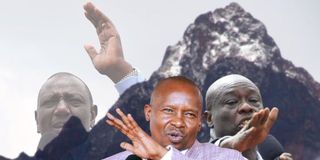
President William Ruto (left), Deputy President Kithure Kindiki and former Deputy President Rigathi Gachagua.

Kenyan politics obeys one immutable law: coalitions are easier to build than to sustain. Every election produces a grand alliance proclaimed as permanent. Every term in office reminds us that permanence is politics’ rarest commodity.
The growing political estrangement between President William Ruto’s Kenya Kwanza administration and much of the Mt Kenya region is therefore no anomaly. It is history repeating itself.
In 1963, Jomo Kenyatta and Jaramogi Oginga Odinga stood together in the struggle for independence under Kanu. Three years later, they were bitter rivals after Jaramogi resigned as Vice-President and founded the Kenya People’s Union.
In 2002, Mwai Kibaki, Raila Odinga, Kalonzo Musyoka, Charity Ngilu and Kijana Wamalwa united to end Kanu’s four-decade dominance. The celebration barely lasted three years. By the 2005 constitutional referendum, the coalition had splintered into the Orange and Banana camps, proving that defeating a common enemy is often easier than governing together.
In 2007, William Ruto and Raila Odinga campaigned side by side against President Kibaki. By the 2010 constitutional referendum, they occupied opposing trenches. Twelve years later, Ruto and Rigathi Gachagua forged the Kenya Kwanza alliance, only for deep political differences to emerge barely two years into government.
The pattern is too consistent to dismiss as coincidence.
Niccolò Machiavelli wrote in The Prince that political loyalty rests more on interests than sentiment. Nearly two millennia earlier, Sun Tzu reached a similar conclusion in The Art of War: “All warfare is based on deception.” His point extended beyond the battlefield. Appearances, expectations and perceptions often shape outcomes as much as brute strength.
Rising cost of living
Politics follows the same logic. Campaigns are won on hope; governments are judged on delivery. Expectations become political weapons. Delayed promises become ammunition for opponents. Silence breeds rumours, which often travel faster than official explanations.
The Bible is equally realistic about the struggle for power. Saul celebrated David after the defeat of Goliath, but admiration quickly turned to fear when David’s popularity eclipsed his own. Scripture records that from that day Saul “kept a jealous eye on David”. The conflict was never about Goliath. It was about power.
Absalom understood another timeless principle. Rather than confronting King David directly, he stationed himself at the city gate, listening to grievances and telling every petitioner: “If only I were judge in the land.” Before challenging the throne, he first won the court of public opinion. Modern politicians would recognise the strategy instantly.
Why, then, has the relationship between Kenya Kwanza and much of Mt Kenya deteriorated so rapidly?
The first explanation lies in expectations. The coalition made unusually specific campaign commitments. Roads were named, markets identified, industrial parks announced and timelines suggested. Precision wins elections because voters know exactly what is being promised. It also creates a scorecard against which government performance is measured.
Second came the tax debate. The 2024 Finance Bill was seen by many households, traders and professionals in the region as imposing a heavier burden when the cost of living was already high. Whether that perception reflected the government’s intentions is ultimately secondary. In politics, perception often becomes reality.
Gachagua's impeachment
Third was political symbolism. The prominence of harambees and empowerment events reminded many Kenyans of an earlier political era. Fairly or unfairly, some voters began asking whether fundraising was replacing the language of completed roads, functioning markets, affordable fertiliser and reliable public services.
Fourth came political management. The impeachment of Deputy President Rigathi Gachagua in 2024, the legal and political challenges facing governors such as Kimani Wamatangi and Kawira Mwangaza, together with successive contests involving leaders associated with the region, were interpreted by many as part of a broader political pattern rather than isolated events.
Finally, allegations that goons have been mobilised for partisan ends have deepened that perception. Whether substantiated or not, they have fuelled the impression that the government is directing its energies against a constituency that only recently stood firmly behind it. History suggests no administration strengthens itself by appearing to intimidate its own political base.
The Old Testament offers a sobering parallel. Rehoboam inherited a united kingdom. Instead of easing the people’s burdens, he answered their grievances with greater severity: “My father chastised you with whips; I will chastise you with scorpions.” The result was immediate. Ten tribes walked away, and the kingdom split in two. It was not conquered by a foreign army; it fractured from within.
That is why Sun Tzu also taught that the highest form of strategy is to prevail without creating unnecessary battles. A wise ruler avoids turning friends into adversaries or strongholds into battlegrounds. For any government, appearing to sanction intimidation or political violence against a region that helped carry it to power would amount not to strategic brilliance but political self-harm.
Coalitions rarely collapse overnight. They erode as trust gives way to suspicion, expectations outpace delivery and allies begin to see one another as rivals. Kenyan history suggests the leaders who endure are not those who build the largest alliances, but those with the wisdom and discipline to sustain them after the campaign ends. In politics, as in war, the gravest defeats are often self-inflicted.
Dr Kang'ata is the Governor of Murang’a County. Email: [email protected]