Less than a year before the 2027 General Election, the Independent Electoral and Boundaries Commission (IEBC) is racing to complete preparations amid intense scrutiny and accusations of bias over procurement of electoral materials. The commission faces a funding gap of up to Sh35 billion, delays in key legislation and the threat of political violence as it works to deliver free, fair and credible elections. IEBC chairman Erastus Ethekon spoke to the ‘Weekly Review’s’ Samwel Owino about the preparations and challenges ahead. Here are the excerpts.
Slightly more than one year into office, what is your experience as the Chairman of IEBC?
It has been a year of immense responsibility, learning and appreciation of the trust the Constitution places in the Commission. IEBC is the custodian of one of the most fundamental expressions of the sovereignty of the people — their right to choose their leaders.
I came into office conscious that my task was not merely to prepare for an election, but to strengthen an institution on which stability and democratic legitimacy depend.
The past year has focused on institutional consolidation, rebuilding confidence, strengthening systems and laying the foundations for the 2027 General Election. There have been challenges, but I remain confident that the Commission is equal to its responsibility. Our duty is not to please the government, opposition, political parties or individuals, but to the Constitution and people of Kenya.
A credible election is not manufactured on polling day. It is built over many months. We have commenced preparations across the electoral value chain, including voter registration, technology, procurement, voter education, stakeholder engagement, logistics, staffing and training.
The first phase of Enhanced Continuous Voter Registration registered 2.3 million new voters against a target of 2.5 million. As at August 17, 2026, we had registered 2,920,600 and were projecting a register of about 28.5 million voters for 2027.
We have also begun major procurement of technology, ballot papers and other materials. But technology and logistics alone cannot guarantee a credible election.
Credibility rests on four pillars: the integrity of the register, the process, officials administering it and public confidence in the outcome. Every component must therefore have appropriate legal, technical and administrative safeguards.
On elections technology, what is IEBC’s response to allegations that it tailor-made the tender for South Korean firm Miru Systems?
In all procurements, the Commission is guided by Chapter 12 of the Constitution, the Public Procurement and Asset Disposal Act, 2015, and applicable regulations.
As we speak, no award has been made to any company. The tendering process is elaborate and final decisions will be reached after rigorous, open and transparent procedures.
In a democracy, criticism of public institutions is legitimate and necessary. We listen to concerns raised by political parties, candidates, civil society, the media and citizens. But there is a distinction between criticism and evidence.
The Commission cannot be governed by political sentiment or conduct elections according to the wishes of the government or opposition. We are constitutionally independent.
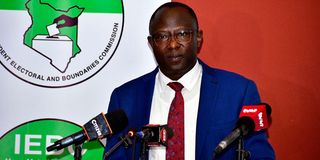
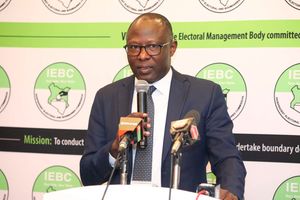
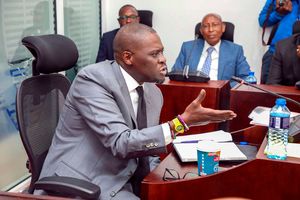
The Independent Electoral and Boundaries Commission (IEBC) chairman Erastus Ethekon.
Photo credit: Nation Media Group
Our loyalty is to the Constitution, electoral law and the sovereign people of Kenya. If there is evidence that an officer has acted improperly, the law provides mechanisms for investigation and accountability, and we welcome such scrutiny.
An allegation does not become a fact through repetition. The Commission will be judged by its conduct. Our undertaking is simple: we shall apply the law without fear, favour or affection.
There is currently a standoff between IEBC and Parliament over the cost of conducting elections. Are MPs justified in their concerns?
Parliament has the constitutional authority and responsibility to scrutinise public expenditure, and the Commission respects that mandate. At the same time, we must explain the resources necessary to deliver a credible, free and fair election.
When the question of expensive elections arises, which country is Kenya being compared with? Our electoral model is unique. We conduct six elections on one day: presidential, National Assembly, Senate, county governor, county assembly and county woman representative.
The logistical requirements are equally unique. Thousands of temporary election officials, many of them young Kenyans, are not volunteers and must be remunerated. Elections also require substantial investment in technology, ballot materials, personnel, voter education, security coordination and nationwide logistics.
Comparisons with other democracies, including India, must therefore take account of different electoral systems, legal frameworks and operational realities.
We must distinguish between expenditure necessary to safeguard electoral integrity and what can reasonably be reduced. The Commission is not asking for a blank cheque, but resources to conduct the election the Constitution demands. We shall continue engaging Parliament. There should be no contest when our common objective is a credible, peaceful, free and fair election.
Parliament has said it will not approve the budget for purchase of new kits for the 2027 polls. What is the latest on this?
The Commission appreciates Parliament’s role in appropriating public funds. At the same time, we must prepare based on the operational realities before us. Electoral technology is an important component of voter identification, verification and administration.
We have commenced the necessary procurement processes in accordance with the law. We are not asking Kenyans to spend money merely because technology exists, but to provide the tools needed for a secure and credible election.
We shall continue engaging Parliament in good faith. What we cannot afford is to postpone critical decisions until there is no time for testing, deployment, training and contingency planning. Elections are unforgiving of last-minute preparation.
I would caution against comparisons that ignore differences in geography, population, electoral architecture and the number of offices contested. Kenya conducts an extensive national election, with thousands of polling stations across vast and sometimes difficult terrain.
There are substantial costs for voter registration, technology, ballot production, personnel, transportation, voter education, security coordination and logistics.
But every shilling spent must be justified. The Commission has no interest in unnecessary expenditure. We must obtain value for money, maintain competitive procurement and seek efficiencies without compromising electoral integrity. A cheaper election is not necessarily a better election. The objective is a credible election at the most responsible cost reasonably achievable.
It is less than one year to the General Election. Is IEBC behind schedule in meeting some of the timelines the commission outlined in its Elections Operations Plan?
We have a plan, and substantial elements are already being implemented. But I will be candid: we have entered a period in which time must be treated as a strategic national resource.
Procurement, voter registration, technology testing, training, voter education, logistics and deployment cannot be compressed indefinitely. Some matters are within the Commission’s control, while others depend on Parliament, Treasury and other government institutions.
Where decisions are required from other institutions, we have continued to engage them. Are we concerned? We are vigilant. Are we panicking? No. The distinction is important.
The Commission’s CEO revolving door — what is the problem with this office? Is it administrative or legal?
The Commission Secretary is a critical office, so institutional stability at the Secretariat is paramount. But changes in office holders do not necessarily mean the institution is unstable. The Commission is larger than any individual.
We have constitutional offices, professional staff and systems designed to ensure continuity. Where there is a vacancy, the law prescribes how it must be filled, and that process must be respected.
We have proceeded with recruitment while ensuring the Secretariat continues to function effectively. My responsibility as Chairperson is to keep the Commission focused on its constitutional mandate despite changes in personnel. Individuals may come and go; institutions must endure.
Over the years, the Commission has failed to inspire confidence among voters, especially young people. Where is the disconnect?
This is one of the most important questions before the Commission. Young Kenyans are not apathetic. They are discerning, demand evidence, question institutions and expect transparency. They also communicate in a digital environment where information and misinformation travel instantly.
The Commission must meet young Kenyans where they are. We cannot engage a new generation only during election years. We must maintain continuous voter education, communicate clearly, respond to misinformation and create meaningful opportunities for young people to interact with the institution.
But communication is only part of the answer. Trust is earned through conduct. If we want young Kenyans to trust IEBC, they must see an institution that is transparent, impartial, accessible and accountable.
The first phase of Enhanced Continuous Voter Registration showed that Kenyans remain willing to participate when registration opportunities are brought closer to them.
We registered 2.3 million new voters against a target of 2.5 million. The next phase will target those who did not register, including young Kenyans who have since attained the majority age and communities facing barriers to registration.
We are targeting about 4.5 million additional registrations. The Commission will announce the precise timetable in good time. My appeal to eligible Kenyans is simple: do not wait until the last possible day to register.
The integrity of the voters’ register is one of the Commission’s highest priorities. Cleaning the register is not a cosmetic exercise or something to be rushed for public relations. It involves systematic verification, biometric processes, identification of duplicate records, updating voter information and other safeguards.
The process is already part of our continuing electoral preparations. At the appropriate stage, the law provides for inspection and verification by voters and other stakeholders.
The objective is that when the register is closed, every legitimate voter is on it, every ineligible record is dealt with according to the law, and the public has confidence in its integrity.
The commission has conducted several by-elections, the latest being Ol Kalou on July 16, 2026. Have you learnt any lessons?
Every election teaches us something. By-elections allow us to examine electoral technology, polling officials, logistics, voter identification, results management, stakeholder engagement and our response to unexpected circumstances.
They also remind us that electoral integrity is not created by the Commission alone. Political parties, candidates, security agencies, the media, civil society and voters all have responsibilities.
Ol Kalou, like other by-elections, provided valuable operational lessons.
But a by-election should not be treated as a rehearsal whose outcome predicts 2027. The political environment of a General Election is broader. We take the lessons, not the outcomes.