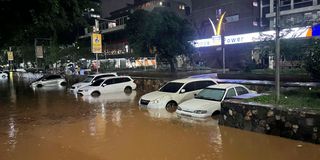
The images are now fixed in our feeds. A matatu half-submerged on Thika Superhighway, people perched on car roofs in Kilimani, and the brown waters of the Nairobi River swallowing tin shacks in Mathare. In just a few days, nearly 50 people have been killed by floods across Kenya. We treat these moments as seasonal nuisances, but in these turbulent climate times, they could get worse.
So, to prepare for the worst, the question must be asked whether Nairobi, or its peers, Dar es Salaam in Tanzania and the Ugandan capital Kampala, can be broken so badly by water that we abandon them?
Most imagine floods destroy a city by knocking down buildings. That is not how a city dies. It dies in the aftermath after the rain stops. Roads close. If trucks cannot bring maize from Eldoret, tomatoes from Kajiado or milk from Kiambu, shelves empty in 48 hours. Electricity grids short-circuit. Safe tap water becomes a myth as pumps fail and pipes burst.
The biggest killer is the toilet. Floods wash up everything that has been flushed away for decades. Raw sewage and street filth flow into homes, schools and kitchens, bringing cholera and typhoid that can finish off a population faster than any wave. When a city cannot feed its people or keep them alive, they do not wait for permission. They run. They escape to the village or any dry patch of land. The city ceases to exist as a society.
This risk extends beyond the city gates. When large swathes of Kenya and Tanzania go under, it is not just the locals who suffer. These two nations are the lungs and arteries of the region. If the highways are cut, the East African hinterland faces ruin. Landlocked nations like Uganda, Rwanda, Burundi, and South Sudan could be brought to their knees as they are severed from their export and import routes.
The above picture is not an impossible outcome. We saw this in Derna, Libya, in 2023. Storm Daniel dumped a year's rain in one day. Two dams upstream collapsed. A wall of water seven metres high roared through the centre, erasing a quarter of the town's buildings and dragging them into the sea. Derna is being rebuilt, but the city that had thrived there for generations was washed away in a single afternoon.
So what would it take for Nairobi to face its Derna moment? Not a tsunami. Just 10 days of heavy, relentless rain. Data from the Kenya Meteorological Department suggests that 10 days of extreme downpours could dump over 500 millimetres of water on the capital. To put that in perspective, Nairobi usually receives about 900 millimetres of rainfall per year. Dumping half of that in 10 days would turn the city into a swamp. Once the hills are saturated, every drop becomes a runaway river.
Elsewhere, people already accept that they cannot fight water. They live in seasonal cities. In Bangladesh or the Sudd wetlands of South Sudan, people move en masse when water rises and return when it recedes. They live in two places depending on the month. Could Nairobi adopt a two-city solution one day?
Nairobians could keep a second home in the rocky heights of Nanyuki in Central Kenya, or retreat to the wind-swept plateaus of Eldoret in the Rift Valley. We may see a surge in Kakamega's population in Western Kenya, where the terrain offers a different kind of safety. These would become our Dry Season Capitals, places where life continues while we wait for the capital to dry.
Install deep drainage tunnels
Nairobi can be saved, of course, but it would be very brutal. It would mean destroying parts of it. Clearing basin estates like South C and South B, built on flood plains where water pools. Riverfront areas like Mathare, Kibera and Mukuru would need a 60-metre no-go zone on both sides, displacing hundreds of thousands to build a forest wall.
Even the rich would not be spared. Apartment blocks in Kileleshwa and Westlands sit on streams or riparian land. Their walls act like dams until they burst. The government would have to bring them down. In Eastleigh and Gikomba, where concrete covers every inch, saving the city would mean tearing up trading hubs to install deep drainage tunnels. Sections of Mombasa Road and Uhuru Highway would need giant underground culverts to carry floods away.
These measures sound like a film script. Imagine the government forcing every young person into National Youth Service to clean the Nairobi River or plant millions of trees, a green conscription where the spade is the weapon.
Can a normal democracy do this in Kenya? Probably not. An elected leader who demolishes a billionaire's mall or forces your cousin to dig trenches will lose the next election. Worst case, therefore, flood-proofing Nairobi might require a temporary brutal dictatorship.
We like to think cities are permanent. History and rising brown water say otherwise, presenting hard choices: destroy the parts of Nairobi that should not be there, or watch the water destroy the whole thing.
The author is a journalist, writer and curator of the Wall of Great Africans. X@cobbo3