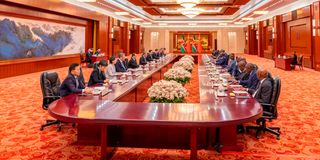
The year 2025 is unfolding as a marvellous one —annus mirabilis—for China’s ties with Kenya, and Africa. On October 1, 2025, I was privileged to be one of the many Kenyans who joined the Chinese people in Kenya, led by the Chinese Ambassador Guo Haiyan, in the colourful celebration marking the 76th anniversary of the People's Republic of China. On this day, in 1949, the Chinese Communist Party emerged victorious and Chairman Mao Zedong, the founding father of Modern China, proclaimed the birth of the People's Republic of China. Uniquely, China’s National Day is co-joined with the Golden Week, a de facto public holiday comprising seven consecutive days.
Speakers during the event lost no chance to underscore China’s deeply rooted historical and ideological ties with Africa, the convergence of the Chinese and African nationalisms and global diplomacy. As Ambassador Guo Haiyan aptly remarked, Africa supported to the hilt the UN General Assembly Resolution 2758, which recognised the People’s Republic of China as the sole legitimate government of China and reaffirmed the One China principle.
China marked its 76th independence day at a time when the US is retreating. China is moving in to fill the void and provide global public goods. In this turbulent and uncertain world, the Kenya-Chinese diplomacy has had its ebbs and flows, including recent blips of overt anti-China rhetoric. But this partnership has been resilient, recently witnessing a significant rebound and prospect of development. The Prime Cabinet Secretary and Cabinet Secretary for Foreign and Diaspora Affairs, Musalia Mudavadi, presided over the Chinese National Day celebrations, framing the event within the broader canvas of Africa-China cooperation.
From April 22 to 26, 2025, President William Ruto’s State Visit to China elevated Kenya-China ties to a “community with a shared future in the new era”. In June 2025, Mudavadi led the Kenyan delegation to the China-Africa Trade and Economic Cooperation Forum in Changsha where President Xi Jinping unveiled his government’s zero-tariff policy which grants duty-free access to nearly all goods from 53 African nations that maintain diplomatic relations with China. In September, a high-level Kenyan delegation visited China to negotiate preferential trade arrangements, poised to significantly boost Kenya’s exports and enhance trade predictability amid crippling US trade tariffs and shrinking market.
“We must move from aid dependency to trade-based development,” Mudavadi said, echoing the clarion cry from an aid-free Africa and push for predictable, reliable, and consistent trade arrangements with the continent’s partners.
From October 2025, Kenya’s iconic Standard Gauge Railway that started in Mombasa and reached Naivasha in 2019, now extends to Kisumu and onward to the Malaba border with Uganda. Hopefully, in less than a decade, an adventurous Kenyan trader or tourist will be able to travel by speed railway from Mombasa on the Indian Ocean seaboard to the Congolese port of Matadi on the Atlantic Coast!
With China’s support, Kenya is upgrading and dualling the 175km Nairobi-Nakuru-Mau Summit highway as a private-public partnership (PPP) at an estimated cost of Sh250 billion (approximately US$1.7 billion). After terminating a previous deal with a French consortium, the Government of Kenya has cleared China's Road and Bridge Corporation, in partnership with the Kenyan National Social Security Fund, to build the road expected to be financed via toll charges.
In September, the Africa policy Institute’s China-Africa Report (September-October 2025), drew attention to tourism as a post-Covid soft power tool in China-Africa diplomacy. Tourism is one diplomatic tool China is eying to help fill in the gaps left behind by the Trump administration's trade wars, tariff hikes and abrupt moves to almost entirely halt and wind down USAID operations.
The 2024 Beijing Action Plan underscores tourism as “a bridge that connects civilisations and strengthens friendship”. Tourism is the ultimate tool of facilitating people-to-people exchanges and understanding. It offers nations huge opportunities to enhance soft power, foster cultural exchange, drive economic growth, promotes peace and stability and support sustainable development. The agenda of the Forum for China-Africa Cooperation framework is to transform the 53 African countries with diplomatic ties with China as prime destinations for Chinese tourists.
Kenya is one of the African countries working to claim and grow their share of the Chinese tourist market, one of the newest, largest, fastest growing and most dynamic globally. China is the world’s top spender in outbound tourism. China’s spending reached more than US$94.790 billion during the Spring Festival in May 19, 2025. Kenya can gain from the robust recovery and growth of China’s tourism in 2024 and 2025 after the pandemic-induced setbacks in the 2019-2022 interlude. As of September 2025, China’s outbound tourism has recovered 50 per cent of its pre- pandemic outbound tourism.
Following the remarkable rebound, China’s tourism sector is projected to be worth US$2.61 trillion by the end of 2025, contributing 11.4 per cent to its GDP. In June 2025, Kenya and China launched the first-ever China-Kenya Culture and Tourism Season to deepen their cultural ties, increase tourist numbers and boost travel and cultural exchanges between the two nations. Kenya and China are strengthening their tourism ties.
During his State Visit to China, President Ruto commended China Media Group’s innovative three-day live broadcast of the Great Migration, describing it as “phenomenal” in an exclusive interview with CMG’s Wang Guan. Over 90,000 Chinese tourists visited Kenya in 2024, with the number expected to grow significantly in 2025. Some 91,000 Chinese tourists have already visited Kenya in 2025. Kenya saw a remarkable growth rate of 167 per cent.
Tourism remains a powerful economic driver in Kenya, contributing four per cent to the nation’s Gross Domestic Product and generating 2.3 million jobs. The China Tourism Day (May 19) has provided vital mechanisms for boosting tourism awareness.
Inadequate knowledge on Chinese market, rising numbers of tourists, the youthful nature of Chinese tourists, long flights times and the consequent high costs, and language barrier are some of the main challenges to China-Kenya tourism that must be urgently addressed.
Professor Peter Kagwanja is the Chief Executive of the Africa Policy Institute, Adjunct Professor at the University of Nairobi and National Defense University (Kenya).