It was refreshing to hear a Health minister admit that caesarean deliveries in Kenya have increasingly become profit-driven for some doctors.
Women who seek care in private hospitals have long known this to be the case, but have had little choice other than to accept the status quo. The alternative is often under-resourced public hospitals that lack even basic necessities such as clean water, towels and properly equipped theatres.
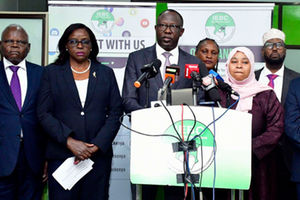
Cabinet Secretary Aden Duale chuckled when he shared how one doctor admitted to him that out of “100 pregnant women who attend her hospital, 93 of them undergo C-Section”.
That is over 90 per cent of pregnant women undergoing C-Section in one hospital. Given how rife the practice is in Kenya’s private hospitals, this equates to 90 per cent of the population of Kenyan women at risk of getting what is potentially a surgical procedure that is not required in the first place.
There must be something fundamentally flawed in the physiology of Kenyan women for a number so high to need a C-Section. The truth most likely is that a number of women who carry healthy pregnancies are subjected to mutilation of their bodies for financial gain. This is not a laughing matter anymore, but criminal matters borne out of medical negligence.
The World Health Organisation emphasises that caesarean section should be performed only when medically necessary, such as in cases of obstructed labour or foetal distress. It also calls for a reduction in unnecessary caesarean deliveries due to the risk of infection and complications in future pregnancies.
The problems in future pregnancies for women who undergo C-Section are: A) Placenta issues (Placenta Accreta/Percreta) – this is where the placenta grows into the C-Section scar, making it difficult to detach potentially causing life-threatening bleeding, B) Uterine Rupture – The scar can tear open and can cause serious complications, C) Still births – Increased risk of still birth for women who underwent C-Section than those who initially had vaginal birth, D) Scar Tissues & Adhesions – Scar tissues can potentially form affecting surrounding organs such as bladder and intestines, E) Ismocele (Niche) – A defect in the scar can lead to spotting between periods or inflammation. Repeat C-Sections increase the risks above. Kenyan doctors taking such liberal views on C-Section delivery are putting the lives of many women in Kenya at unnecessary risk.
The lack of integrity in the medical profession, alluded to by CS Duale, where doctors become ambulance chasers, subjecting women to mutilation of their bodies and putting them at risk of harm through unnecessary C-Section surgical procedures, is all the more reason to delink public institutions such as SHA from private care. The problem of C-Section is just the tip of the iceberg in private hospitals where monetary interests are valued above patients’ lives. The problem affecting women forced to undergo C-Section was created by the government, and it is their place to rein in private hospitals that have turned Kenyan women into cash cows by forcing the majority of them to undergo surgical procedures they never needed.
I have always been against the use of public funds to prop up private hospitals. It is a recipe for disaster in Kenya, where integrity is in short supply. Private hospitals are for profit and will do anything to stay afloat, whether that is defrauding the SHA or forcing women to undergo C-sections to ramp up their profits at the expense of women’s health.
The women most at risk from C-Sections are from economically stable homes or those who can afford SHA. The poor women I have interacted with before; the majority have given birth safely in public hospitals through vaginal delivery.
This means the idea of C-Sections is made up by doctors in private hospitals mainly as I mentioned above, for financial reasons. C-Section means longer stay in private hospitals, and coupled with surgical fees, it has proven to be profitable for private hospitals.
If poor women can safely give birth at a public hospital through vaginal delivery, then it means the artificially created problem of C-Section delivery can be resolved by improving public hospitals through more medical personnel and facilities and giving women the confidence to use them.
Most importantly, the country needs to think of specialist hospitals for children and mothers across the counties and manage them well to keep women safe from sharks in private hospitals that are butchering otherwise healthy women.
There is a sense that most women forced to undergo C-Section do so with limited information about what it entails and the risks involved. They must now be allowed to make informed choices by informing them of the risks of C-Section delivery in future pregnancies. Also, let C-Section delivery be authorised and conducted only by the most senior and qualified doctors. As things are, any doctor in a white coat can open women up without requisite surgical skills – just for money!
Crucially, there should be a new regime to police gynaecologists and obstetricians in private hospitals who are subjecting women to risky delivery procedures such as C-sections. Women’s safety during delivery must come before profits.