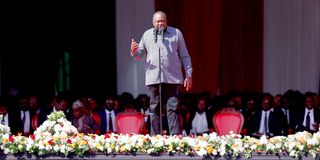
Former president Uhuru Kenyatta during the burial of the former Prime Minister Raila Odinga at Jaramogi Oginga Odinga University on October 19,2025.

After emerging victorious from World War II in the 1940s, the United States became embroiled in the Cold War with the communist USSR in the 1960s.
The Cold War had already resulted in the division of Korea into the communist North and the capitalist South. A similar ideological conflict erupted in Vietnam, where the US allied itself with South Vietnam.
However, a significant problem arose when North Vietnamese communists took refuge in the Cambodian jungles. Meanwhile, Cambodian communists, known as the Khmer Rouge, were fighting the Cambodian authorities in a low-level guerrilla campaign. King Norodom of Cambodia was neutral, refusing to help the US flush out the Vietnamese communists.
In an attempt to address this issue, the US covertly supported the overthrow of the Cambodian king in 1970, which brought Lon Nol to power. The deposed king supported the Khmer Rouge, while Lon Nol permitted the US to bomb the Cambodian jungles in order to target the Vietnamese guerrillas.
This led to unforeseen consequences. Public opinion in Cambodia shifted in support of the Khmer Rouge, and the rebellion gained momentum. Lon Nol was overthrown, and the Khmer Rouge seized power.
Radical policies
The Khmer Rouge’s radical policies had devastating consequences. They attempted to create a rural utopia by forcibly relocating everyone from cities and towns to rural areas to grow rice. The regime abolished money, private property, and markets, forcing people to work 14 hours a day. These policies resulted in the deaths of 2 million Cambodians.
After losing the Vietnam War, the US saw the communist regimes of Cambodia and Vietnam eventually turn against each other. Years later, communism as an ideology collapsed, and the Vietnamese communists transitioned to capitalism.
Ultimately, none of the parties involved in the tragic history of Cambodia and Vietnam foresaw the consequences of their actions.
The Cambodian king lost his throne by remaining neutral. Khmer Rouge won the presidency by supporting the US. The Cambodian people lost when they were massacred by the Khmer Rouge. The Khmer Rouge lost power. The Northern Vietnamese Communists lost their ideology when they became capitalists.
This is the nature of politics, where actors often fail to accurately predict the outcomes of their decisions.
A similar example of unforeseen consequences can be seen in the actions of US President Nixon. Facing re-election in 1972, Nixon became panicky and sent spies to plant bugs in his competitors’ offices. However, the burglars were caught, and despite Nixon’s landslide victory, the scandal led to his impeachment and resignation.
In hindsight, Nixon’s actions were unnecessary because he would have won the election regardless.
International politics
This phenomenon is not unique to international politics. Kenyan politics has its own share of unforeseen consequences. The demise of “Baba” and the subsequent political revival of Uhuru Kenyatta during Baba’s burial is a case in point.
The Kenyatta dynasty’s resilience is reminiscent of the “Terminator” movie character, a killing machine that can shape-shift and seemingly cannot be destroyed.
If you bomb it, it turns into liquid that solidifies back into a human-like machine to continue chasing you. Kenyatta left power at a low point, but now almost everyone is running after him.
Political dynasties can behave similarly, with the public’s perception of them changing rapidly.
Just like the Terminator, who says, “I’ll be back.”
The consequences of recent events, such as the ousting of RG, are still unfolding. Only time will tell how these events will play out.
Follow our WhatsApp channel for breaking news updates and more stories like this.
https://whatsapp.com/channel/0029Va5EF2859PwPPI4u8747
Dr Kang’ata, PhD in law, is governor of Murang’a County. email [email protected]