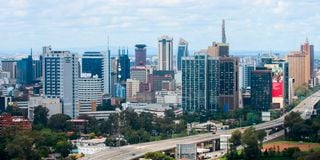
Nairobi City Skyline on April 27, 2023.

The problem of the twenty-first century is the unprecedented challenge of urbanisation. This is true of Nairobi, Kenya’s capital city of 5.12 million people, founded 125 years ago in the late 1890s as a colonial railway settlement. The future of the world is manifestly urban.
It is projected that the world’s population living in urban areas will rise from 55 per cent today to over 68 per cent by 2050. While the over 10,000 cities across the world today are growing bigger, new ones are emerging. As a result, four out of every five people in the world will most probably be living in old and new cities by the middle of the 21st century.
Urbanization is a Janus-faced phenomenon, presenting new opportunities and posing unprecedented challenges. While cities today occupy only 2 per cent of the world’s total land area (57.31 square miles), they contribute to 70 per cent of the global GDP, over 60 per cent of global energy consumption, 70 per cent of Greenhouse Gas Emissions and 70 per cent of global waste, according to UN-Habitat.
There is no better time to think urban than today. I am greatly honoured to be a speaker at the upcoming Beijing Forum on “Swift Response to Public Complaints” on December 18-19, 2024. Held under the permanent theme of “People's City, Better Future”, the forum offers an ideal platform for experts and policymakers to share insights and lessons learnt and to explore new innovative and practical solutions to the governance of cities. This year’s focus on “Modernizing for People-Centered Urban Governance” captures the aspirations of humanity for a new model of people-centred urban development — integrating justice, equity, welfare and shared prosperity as facets of sustainable development.
Urban governance
The modernisation of urban governance, we now know, cannot be a ‘one size does not fit all’ model as the myth of ‘modernisation equals Westernisation’ seems to suggest. One thing is crystal clear: the modernising of towns and cities across the world is a powerful tool for sustainable development and poverty eradication. But the process must recognise the diversity of human cultures.
For example, the modernisation of urban governance in China carries the birthmark of the Chinese civilization. However, in his writings, statements and guidance to the ruling Chinese Communist Party (CPC), President Xi Jinping has called for “accelerating the development of a new type of urbanization that puts people at the core.” By the same token, a people-centered urban governance must also accelerate the realisation of the a just, equitable and prosperous multipolar world in the 21st century.
In nutshell, the Chinese-styled modernisation of Beijing started with the upgrading its 12345 hotline that provides services to the City’s over 20 million residents. As a result, the city has created a people-centered, service-oriented and collaborative model of smart city governance, which is able to swiftly address the demands of its residents. Four lessons for Nairobi and other cities are discernible.
First, the integration and coordination of urban governance is king. Beijing’s urban governance model has integrated planning, construction and management processes, thus creating a seamless and integrated delivery of services to residents.
Second, as the hallmark of the smart city of the 21st century, the creation of digital urban governance is propelling the digital economy and efficient management of cities. Beijing’s digital urban governance has strengthened risk prevention, increased operational efficiency and management of the world’s 9th largest City.
Third, advancing urban renewal and transformation calls for strict adherence to the principles of small-scale, gradual and sustainable development. The City of Beijing has advanced four interlocking forms of renewal to achieve high-quality development. One is ‘protective renewal’ to preserve the historical heritage of the City and its vicinities. Two is ‘functional renewal’ to drive the transformation of industrial dynamics. Three is ‘supportive renewal’ to enhance the quality of public services and delivery. Finally is ‘social renewal’ to address the specific needs of residents, adding value to the services, expanding recreation and aesthetic beauty of the city.
Fourth, urban governance is about people; cities must be governed by their own people. Beijing has established a community governance system tethered to community-level Party organization, existing social governance structure and grassroots organizations. This has enhanced public participation, community dialogue and consultation and pushed community governance to a whole new level of innovation and social engineering.
Paradigm shift
We owe it to the future generations to fully implement the New Urban Agenda (NUA) of the United Nations. As a paradigm shift based on the science and principles of planning, construction, development, management and improvement of urban spaces, the New Urban Agenda is speeding up the achievement of the UN Sustainable Development Goals (SDGs) particularly SDG 11 on making cities and human settlements inclusive, safe, resilient and sustainable. China's Belt and Road Initiative (BRI) and the Global Development Initiative (GDI) are part of this global urban renewal to address challenges that threaten our ability to deliver on the SDGs.
Notably, the forces spurring the growth of cities converge in the Global South as the new frontier of urbanization and population growth. We now know that close to 90% of this increase in the world’s population is taking place in Asia and Africa, according to a new United Nations data. Three countries in the global South — India, China and Nigeria — will account for 35% of the projected growth of the world’s urban population by 2050.
Africa is the least urbanized continent in the world. While Africa and Asia are now home to nearly 90% of the world’s rural population, investments in new infrastructure including highways, waterways, seaports, airports and railways are spurring the growth of existing towns and cities and the emergence of new ones.
Prof Peter Kagwanja is Chief Executive at the Africa Policy Institute (API). This article is an excerpt from the speech by Professor Peter Kagwanja during the 2024 Beijing Forum on: “Swift Response To Public Complaints” Co-Hosted by the Chinese Academy of Social Sciences (CASS), The China Media Group (CMG), The CPC Beijing Municipal Committee and the People's Government of Beijing Municipality, to be held in Beijing on December 18-19, 2024.