Ugali, that beloved staple of Kenyan tables, is going to be on the agenda in next year’s election.
The rains in the Rift Valley breadbasket have been skittish. The maize crop in parts of the country has shrivelled and looks like onions in the worst places and, in the best of places, hardly rises above the height of a man. The fields evoke scenes from Alan Paton's Cry, the Beloved Country – a landscape of farmers peering at the sky with anxiety as a season's labour dries up in the sun.
Depressed harvests and the resultant food shortage are never good news, but in an election year, they are damning.
The spectre of a poor harvest hangs over the government, especially because it has spent more than Sh34 billion on fertiliser subsidies over the past three financial years and budgeted a further Sh18 billion this year, bringing the total commitment to over Sh52 billion.
Kenyan elections are fought over many things: ethnicity, personalities, scandals, grand promises and historical grievances. Every so often, they return to the most elemental of questions: food.
The politics of maize has shaped the history of independent Kenya. Governments have survived corruption scandals, ethnic tensions and economic downturns, but few things provoke public anger like the price of unga. The stomach is an unforgiving political institution.
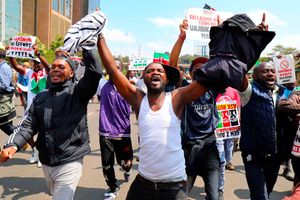
The 2017 election was fought partly against the backdrop of soaring unga prices and queues for subsidised flour. Inflation suddenly acquired a face: the packet of maize flour; and the sufurias made a comeback in the 2023 protests.
This year, the stakes are particularly high. The government has made subsidised fertiliser and increased food production a centrepiece of its economic narrative. If the harvest disappoints, it will not merely be an agricultural setback. Notwithstanding the money spent on fertiliser and seed, the nation's staple remains hostage to the rain.
A poor harvest provokes anxiety and is followed by speculation, which is answered with policy decisions to bring in imports. Millers demand urgent intervention while farmers plead for protection. Every administration eventually encounters the question of whether or not the government should import maize.
Massive, subsidised maize imports may indeed bring down the price of unga in the short-term and provide immediate political relief. No government entering an election year can be indifferent to the price of the nation's staple and urban households suffocating in food inflation.
In Kenya, maize emergencies produce overnight millionaires. Questions arise about who receives import permits, who gets tax waivers and who profits from the crisis. A failed harvest translates into an opportunity to reap rents. But a farmer who has spent months tending a crop only to watch imported maize collapse prices is a casualty of such policy.
Lastly, dependence on imports is itself a confession of vulnerability. A country that cannot reliably feed itself is hostage to global commodity markets, currency fluctuations and the policy decisions of distant governments.
Yet refusing to import can be equally dangerous. The urban poor cannot stomach arguments about protecting farmers; those in agriculture depend on it to meet rising needs. The politics of maize is therefore a brutal choice between competing hardships. Climate change has made this balancing act even more difficult. The old assumptions of Kenyan agriculture are crumbling. The long rains are no longer long. The short rains are increasingly unreliable. Farmers who once planted according to familiar rhythms now gamble with the weather.
Government can no longer speechify about reducing dependence on rain-fed agriculture without demonstrating that irrigation is delivering higher production. After more than Sh52 billion committed to subsidising fertiliser, the question is why farmers are still praying harder than the irrigation pumps are working?
Strategic grain reserves, climate-resilient seed, crop insurance and diversified food systems are no longer optional luxuries but political necessities.
Even as droughts and erratic rainfall become features of Kenya’s climate rather than exceptions to it, they are treated like an unexpected visitor. The withered farms in the Rift Valley are an early warning that the country's food security model is becoming increasingly fragile. Every maize stalk in the Rift Valley is more a political windvane than an agricultural disappointment.
More importantly, the poor state of the maize crop is a signal that food security is no longer a seasonal crisis; it is a national security question. Conversations that begin on the farm move to the market before they reach the dinner table. Private calculations about how parents will feed families eventually become public moods and political choices deposited in the ballot box.
Economists monitor inflation through baskets of goods and consumer-price indices. Ordinary Kenyans only ask one question at the kiosk: How much is unga today? Because the cost of ugali is the true inflation index.
Kenya voters have been known to forgive corruption, an anemic development records, even constitutional infidelity, but hunger is where they draw the line. The next president may discover that in Kenya, elections are not won in rallies — they are decided in the kitchen.
The writer is a board member of the Kenya Human Rights Commission and writes in his individual capacity. @kwamchetsi; [email protected]