A push to supply materials to affordable housing sites and automation of government services have pushed about two million small businesses to register over the past three years, handing the taxman visibility of the enterprises that operated under the radar.
Amidst the chase for contracts to supply doors, windows and other Jua Kali supplies, government data shows that more than 50,000 associations of micro and small businesses sought Micro and Small Enterprise Authority (MSEA) certificates.
The number of associations issued with MSEA certificates moved from about 2,000 in 2022 to 58,200 by the end of June 2025 with individual enterprises hitting 2.25 million, the State Department for Micro, Small and Medium Enterprises (MSME) Development says.
The department credits the affordable housing programme (AHP), which ring-fenced Sh11 billion for the Jua Kali sector to supply materials such as doors, windows and hinges at construction sites, for the growth in registered businesses.
Businesses allowed to supply the materials were required to be tax compliant, pushing many informal traders to seek MSEA certificates, which come with a tax compliance certificate, the government says.
“Through that formalisation we have created visibility of many Jua Kalis who are currently supplying to the affordable housing projects. We have formalised 2.25 million MSMEs that now have MSEA certificates, through 58,200 associations,” said MSME Development Principal Secretary Susan Mang’eni.
Individual MSMEs and skilled individuals come together in groups of at least five to form an association that can be certified by MSEA.
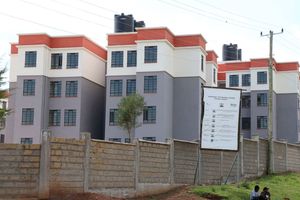
Mukuru affordable housing project units in Nairobi on May 10, 2025.
Photo credit: File | Nation Media Group
During the State of the Nation address in Parliament last week, President William Ruto said 230,000 affordable houses were under construction, with 428,000 jobs created.
“The programme has created over 428,000 jobs, including architects, engineers, fundis, plumbers, electricians, carpenters, masons, steelworkers, transporters, and thousands of MSMEs in fittings, fabrication, and interior works,” he said.
The State Department says reducing the number of MSMEs that can join hands to form an association from 30 to five has also made it easy for the small enterprises to formalise and seek supplies to the government.
Following the transfer of MSEA from the State Department for Trade during the previous administration to MSME Development, currently, the government has also changed policy, enabling the Kenya Revenue Authority (KRA) to issue tax compliance certificates for businesses in associations that get MSEA certificates.
Tax compliance certificates
Many MSMEs opted to seek the MSEA certificate because they could get tax compliance certificates and trade with the government, without going through the tedious company registration process, the state department said.
“By forming associations, they get both purchasing and bargaining power, even in terms of negotiating for the contracts. Those that got affordable housing contracts have been paying taxes, which means we have expanded the tax base in that region,” the PS said.
While observing that the AHP was the main driver for informal businesses to come on board, the state department also noted that automation of public services, most of which fall in line with MSMEs, triggered the businesses to register to access the services.
Pangani affordable housing project in Nairobi.
Photo credit: File | Nation
Among the services the government has automated is procurement with the launch of the electronic government procurement (e-GP) system.
Rollout of the Electronic Tax Invoice Management System (eTIMS) also forced many small businesses to come on board after the government and corporates stopped dealing with businesses not onboarded on eTIMS.
“These normal processes of business registration have also seen an increase after we started the e-Citizen and the digitisation. More than 22,000 services have been digitised, from a far lower number in 2022, and most services that have been digitised are those performed by MSMEs,” Ms Mang’eni said.