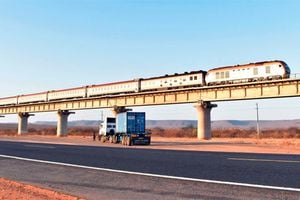
A decision by the Kenya Ports Authority (KPA) to retain Sh6.2 billion of the revenue it collected from the Mombasa-Malaba Standard Gauge Railway line caused the Kenya Railways Corporation to default on its loan obligation for the project.
Auditor-General Nancy Gathungu, in her report to the National Assembly Public Debt and Privatization Committee, pointed out that KPA retained the amount contrary to the agreement governing the loan repayment, causing the Kenya Railways to default on its repayment of the on-lent loan.
Auditor-General Nancy Gathungu.
Photo credit: File | Nation Media Group
According to the report, during the year under review, Kenya Railways failed to meet its loan repayment due to the monthly retention by KPA, which was responsible for collecting and remitting SGR freight revenue to an escrow account on behalf of the Kenya Railways.
The report revealed that from July 2023 to December 2024, KPA collected Sh22 billion out of which, Sh16 billion was transferred to the escrow account while it retained Sh6 billion.
“The audit established that the retained revenues catered for potential refund claims arising from tariff disputes and discounts, despite lack of a provision for the retention in the Take or Pay Agreement,” reads the report.
Ms Gathungu says in her report that retention of the Sh6 billion is contrary to paragraph 6 (b) of the Take or Pay agreement, which stipulates that KPA shall on behalf of Kenya Railways collect the rates and charges payable for the transportation of goods using the SGR line in return for an administration fee to cover administrative costs for collecting and remitting the rates and charges payable to Kenya Railways and remit to the Escrow Account on a monthly basis.
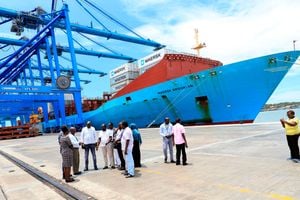
Kenya Ports Authority yard in Mombasa.
Photo credit: Kevin Odit | Nation Media Group
“This unauthorised revenue retention deprived Kenya Railways of sufficient funds required for loan repayment. Further indicated KPA’s non-compliance with the agreement and adversely affected Kenya Railway’s financial obligations towards repayment of on-lent loans,” reads the report.
The move by KPA to retain the amount means that Kenya Railways Corporation is not generating enough revenue to pay the loan acquired for the building of the Standard Gauge Railway line from Mombasa to Malaba.
The report on the performance audit of management of on loan lending activities in Kenya shows that Kenya Railways is not meeting its obligation on the Sh568 billion loan repayment, which Chinese extended to the government for the extension of the SGR line to Malaba.
The report shows the loans were advanced in 2014 and 2015 for the SGR implementation for four phases.
“Review of loan records and interviews held with the Managing Director, Kenya Railways Corporation was not meeting revealed that the corporation was not meeting its loan obligations for three on-lent loans totalling to Sh569 billion inclusive of capitalised interest accrued during the grace period,” reads the report.
“Further, the review revealed that the corporation was not generating sufficient revenue for repayment of its on-lent loans. This was partly because as at the time of the audit, the objective of the project which was the implementation of the standard gauge railway from Mombasa to Mala was yet to be fully realised as was envisioned in the feasibility study,” further reads the report.
Ms Gathungu pointed out in her report that at the time of the audit in January, 2025 only phase 1 and phase 2 had been implemented.
Kenya borrowed $5.08 billion (Sh656.54 billion) from China Exim Bank for the construction of the two phases of the SGR.
Photo credit: File | Nation
Kenya borrowed $5.08 billion (Sh656.54 billion) from China Exim Bank for the construction of the two phases of the SGR.
The first phase of the modern railway from the port city of Mombasa to Nairobi received two facilities of $1.6 billion (Sh206.78 billion) and $2 billion (Sh258.94 billion), while Phase 2 connecting the capital city to Naivasha took up $1.48 billion (Sh191.63 billion).
The loans are dollar-denominated and have floating interest rates reportedly set at 3.6 percent or 3.0 percent above the average London Interbank Offered Rate (Libor)—a global benchmark retired in June 2023 and replaced by Secured Overnight Financing Rate (SOFR) and other alternative reference rates.