Central Bank of Kenya (CBK) Governor Kamau Thugge has warned that Kenya faces difficulties honouring its ever-growing public debt obligations, which stand at Sh11.8 trillion, due to liquidity challenges.
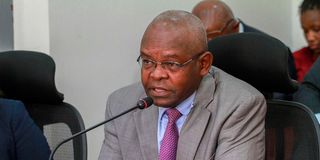
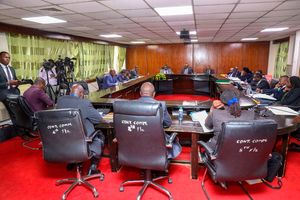
Dr Thugge made the revelations before the Public Debt and Privatisation Committee of the National Assembly, pointing out that the debt stock is growing faster than the Gross Domestic Product (GDP).
“Public debt remains sustainable but faces a high risk of debt distress,” Dr Thugge said, adding that “the recent borrowing targets have been quite ambitious”.
Reputable international credit rating agencies Standard and Poor’s (S&P), Fitch Ratings and Moody’s have also raised doubts over the country’s ability to manage debt repayment.
In 2023, Kenya’s sovereign rating was placed at B by both S&P and Fitch. Moody’s rated Kenya at B3 with a negative outlook.
According to Dr Thugge, the Sh11.8 trillion public debt recorded in the financial year 2024/25 is an increase by 11.7 per cent and was 69 per cent of the GDP as at June 30. In October 2023, Parliament passed changes to the Public Finance Management Act to replace the Sh10 trillion public debt numerical ceiling with a GDP ratio of 55 per cent.
The increasing debt stock, Dr Thugge said, has been due to rising borrowing needs “amid controlled macroeconomic stability and reflects increases in both domestic and external debt.”
To address the situation, Dr Thugge said that fiscal consolidation is required to reduce the pace of debt accumulation and lower the ratio of debt to GDP. He stated that CBK will continue supporting the country’s macroeconomic stability, modernise domestic debt market infrastructure, diversify the investor base and mitigate exchange rate risk.
The Central Bank of Kenya (CBK) headquarters in Nairobi.
Photo credit: File | Nation Media Group
According to documents presented by Dr Thugge, as at June 30, domestic debt grew by 17 per cent to Sh6.33 trillion, about 37 per cent of GDP, while external debt grew by 6.1 per cent to Sh5.5 trillion (32.1 per cent of the GDP).
The CBK boss noted that public and publicly guaranteed debt has grown exponentially from Sh7.7 trillion in the 2020/21 financial year to Sh8.8 trillion in 2021/22, Sh10.6 trillion in 2022/23, it remained the same in 2023/24 before climbing to Sh11.81 trillion.
Data from CBK shows that while Kenya’s domestic debt repayment performance has been 100 per cent for the financial years 2014/15 to 2020/21, it slackened from the financial years 2021/22 to 2024/25.
Given the high public debt level, rising interest costs and increasing reliance on domestic borrowing, Dr Thugge said “further strengthening of fiscal and monetary coordination is essential”.
“Remain on course with growth-friendly fiscal consolidation and enhance resilience by creating fiscal buffers,” said Dr stressing the need to “focus on a dedicated liability management plan to reduce debt refinancing risks in line with market conditions.”
Dr Thugge also called for accelerated concessional external financing to reduce pressure on domestic interest as well as the broadened use of the public-private partnerships to finance public infrastructure projects.
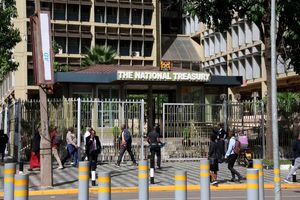
The coordination efforts CBK has undertaken with the National Treasury in managing domestic debt include predictable borrowing strategy—a joint planning of Treasury bonds and bills auctions—based on liquidity conditions to ensure stable investor expectations.
There is also the alignment of monetary and fiscal actions with the government borrowing plans. This, CBK says, is critical in managing liquidity and avoiding undesired shocks. Further, there’s joint liability management operations that enable continuous monitoring of yields and maturities to “smoothen” the debt maturity profile, lower refinancing risks, relax fiscal space for priority spending and support stability of the foreign exchange market.
Defaulting on debt, which means the borrower not fulfilling the terms of the loan as agreed, can lead to severe consequences, such as a damaged credit score, legal action and the seizure of assets.
Signs of a country sliding into debt default include borrowing to repay debt, which Kenya has been doing due to reduced revenue collection, essentially creating a “debt spiral.” Another indicator is the high debt-to-income ratio, which means that monthly debt payments exceed 50 per cent of the income.
At 69 per cent, Kenya’s debt-to-GDP ratio is above the International Monetary Fund recommended threshold for developing countries.
Fiscal analysts at the Parliamentary Budget Office (PBO) define debt distress as the country’s inability or difficulty in servicing its debt obligations, meaning that it cannot make timely payments of the interest and principal.
“This situation is characterised by a high risk of default and requires debt restructuring as the country is unable to meet its financial commitments,” said a PBO official.