Maize farmers who have been hoarding the crop are staring at heavy losses after cheaper imports from the Common Market for Eastern and Southern Africa (Comesa) member states destabilised local market prices at the expense of domestic producers.
Data from the grain traders’ market indicates that maize prices have fallen from Sh4,600 to Sh4,000 over the past two months. This has eroded the profit margins of farmers who have been holding onto their crops in the hope of getting higher returns.
Agriculture experts and farmers have expressed fear that the situation could worsen in the coming months as additional maize supplies are expected from Tanzania, Uganda, Zambia, Malawi, Angola and Mozambique.
“Most of these countries have realised bumper maize harvest and they target Kenya as their main market. But when the cheaper imports flood the market, local producers find themselves unable to recover their investment,” said David Maina, the chairperson of Grain Belt Millers Association (GBMA).
Maize prices have fallen from Sh4,600 to Sh4,000 over the past two months.
Photo credit: Shutterstock
The association, which brings together more than 35 small-scale millers, said they are faced with market challenges for their products due to unregulated imports of cheap maize from Comesa member states.
The entry of cheap maize into the local market has pushed down the prices to the relief of consumers who can afford the stable source of food to most households.
The imports, allowed under regional trade agreements that promote duty-free access among member states, have sparked debate over the balance between food security and farmer protection.
“Tanzania, for instance, has maize stocks for the last one and half seasons and they have nowhere to sell the produce. Likewise, Zambia realised bumper harvest last season and they are also targeting Kenya as their main market distorting local prices,” said Kipngetich Mutai, a dealer in regional maize trade.
Farmers said the current market prices barely cover production expenses and they will incur heavy losses ahead of the harvest of this season’s crop in many parts of the South Rift region.
“Maize remains Kenya’s staple food and a major source of income for millions of households but if farmers consistently fail to make profits, many will shift to alternative crops or reduce production altogether. That could create future supply shortages and expose the country to external market shocks,” said Jackson Kemboi, a cereals sector stakeholder from Sergoit in Uasin Gishu County.
Data from the Kenya national Bureau of Statistics (KNBS) and the Ministry of Agriculture indicate that the country imported 30,000 tonnes of maize early 2026 with a potential of up to 500,000 tonnes.
Tanzania is Kenya’s traditional source of maize to meet shortages of the staple, but non-tariff restrictions such as export permits has promoted diversifications to Zambia.
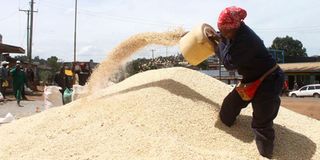
Farmers dry maize in Elburgon town, Nakuru County.
Photo credit: File | Nation Media Group
The government in February secured a commitment for one million 90kg bags of maize from Zambia to cushion against impending shortages projected to affect 3.6 million Kenyans by June 2026.
However, maize traders have decried infiltration of cartels in the regional market, who they say have set tough conditions to benefit from imports.
“Maize goes for as low as Sh2,300 at farm gate levels in many parts of Tanzania, including Dodoma, but the supply chain has been infiltrated by cartels who have set tough conditions like purchasing the commodity in bulk of above 100 tonnes to earn profit,” said David Muli, a trader.
He said that Tanzanian maize lands at Sh3,600, which is cheaper compared to Sh4,000 in the local market as the cost of the crop continues to fall, threatening livelihoods of many farmers.
The reduced prices have negatively affected farmers in the maize growing counties of Uasin Gishu, Trans Nzoia, Nandi, Bungoma and Nakuru, where the crop forms a critical pillar of the local economy.
“The decline in farm incomes affects household livelihoods and interrupts investment in subsequent farming seasons,” said Mary Jepkosgei from Ziwa, Uasin Gishu County.
“Apart from the availability of cheaper imports, maize prices are expected to decline further due to harvest of short term crops –potatoes, beans among other alternative food,” said Joshua Kosgei, an Eldoret-based miller.
President William Ruto's administration has put in place measures that will ensure that the country does not import maize and instead support farmers to increase crop productivity.
The Ministry of Agriculture early this year issued a 30-day ultimatum to farmers to release their maize stock after it admitted limited supplies of the staple that would force the government to permit duty free maize imports to stabilise flour prices.
Agriculture and Livestock Development Cabinet Secretary Mutahi Kagwe.
Photo credit: File | Nation Media Group
Agriculture Cabinet Secretary Mutahi Kagwe has asked maize farmers to comply with the directive to mitigate against possible losses due to duty-free maize imports.
“We are offering Sh4,000 per bag and we have Sh1.7 billion for payments. We must stock our strategic reserves and be prepared for emergencies. Our priority is not to import but to buy from farmers,” said the CS.
“We are stuck with maize in our stores and there is no other option but to sell the produce at current market price,” said James Songok, a large-scale farmer from Kerita in Uasin Gishu County who has over 200 bags of maize.
The panic selling by the large-scale farmers has triggered further decline in maize prices to the relief of consumers who can access the commodity at affordable costs.