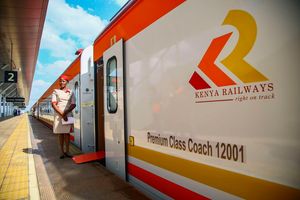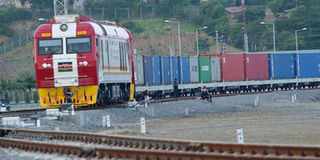
A Kenya Railways commercial cargo train.

Kenya Railways Corporation is embroiled in a Sh173 billion dispute with a logistics firm, ATI Freight Kenya Limited, arising from unpaid freight charges, demurrage fees and the commercial use of detained cargo containers.
The row escalated after the High Court last week ordered the state corporation to account for revenues earned from leasing and using the company's 250 containers since 2018.
Kenya Railways had detained the containers over alleged unpaid cargo transport charges and mounting demurrage fees after ATI Freight Kenya allegedly stopped clearing freight dues. Kenya Railways later started leasing the containers to third parties to ferry their goods.
The court directed Kenya Railways to provide “a full and accurate account” of all revenues generated from the containers before its multibillion-shilling claims against ATI Freight can be determined.
The court ruling arose from a commercial dispute that also involved Stanbic Bank Kenya Limited, which had financed the company's acquisition of the containers in 2016 through asset finance facilities amounting to $2.5 million.
Kenya Railways had lodged a cross-claim seeking Sh46.5 million in cargo movement charges and $1.34 billion (Sh173 billion) in demurrage charges on detained containers and interest accumulated between October 2018 and January 2020.
It said the debt was compounded by statutory interest of 10 percent per week under the Kenya Railways Act.
The corporation argued that ATI Freight failed to pay agreed freight charges after Kenya Railways assumed cargo train operations following the collapse of Rift Valley Railways’ concession.
Court records show ATI Freight contracted Kenya Railways to transport edible oil cargo after the state corporation formally took over freight services on August 1, 2017.
In addition, the company stopped paying agreed cargo transportation charges and failed to clear containers retained at Kenya Railways' freight yards after delivery operations, leading to accumulation of demurrage fees and storage-related penalties.
The corporation relied on provisions of the Kenya Railways Act to justify detention of the containers and imposition of demurrage charges.
A Kenya Railways commercial cargo train.
But the dispute shifted after Kenya Railways admitted during the hearing that it had been commercially using the containers for third-party transport business.
Kenya Railways General Manager for Operations Eric Njoroge told the court that the corporation leased out the containers to recover debts allegedly owed by ATI Freight.
Under cross-examination, he admitted that the practice had been ongoing since 2018 and that the State Corporation had not rendered accounts showing revenues earned from the commercial use.
“The second defendant (Kenya Railways) had leased the containers in order to recover the debt allegedly owed by the first defendant (ATI Freight),” the court said in the ruling.
The court added, “The second defendant, having admitted to commercially utilising the containers and deriving revenue therefrom, is under an obligation to account for such use.”
It further held that without proper accounting, the exact debt owed by ATI Freight could not be accurately established.
The court ordered that any amounts eventually found due to ATI Freight from the revenues generated through the containers’ use be offset against sums claimed by Kenya Railways.
The case began after Stanbic Bank sued ATI Freight and Kenya Railways in 2019 seeking recovery of $1.33 million and Sh17.1 million alongside repossession of the containers financed under two hire-purchase agreements.
The bank argued that ATI Freight had defaulted on facilities advanced in 2016 for the purchase and refinancing of the containers used in regional freight operations.
Stanbic also claimed it held a first fixed charge over the containers through registered debentures securing up to $2.5 million.
The bank accused Kenya Railways of unlawfully refusing to release the containers despite being aware of its security interests.
ATI Freight denied defaulting and maintained that the financing facilities had been fully repaid.
Its director, Vinay Singh, argued that Kenya Railways continued to use the containers for commercial gain without accounting for revenues generated from them.
After reviewing bank statements and loan records, the court found that Stanbic had indeed advanced the facilities but failed to prove ATI Freight defaulted.
The court said the evidence showed that the hire-purchase loans had been fully serviced by January 18, 2019, with the accounts reflecting credit balances.
It ruled that Stanbic’s later claims related to separate facilities that had not been properly pleaded or supported with signed offer letters.
The court also declined to allow Stanbic to repossess the containers from Kenya Railways, saying the bank’s enforcement rights depended on proof of default.
ATI Freight’s separate claim seeking restoration of allegedly vandalised containers was also dismissed after the court found insufficient evidence linking the alleged damage to Kenya Railways’ use of the equipment.
Follow our WhatsApp channel for breaking news updates and more stories like this.