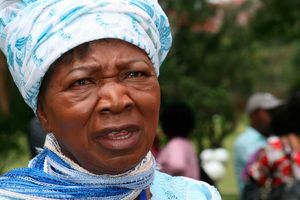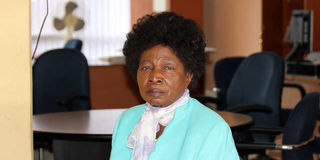
Phoebe Asiyo, who passed away on July 17, 2025.
The lights dimmed July 17, 2025, when Phoebe Asiyo had passed away in North Carolina, USA.
In the wake of this profound loss, I received a heartfelt WhatsApp message from her daughter and primary caregiver, Atieno Asiyo, who wrote, “Mum has rested; she has gone back to her heavenly home.” As I read her words, a wave of grief washed over me.
I wept not only because I had lost someone who had shown me unwavering love and support but also because Kenya had lost a remarkable icon for gender equality, nationalism, and Pan-Africanism.
Phoebe Asiyo was a trailblazer, who had witnessed the nation's transformation, embodying resilience and strength as one of the last living figures able to narrate Kenya's complex history from the era of colonialism to independence.
As a young girl growing up in Kendu Bay, Phoebe Asiyo had vivid memories of planes soaring overhead and landing in Lake Victoria, navigating between Kendu Pier and distant supply depots during the Second World War.
Gendia SDA Mission, a historic outpost, served as a strategic stronghold for British soldiers during the war.
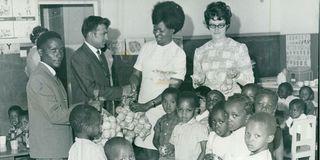
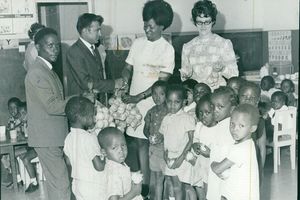
1971: Vitafoam (EA) Ltd branch manager Kishor Shah presents to Phoebe Asiyo (in white dress), the Chief Executive Officer of Child Welfare Society of Kenya, balls and mattresses as gifts towards children at Mama Ngina Kenyatta Children's Home in Nairobi.
It was a busy hub where food, ammunition, and other vital supplies were collected and dispatched to the front lines, supporting the troops engaged in fierce battles in far-off places, possibly Kismayu or Burma.
After completing her “O” Level studies at Kamagambo Secondary School, Phoebe enrolled at Kangaru Teachers Training College (KTTC) in 1950, just before the eruption of the Mau Mau War of Independence.
Her journey to Kangaru was remarkable — her father, Joel Omer, a pioneering African convert and pastor in the Seventh Day Adventist Church at Gendia Mission Station in Kendu Bay, arranged her passage by securing one ticket from East African Railways and Harbours.
This ticket allowed her to take a ferry from Kendu Bay pier to Kisumu. From Kisumu, she boarded a train that carried her to Nairobi, where a family friend of her father’s welcomed her and helped her to Embu to begin her college education.
In Kangaru, some of her fellow students included Matere Keriri, who later became State House Comptroller under Mwai Kibaki’s government, and James Mathenge, who became permanent secretary in the office of the president.
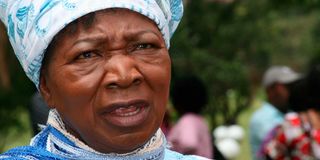
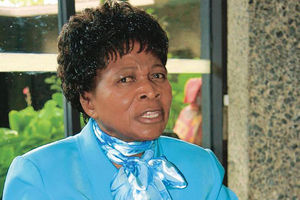
Former Karachuonyo Member of Parliament, the late Phoebe Asiyo.
While there, she would occasionally spend her weekends at Jeremiah Nyaga’s home, helping with household chores and caring for his children.
Nyaga would pay her a stipend for her assistance, which constituted part of her pocket money. She later served with Jeremiah Nyaga in Parliament.
Armed with a diploma from Kangaru TTC, Pheobe moved to Nairobi, where she began work, initially as a social worker covering the Ngong, Kiserian, Bahati, Babadogo, Ruaraka, and Ololua areas for the Municipal Council of Nairobi.
This was a time of emergency, declared by the colonial governor, Sir Evelyn Baring, following the outbreak of the Mau Mau war, and there were many vulnerable women and children, mostly Kikuyu, whose husbands or parents had died or disappeared during the conflict.
Phoebe collected the children to seek government aid for them and helped battered or injured women access medical treatment. Around this period, she married Bezellel Riachard Asiyo Genga (BRAG), a neighbour of Tom Mboya in Kaloleni Estate, Nairobi. Together, they were blessed with children Atieno Asiyo, Mary Nyamasi, Juni Asiyo, Aseto Asiyo, and Ceasar Asiyo.
While staying in Kaloleni, Phoebe experienced a significant turning point in her political journey.
During this time, racial segregation was still prevalent in Nairobi, and the Maendeleo Ya Wanawake Organisation (MYWO), established in 1952, was exclusively for white women, focusing on programs that benefited them in Kenya.
In response, Phoebe Asiyo initiated a movement and organised demonstrations from Kaloleni along Landhies Road to the Secretariat building (now known as Jogoo House) to protest against MYWO.
She aimed to create an organization that would advocate for and represent the issues of African women, which she named Maendeleo na Usalama Wa Wanawake na Watoto (the Well-being of Women and Children).
The colonial government recognised her efforts, and soon after, Gladys Beecher, the daughter of Louis and Mary Leakey and the wife of Anglican Archbishop Leonard Beecher, stepped down, enabling Phoebe to become the first African president of MYWO in 1958.
In her book, she recounts how many white women refused even to shake her hand when Gladys introduced her to them in their homes and offices.
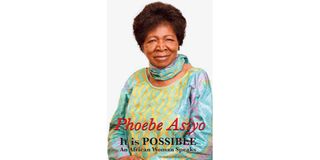
The cover of former MP Phoebe Asiyo's memoir, It's possible: An African Woman Speaks.
Despite this, she remained undeterred and attended various tea parties hosted by white women at ranches such as Delamere Farm and Keekopey Ranch, as well as at Lord Egerton's in Nakuru.
Notably, several influential women, including Lady Eugenie Dorothy Hughes, the first East African female architect, Nancy Shepherd, MYWO's first chief executive, and Lady Agnes Ramat Show, offered their support.
During the period when Phoebe was being prepared to assume the presidency of MYWO, she encouraged Mrs Gladys Beecher to send Ida Lydia Mbotela, the mother of the late veteran broadcaster Leonard Mambo Mbotela, to the Associated Country Women of the World (ACWW) conference in Colombo, Ceylon (now Sri Lanka).
This marked the first occasion on which an African woman was sent overseas by MYWO.
During this period, discussions regarding Kenya’s independence were intensifying.
Maendeleo Ya Wanawake
Phoebe Asiyo gathered a group of 11 women leaders, including Elizabeth Kobilo Chesire, the mother of Zipporah Kittony, the renowned chair of the Maendeleo Ya Wanawake Organisation; Ida Mbotela, Rahab Nanjiru Kamanda from Nairobi, mother of Lois Thuo, the vice chairperson of Sauti Kuu Foundation; Agnes Nderitu from Central Province; Ruth Habwe representing Western Province; Tabitha Ogega from Kisii Nyanza; Mary Kitwa from Eastern Province; and Grace Mabuu from Rift Valley Province.
They were provided with a Land Rover that took them from Nairobi to Kitale, and from Kitale to Lodwar, where they then hitched a ride on a lorry.
Upon their arrival at the Lodwar detention camp, Jomo Kenyatta was moved to tears upon seeing them. Unlike the men, who arrived with stacks of files and documents for political discussions, the women brought fresh flowers and fruits for Mzee.
The emotion in the room was palpable. The silence was broken by Aida Mbotela, who asked everyone present to bow their heads for a word of prayer.
Following the prayer, they addressed a number of issues, including concerns about maternal health for women.
They advocated for the establishment of maternity wards, as many African women were dying or losing their children during childbirth, and they pushed for the creation of nursery schools for African children in Kenya.
Asiyo and Nyerere
While in Kaloleni, a disturbing noise outside her house, number 38, caught her attention.
When she stepped out to see what was happening, she discovered White colonial askaris arresting Mwalimu Julius Nyerere, who had come to visit Tom Mboya, residing in House number 32.
Mboya, a Pan-Africanist, often hosted many visitors from Africa during that era of independence movements.
In the ensuing chaos, Nyerere, clutching a briefcase, swung it in the direction of Pheobe, who picked it up and kept it safe for him.
She later returned it to him in Tanzania after both Kenya and Tanzania had gained independence.
Mwalimu Julius Nyerere was extremely grateful for her gesture, which further strengthened their friendship.
Phoebe Asiyo was part of the group commissioned by Tom Mboya to weave the Kenyan flag and its symbols just before independence.
Prisons superintendent
After Independence in 1963, President Kenyatta appointed Phoebe as the first African Assistant Superintendent of Prisons at Langata Quarry Women’s Prison (now known as Langata Women’s Prison).
She reported to MP Rochfort (Head of Women’s Prison), WJ Burton (Commissioner of Prisons), and Andrew Saikwa, the Assistant Commissioner of Prisons.
In her role, Phoebe handled several sensitive files of leaders who had been incarcerated during the struggle for Independence, thus cultivating strong relationships with them.
The trauma of interacting with prisoners on death row motivated her to advocate for the removal of the death penalty during the constitutional making conference.
Since Prisons was under the Ministry of Home Affairs, then headed by Jaramogi Oginga Odinga as Vice President and Minister for Home Affairs, and Kitili Mwendwa as Permanent Secretary, Phoebe enjoyed unfettered access to Jaramogi and also to President Jomo Kenyatta, through Mama Ngina Kenyatta, who was her friend.
She travelled to many UN meetings with Kenya’s First Foreign Affairs Minister, Joseph Murumbi, who she regarded as Kenya’s foremost intellectuals and a respected voice in UN circles.
She told me that when Murumbi spoke, the whole room went quiet.
She recalled the day Jaramogi resigned from the government in April 1966. Jael Mbogo came to her house to share rumours that Jaramogi was planning to resign as Vice President.
They hurried to his home, where they found another friend, Mama Salome Mitula, a prominent businesswoman from Shauri Moyo, who was screaming and imploring Jaramogi not to resign.
They learned that after experiencing humiliation at a meeting held at what is now the KICC, Jaramogi rushed to his office and asked his secretary, Okello Odongo, an African American, to draft a resignation letter.
Despite the women’s pleas and begging for him to reconsider, Jaramogi went ahead and submitted his resignation.
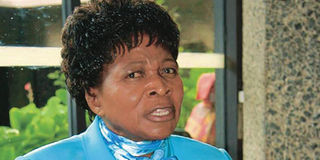
Phoebe Asiyo, who contested and won the Karachuonyo Constituency seat in 1979.
Shortly after the assassination of Tom Mboya, Phoebe Asiyo was appointed chairperson of the Child Welfare Society, replacing Pamela Mboya, who was grieving the loss of her husband.
The Mboya and Asiyo families were very close, and Phoebe felt deeply the pain of Mboya's death. She believed that Kenya had lost a gem who could have transformed the country into a first-world economy.
Another loss that she said saddened her was that of Dr. Robert Ouko, Kenya’s former Foreign Minister. His charred body was discovered in Got Alila, Koru, Kisumu County, on February 2, 1991.
Phoebe and Ouko had served together in Kanu, and both were members of the Nyanza Parliamentary Group. Additionally, Phoebe knew Christabel, Ouko's widow.
Political test
As the Member of Parliament for Karachuonyo, Phoebe Asiyo faced numerous political challenges, many of which were orchestrated by her rival, Okiki Amayo, the chairman of the notorious Kanu Disciplinary Committee.
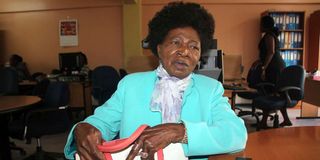
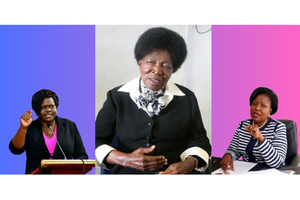
Former Karachuonyo Member of Parliament, the late Phoebe Asiyo.
This powerful body was created to discipline errant members of the ruling party.
Surviving these storms was not easy for Phoebe; she endured many violent encounters while working tirelessly to promote development through her NGO networks and established connections with diplomatic missions, including DANIDA.
During her election campaign in 1979, an incident occurred when a snake was thrown into her car, causing widespread panic. Nevertheless, she persevered and went on to represent her constituency for many years.
Jaramogi Oginga Odinga, a close friend of her father and the head of the Luo Council of Elders, supported her political endeavours.
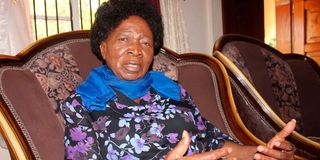
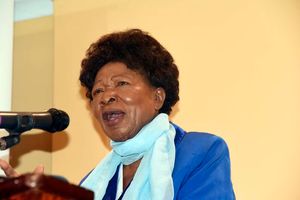
Mama Phoebe Asiyo in this file photo taken in 2017. Her 'failed' motion in 1997 became the foundation of gender equality we know today.
After the 1992 elections, Jaramogi expressed disappointment that, for the first time in Kenya’s history, all Luo MPs were in the opposition.
This led him to convene a meeting at his rural home, where they resolved to explore ways to cooperate with the government.
Unfortunately, these discussions did not come to fruition, as Jaramogi passed away in 1994. His death prompted President Moi to honour him, even attending his funeral.
Phoebe took great satisfaction in witnessing Raila Odinga shake hands with President Mwai Kibaki in 2008 after the contentious 2007 presidential election and the subsequent post-election violence that claimed over 100 lives.
She also appreciated the March 2008 handshake between President Uhuru Kenyatta and Raila Odinga following the troubled 2017 general election.
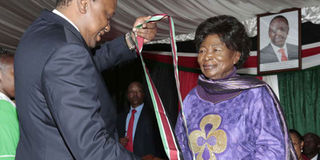
President Uhuru Kenyatta confers the Chief of Burning Spear award to Phoebe Asiyo at State House, Nairobi, on August. The President also launched Ms Asiyo memoir "It is Possible: An African Woman Speaks". PHOTO | MARTIN MUKANGU | NATION MEDIA GROUP
Furthermore, she welcomed Raila’s collaboration with President William Ruto in 2024 in response to the Gen-Z protests. A true nationalist, Phoebe believed that the stability of the nation and respect for the flag and national anthem were far more important than any personal ambitions.
She often wept for the lives lost during political conflicts. For this reason, along with other leaders of goodwill, she played a significant role in forming initiatives to foster peace and unity.
As part of a team of eminent individuals advocating for the implementation of the two-thirds gender rule, she worked alongside notable figures such as Zipporah Kittony, Beth Mugo, Jane Kiano, Tecla Lorupe, Professor Wanjiku Kabira, Betty Murungi, James Mwangi, the CEO of Equity Bank, S.K. Macharia, the chairman of Royal Media Services, and Kiprono Kittony, who was then the chairman of the Kenya National Chamber of Commerce and Industry.
This group also established the Women’s Situation Room, which promoted electoral peace in the lead-up to the 2013 general elections.
One of her proudest achievements was the promulgation of the Constitution of Kenya in 2010, a document she fought for over many years.
As a women's rights leader, Member of Parliament, and a member of the Constitution of Kenya Review Commission (CKRC), she was dedicated to obtaining better constitutional protections, including a comprehensive bill of rights and gender equity for all Kenyans.
UN footprint
In UN circles, Phoebe Asiyo was a well-known figure. She had meaningful interactions with influential women, including Barbara Bush, the wife of US Ambassador to the UN George Bush (who later became President).
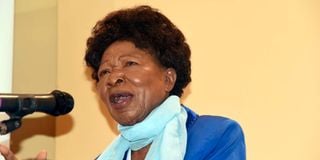
The patron of Maendeleo Ya Wanawake Phoebe Asiyo.
Phoebe first met Barbara in 1971 and attended the UN General Assembly when China's request for admission to the UN was debated — a contentious issue she had followed since her first participation in UN meetings in 1965.
At that time, African and other smaller nations supported China's admission, which led UN Secretary-General U Thant to announce China's acceptance into the organisation.
Since then, Phoebe had attended every UN Women’s meeting and formed lasting friendships with Dr. Margaret Snyder, who headed the UN Economic Commission for Africa (UNECA).
In Africa, Phoebe Asiyo was recognised as an exceptional coalition builder and had strong relationships with notable figures such as Maria Nyerere, Miria Obote, Nyiva Mwendwa, Margaret Kenyatta (the first female Mayor of Nairobi), Joyce Mpanga, Winnie Mandela, Graca Machel, Muthoni Likimani, Rachel Mzera, Rebecca Mulira, Hellen Faith Nkurumah, Dr. Jennifer Riria, Kamla Sikand, Gertrude Mongella, Professor Julia Ojiambo, Grace Ogot, Ida Odinga, and industrialist Esther Afua Ecloo of Nkulenu Industries in Ghana.
For Phoebe, tribal, racial, or religious differences were never barriers. She was able to connect with everyone, always focused on the common good rather than personal gain.
Phoebe Asiyo voluntarily handed over the title deed for Maendeleo House to the MYWO in the presence of President Uhuru Kenyatta, then Public Service, Youth and Gender Affairs Cabinet Secretary Prof. Margaret Kobia, and MYWO chairperson Rahab Muiu in 2020.
The building and land that house the MYWO headquarters were registered in the names of four trustees, all of whom had passed away. As the last living trustee, Phoebe transferred the title to the organisation.
Phoebe’s life and legacy were deeply intertwined with the fabric of Kenyan and African society, reflecting both the struggles and triumphs of a nation in transition.
Her loss leaves a profound void in the hearts of many who admired her unwavering commitment to justice and equality.
A historiographer