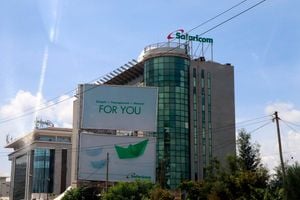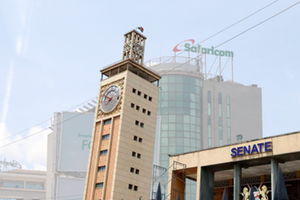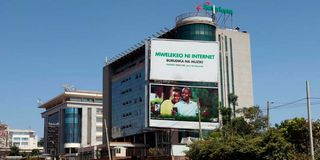
The Safaricom head office in Nairobi.

Stakeholders in the telecommunications sector have raised concerns over the pricing model used in arriving at the proposed partial sale of 15 percent of the government stake in Safaricom Limited, warning that the Sh34 per share could have been undervalued.
The telecommunications experts also warned that Vodacom's majority stake in Safaricom could limit government influence in strategic decision-making.
The Institute of Certified Public Accountants (ICPAK) and the Technology Service Providers Association of Kenya, an industry association, said in the Safaricom transaction, the per-share price of Sh34 was set without a publicly disclosed methodology.
"Independent benchmarking or third-party validation is minimal. The proposed price of Sh34 per share has not been accompanied by a clear explanation of the valuation methodology, raising concerns over price discovery and accountability," Professor Elizabeth Kalunda, the ICPAK chairperson, said.
"The proposed price of Sh34 per share has not been accompanied by a clear explanation of its methodology, raising concerns over price discovery and accountability."
The ICPAK's concerns come even as industry regulators, the Communication Authority (CA), the Capital Markets Authority (CMA), and the Competition Authority (CAK) welcomed the partial sale of the government stake in Safaricom, saying the price was competitive and the transaction is unlikely to negatively affect the market.
The CMA, CA, and CAK said the Sh34 per share that Vodacom South Africa will pay for a 15 percent stake is competitive and could only be achieved through a block sale.
The Safaricom head office in Nairobi.
Wycliffe Shamiah, the CMA chief executive officer, David Mugony, the CA Director General and David Kemai, the CAK Director General, told lawmakers that Safaricom has already requested approval of the proposed change in shareholding and is going to get a response from the regulator (CA) within a week.
"The preliminary position of the Authority (CA) is that the request for the proposed change in shareholding can be accommodated considering that: there is no local shareholding threshold requirement under policy, the transaction retains local equity participation through the government of Kenya, and the transaction has been approved by the Cabinet," Mr Mugonyi said.
ICPAK told the joint committee on Finance and National Planning and that of Debt and Privatisation, that basing the transaction price primarily on the six-month Value Weighted Average Price (VWAP) relies on historical trading data and liquidity conditions rather than Safaricom’s intrinsic value.
Prof Kalunda said the approach may not fully capture the company’s long-term growth prospects, future cash-flow potential, or strategic importance to the State.
"There is a need to link the proposed premium to Safaricom’s expected future earnings, sector outlook, and relevant macroeconomic trends, rather than relying solely on historical trading metrics," Prof Kalunda told MPs.
"This will enhance clarity of the valuation methodology and strengthen public trust in Kenya’s Capital Markets."
ICPAK raised concern that the offer price of Sh34 is below Safaricom’s all-time high of Sh44.7 in 2021, reinforcing public perceptions that the asset may have been sold below its intrinsic value.
The joint committees chaired by Molo MP Kuria Kimani and Balambala lawmaker Abdi Shurie are conducting public participation on the proposed partial sale of 15 percent government shareholding in Safaricom PLC.
The government, through Sessional Paper No 3, is seeking to generate approximately Sh204 billion ($1.57 billion) in gross proceeds through the divestiture of a 15 percent stake in Safaricom at a premium of 23.6 percent to the six-month volume-weighted average price ending December 2, 2025.
The government is seeking to sell 6 million shares in Safaricom to South African telecommunications firm Vodacom at Sh34 per share.
The government currently owns 35 percent of Safaricom shares, whose current market value is estimated to be valued at between Sh280 billion and Sh300 billion.
The decision to dilute shares in various government-linked enterprises follows the recent signing into law of the Privatisation Act, 2025, which came into effect on October 21, 2025.
Also Read: Sell Safaricom shares to highest bidder
The new law compels the National Treasury Cabinet Secretary to consult the members of the public and all persons who are likely to be affected by the privatisation of a public-owned entity prior to identifying the public entities for privatisation.
It also requires that the Privatisation programme, which contains public entities identified for privatisation, be approved by the Cabinet and the National Assembly, before implementation of the privatisation processes.
Vodafone South Africa owns a majority shareholding of 40 percent in the profit-making telecommunication firm. Free float shareholders hold a 25 percent stake in Safaricom Limited.
Section 74 of the Privatisation Act, 2025 provides that the national government may sell or dispose of part or all its shares in a government-linked corporation, with the approval of the Cabinet, which approval of the Cabinet may only be given taking into considerations of the National Treasury regarding the financial implications of the sale of such shares.
For the government to dilute its shares in any government-linked enterprise, the decision will have to be ratified by the National Assembly.
"We have not been able to explicitly come up with a figure for Safaricom's share price. We do not have information on the valuation," Prof Kalunda told the committee.
"We need more valuers, including international valuers who are not interested in this transaction. We need more information so that wecan come up with a fair valuation of Safaricom."
MPs Peter Kaluma (Homa Bay Town), Abraham Kirwa (Chesumei), and Julius Melly (Kesses) raised fears about handing a foreign firm the country's critical security and data.
They demanded to know whether ICPAK had quantified the potential effects of handing Vodacom SA 55 percent controlling shareholding in Safaricom.
ICPAK said that Vodafone Kenya's shareholding will increase to 55 percent, resulting in majority control and potentially reducing the government’s leverage in strategic decision-making.
"The decision to pursue a private transaction rather than a public offering has attracted criticism, which may undermine public confidence in the privatization process," Sandeep Main, ICPAK member for Public Policy and Government committee, said.
"The perceived weaknesses in transparency and valuation may complicate future privatisation efforts by intensifying political and public resistance."
Mr Main said ICPAK recommend comprehensive risk assessment to address data privacy, financial stability and alternative funding options post divestiture.
ICPAK said the divestiture of strategic national assets should be permitted only as a last resort, after demonstrating that all alternative financing and revenue mobilisation options have been fully explored and exhausted.
Telechnology Service Providers Association of Kenya's Alan Oluoch said the credibility of the partial divestiture hinges on absolute transparency in the valuation methodology and timing.
"The government should publicly disclose the comprehensive valuation report, subject to standard commercial confidentiality carve-outs and the rationale for the chosen disposal method," Mr Olouch said.
"A transparent process will maximise public trust, achieve fair value for the national asset, and bolster investor confidence in Kenya's Capital Markets.
Mr Olouch asked the committee to include prudent safeguards in the divestiture that may include golden share provisions, consider limiting foreign ownership or other mechanisms approved by relevant regulators to ensure national security, data sovereignty, and economic stability.
Airtel Kenya said it has no opposition to the proposed partial divestiture of government shares in Safaricom since that transaction will only result in internal changes.
Joy Nyagah, the director legal and regulatory affairs, told MPs that Airtel Kenya does not expect that there will be an impact on the existing telecommunications business environment.
"It will not affect us. What we would request is assurances that you will convey to the government that we would appreciate it if regulatory bodies would continue with commitment to ensuring that there is a level playing field in the industry, even as changes happen in the main player in the telecommunication sector," Ms Nyagah said.
"In principle, we as Airtel are not opposed to the proposed divestiture of government shareholding in Safaricom."
Safaricom Dealers Association said while they are not opposed to the divestiture of government shares, there is a need for clear safeguards to protect the over Sh1 trillion that dealers have invested in the Safaricom value chain.
Dr Easter Muchemi, chairperson of Safaricom Dealers Association, asked Parliament to explicitly indemnify dealers, retain current partners as primary customers and market touch point for all current and future Safaricom products and services.
The dealers also demanded a seat at the board of Safaricom to protect the interests of dealers and over 800,000 employees.
"Any disruptive restructuring is not only a business risk but national, social and economic shocks; these changes are material, can lead to redundancies, small and medium enterprises (SMEs) collapse, and a negative multiplier effect in the economy," Dr Muchemi said.
"Should the divestiture proceed, we are counting on Parliament to protect the interests of the dealers."