Interest paid by Treasury on its emergency borrowing from the Central Bank of Kenya (CBK) dropped by 55 per cent in the six months ended last December to Sh1.58 billion, reflecting the early impact of reforms and eased rates.
Treasury’s cost of borrowing fell from Sh3.48 billion in a similar period a year earlier.
A report by the Controller of Budget attributes the dip to the Treasury Single Account (TSA) system.
“The decline in overdraft interest payments during the reporting period, compared to a similar period in financial year 2024/25 was primarily due to implementation of the TSA System that commenced in July 2025 and a drop in CBK’s interest rates, which stood at nine per cent in December, down from 11.25 per cent in December 2024,” reads the controller’s report.
Interest on the borrowings is charged on the outstanding balance at the end of every month, at the rate equivalent to the Central Bank Rate (CBR), with the average rate during the reporting period standing at 9.41 per cent per annum, down from 12.3 per cent in the corresponding period a year earlier.
At the start of the current fiscal cycle, Treasury adopted the TSA, which is a public finance reform designed to consolidate government cash balances held across ministries, departments and agencies into a single account at the CBK.
The Central Bank of Kenya.
Photo credit: File
By pooling the balances, the system allows the government to utilise idle funds in the public sector before resorting to borrowing.
This improves visibility over government cash flows and reduces the need for short-term borrowing through the overdrafts.
Before the introduction of the TSA, ministries, departments and agencies maintained multiple accounts in commercial banks, some of which held idle balances that were not readily accessible to the Treasury.
This fragmentation often made the government to borrow through the CBK facility even when cash was available elsewhere.
CBK lends to Treasury as a short-term financing mechanism through which the government can cover temporary mismatches between revenue and expenditure.
Under Kenya’s fiscal framework, overdraft is restricted to a maximum of five per cent of the most recently audited government revenues and must be repaid within 12 months.
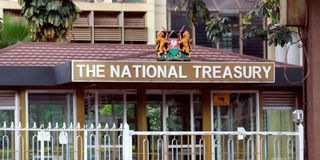
The National Treasury Building in Nairobi.
Photo credit: Pool
During the period under review, the overdraft limit stood at Sh97.05 billion.
The easing of rates reflects a broader shift in monetary policy as the CBK gradually loosens conditions after a period of aggressive tightening aimed at containing inflation and stabilising the shilling.
Last month, CBK reduced its benchmark policy rate for the tenth consecutive time, bringing it to 8.75 cent from nine per cent set in December.