The government is in the final stages of repealing the Kenya Ports Authority (KPA) Act to pave the way for the privatisation of sections of Mombasa Port and three berths at Lamu Port.
The move will dissolve the authority and reincorporate it as a Public Limited Liability Company under the Companies Act. In the final version of the public-private partnership disclosure for the Kenyan port sector seen by the Nation, KPA has begun selecting private operators for Lamu Port berths 1–3, the Lamu Special Economic Zone, Mombasa berths 11–14 and Mombasa Container Terminal 1.
The document indicates that the government expects the transition to increase cash flows from Mombasa and Lamu ports by Sh44 billion annually. According to the government, the Government-Owned Enterprises (GOE) Act, enacted in November last year, provides the legal framework for KPA to transition into a private company, aligning with the Economic Strategy Paper 2003 and the Kenya National Master Plan.
“The GOE will increase pressure on KPA to become profitable and self-sustainable. Public-private partnership (PPP) transactions are the most effective way to achieve these goals. Once becoming a GOE, the authority is expected to operate as a commercial, profit-oriented entity,” the document reads.
Read: Mombasa starts to benefit from push of port revenue sharing
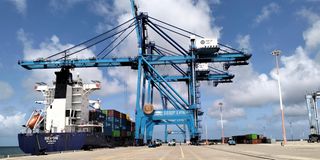
Cranes lifting cargo from MV Devon at the Lamu Port on June 5, 2025.
Photo credit: Kalume Kazungu | Nation Media Group
Under this model, cargo operations are temporarily transferred to the private sector, which pays a concession fee to KPA. No public infrastructure will be sold, and the government will retain regulatory oversight. “The landlord model is expected to provide the private party undertaking day-to-day operations with the flexibility to make timely decisions while preserving public control over the strategic assets and functions,” the document states.
Other global ports managed under this model include Los Angeles, New York, Hamburg, Rotterdam, Tanger, Santos and Singapore. In a recent interview, Roads and Transport Cabinet Secretary Davis Chirchir explained that the GOE Act, 2025, reforms state-owned entities, including KPA, into commercially driven, self-sustaining public firms under the Companies Act.
“The law replaces the State Corporations Act with a framework focused on profitability, accountability, and, in some cases, minority shareholder representation on boards,” he said.
He added that the Act reorganises 66 commercial entities to operate as businesses rather than government departments with the aim of generating dividends for the Exchequer. It also separates ownership roles between the National Treasury and relevant ministries, providing a clear, performance-based framework. “The GOE will be a big game-changer, allowing organisations like KPA to operate like the private sector. It seeks to streamline governance across state corporations by separating policy oversight from operational management, tightening accountability and accelerating decision-making,” he said.
The CS noted that KPA now has the authority to “acquire equipment to reduce congestion and enhance cargo handling at both Mombasa and Lamu ports”. By adopting a PLC structure, authorities aim to align terminal performance with growing throughput, protecting trade flows and investor confidence.
Under the PPP, the private company will rehabilitate Mombasa Port berths 11–14, which require urgent refurbishment at Sh45 billion. The operator will modernise the 1950s quay, build a multipurpose terminal and a container storage yard, and set up a truck waiting area.
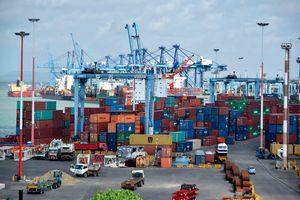
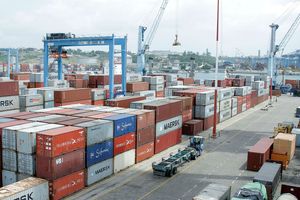
Containers with various imported goods at the port of Mombasa.
Photo credit: File | Nation Media Group
Lamu Port—currently operating at only five per cent of its capacity—is expected to see commercial growth through private sector collaboration in the Special Economic Zone, reducing the government’s financial burden. However, stakeholders have raised concerns about job security, given the lean workforce model under the PPP.
Shippers Council of Eastern Africa CEO Agayo Ogambi welcomed the move, citing rising port throughput of over 10 per cent annually and the need for capital investment and improved berth productivity.
“KPA will still manage some berths, creating a pricing balance and providing options to shippers. Importantly, the PPP must be transparent, ensuring public and national interests are safeguarded. Job security must remain a priority as the port supports millions of livelihoods and resultant job loss could be catastrophic,” Mr Ogambi said.
Maritime analyst Andrew Mwangura noted that privatising Lamu Port could increase operations from the current five per cent, but workforce transitions must comply with labour laws. “Feasibility studies show KPA’s value could increase from three to 13 per cent under various partnership scenarios. Public expenditure will reduce, and operational risks will be transferred to those best placed to manage them.”
The PPP document outlines options for employees, including secondment to government entities.
“All existing agreements between KPA and its employees are transferred to the new company. While some staff might be seconded to the new company, employees remain with KPA, but their services are leased to the private company. The secondment will be voluntary,” read the document.
Previous attempts to privatise parts of the ports faced political opposition and legal challenges. However, a 2024 consent agreement between KPA, the government and the Taireni Association of Mijikenda which challenged the privatisation, paved the way for the process.
The agreement adopted as a High Court order by a three-judge bench of the High Court requires KPA to ensure stakeholder involvement and public awareness throughout the process.