The government will borrow Sh5.9 trillion in the next three financial years to finance its expenditure projections, which would escalate the country’s public debt stock beyond the Sh12.25 trillion as of November 2025.
The borrowing plan for the 2026/27 to 2028/29 financial years is contained in the 2026 Medium-Term Debt Management Strategy (MTDS), a government document prepared by the National Treasury and presented to the National Assembly.
The government document projects the country’s debt stock escalation to about Sh15.7 trillion by June 2029 based on a borrowing mix of 82 percent domestic and 18 percent external, “anchored on fiscal consolidation and liability management.”
The projected borrowing for the three years translates to Sh2 trillion a year, Sh163.9 billion a month, Sh5.5 billion a day, Sh227.6 million an hour, Sh3.8 million a minute and Sh63,228 a second.
The National Assembly Public Debt and Privatization Committee, in a report to the House, warns that the rising public debt is increasingly tightening fiscal space through higher debt-service obligations.
In view of the anticipated reliance on commercial borrowing, the House Committee wants the National Treasury to undertake, among others, robust reporting mechanisms on the utilization of commercial loans to enhance traceability and accountability, “particularly where such proceeds are applied to general budget support.”
Cabinet Secretary for the National Treasury and Economic Planning John Mbadi.
Photo credit: Dennis Onsongo | Nation Media Group
“The National Treasury and relevant institutions sustain structural reforms aimed at raising potential growth and competitiveness, including reforms that strengthen productivity, support exports and enhance the investment climate, in line to improve long-term debt sustainability,” the Public Debt Committee says.
The committee’s report shows that over the 2026/27 - 2028/29 period, interest costs averaging Sh1.2 trillion over the medium term, are expected to average “roughly 54 percent of GDP and to consume approximately 41 percent of total revenue.”
“They are set to be the largest singular expenditure head with interest payments averaging 34 percent of recurrent expenditures and 150 percent of development expenditure over the medium term,” the report of the House committee reads.
This, the committee says, implies a growing share of resources will be absorbed by servicing debt rather than financing productivity-enhancing investments that support the GDP growth.
The Parliamentary Budget Office (PBO), in a document to parliament, expressed reservations on the projected borrowing that it says will crowd out development spending and as it creates indirect fiscal constraints specifically on county governments “through reduced equitable share headroom and contingent liability exposure.”
“While the strategy reduces exchange rate risk, it increases refinancing pressure on the domestic market and creates indirect fiscal constraints,” the PBO document, before parliament, says.
The MTDS is a critical instrument for guiding government borrowing and managing public debt in a manner consistent with the constitution and the Public Finance Management (PFM) Act.
It provides the National Treasury's proposed approach to meeting the government's annual financing needs while seeking to minimize costs and contain key risks- “particularly refinancing, interest rate and foreign exchange risks-over the medium term.”
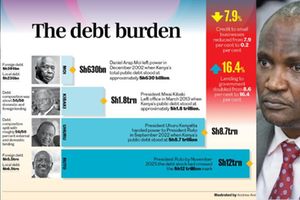
As of November 2025, the country’s debt stood at Sh12.25 trillion, which includes Sh6.78 trillion in domestic debt and Sh5.47 trillion in external debt.
Parliament. Treasury PS Chris Kiptoo appeared before the National Assembly Special Funds Accounts Committee on November 11, 2025 and had to apologise for his no show in previous invites.
Photo credit: File | Nation Media Group
With a Sh1.2 trillion deficit in the proposed Sh4.7 trillion budget for the 2026/27 financial year, the Public Debt Committee projects commercial borrowing to persist, “thereby exerting upward pressure on the overall cost of financing the fiscal deficit.”
The MPs warn that no discernible improvement has been recorded in the cost and risk profile of the public debt stock, as key indicators deteriorated between June 2024 and June 2025.
The committee’s report reveals that the percentage of debt maturing in one year increased as domestic debt risk dynamics “continue to exert upward pressure on the overall risk exposure of the portfolio.”
“An assessment of the MTDS indicates that the costs and risks of the current debt stock are elevated, largely driven by the structural characteristics of the rising domestic debt portfolio,” the committee says adding, “the fiscal deficit, being the primary driver of new debt accumulation, is expected to remain elevated.”
“As such, prudent debt management is increasingly imperative, as sustained risk exposure combined with the rising frequency and magnitude of debt servicing obligations could undermine medium-term fiscal sustainability and dampen economic recovery.”
Accordingly, the committee says, sustained fiscal consolidation, strengthened transparency, improved efficiency in resource allocation, optimal utilization of constrained fiscal space, and firm fiscal discipline should constitute central policy priorities for both national and county governments over the long term.
The MTDS for the medium term outlines a borrowing framework of a gross financing mix of 18:82 for gross external and gross domestic borrowing, respectively and a net financing composition of 22:78 for external and domestic financing, respectively.
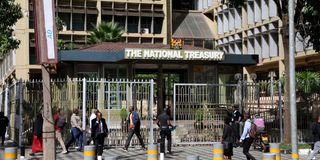
The National Treasury Building in Nairobi.
Photo credit: Pool
“This configuration confirms that the domestic market will remain the primary source of deficit financing during the period. Broadly, the strategy aims to lower the overall cost of the debt portfolio and mitigate refinancing risks by rebalancing issuance toward medium- and long-term Treasury Bonds,” says the Public Debt Committee.
With the government to focus on the local market, PBO says that “the domestic debt portfolio remains more exposed to the highest refinancing and interest rate risks, despite efforts to lengthen maturities by shifting issuance from short-term instruments to medium- and long-term tenors.”
This is, according to the committee, is evidenced by several factors.
They include a shorter average time to maturity for domestic debt, about 6.4 years, compared to external debt, which is 10 years.
There is also a higher proportion of domestic debt maturing within one year, about 20.5 percent relative to external debt of 6.9 percent and a higher weighted average interest rate on domestic debt 13 percent compared to the external debt portfolio of 4 percent.
This as PBO warns that the public debt stock continues to expand, increasing the macroeconomic adjustment required to keep debt on a sustainable path.
As the debt ratio is expected to average about 67 percent of GDP in nominal terms and approximately 62 percent in present value (PV) terms, the House committee notes that the statutory PFM benchmark of 55 percent by October 2028 “may not be achieved, implying continued breach of the threshold.”
“In this context, the fiscal path underpinning the 2026 MTDS does not adequately align with the debt-limit requirement set out under the PFM Act.