Hello

Your subscription is almost coming to an end. Don’t miss out on the great content on Nation.Africa

Ready to continue your informative journey with us?

Hello

Your premium access has ended, but the best of Nation.Africa is still within reach. Renew now to unlock exclusive stories and in-depth features.

Reclaim your full access. Click below to renew.

Caption for the landscape image:

Counties boost development spending but absorption low

Scroll down to read the article

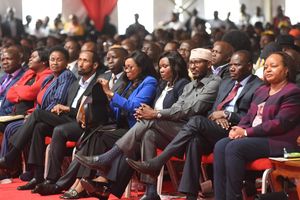
President William Ruto, Governor Gladys Wanga, (left) Council of Governors Chair Ahmed Abdullahi (left), Vice Chair Mutahi Kahiga (2nd right), Senate Speaker Amason Kingi (2nd left), Governor Joshua Sang (extreme left) and PS Devolution Michael Lenasalon (extreme right) unveil the Council of Governors (COG) Devolution Institute Manual during the opening of the Devolution Conference, 2025 at Homabay National School, Homabay County


Photo credit: Photo | PCS

The development absorption rate among counties hit 30.8 per cent in the first nine months of FY 2025/26, up from 25.6 per cent in the corresponding period, signalling a focus on economic growth.

National Treasury data shows counties used Sh72 billion of the Sh234.3 billion approved for development between July 2025 and March 2026.

“This indicates that nearly one-third of budgeted development expenditure had been utilised by the end of the review period,” the Treasury said.

“While the improvement reflects enhanced implementation of development programmes and projects, the overall absorption rate remains relatively low, suggesting the need to accelerate project execution during the remaining quarter of the financial year.”

Nandi, Meru and Wajir recorded the highest development absorption rates at 55.3, 54.5 and 53.5 per cent, respectively. Marsabit had an absorption rate of 51 per cent.

Meanwhile, Siaya, Lamu and Kajiado had the lowest absorption rates at 13.1, 11.2 and nine per cent, respectively.

Low development spending contrasts with stronger recurrent absorption, which stood at 65.1 per cent during the first nine months. Counties took up Sh331.6 billion of approved recurrent budget, representing 65.1 per cent.

Council of Governors

The Council of Governors, led by chairperson Anne Waiguru (Kirinyaga Governor) (centre) at a past media briefing in Nairobi.

Photo credit: File | Nation Media Group

Nairobi (85.8 per cent), Meru (77.2 per cent) and Machakos (75.4 per cent) recorded the highest recurrent absorption rates, while Kericho, Uasin Gishu and Embu had the lowest rates at 53.8, 53.7 and 52.3 per cent, respectively.

Capital investments

Counties use recurrent expenditure for day-to-day operations and salaries, while development expenditure covers capital investments and infrastructure such as roads, hospitals and water systems.

“While sustained funding of recurrent expenditure is essential for government operations, counties should continue to balance recurrent spending with investment in development programmes to support long-term socio-economic growth,” said the Treasury.

The law mandates a minimum 30 per cent allocation for development. Controller of Budget Margaret Nyakang’o last week flagged counties for spending nearly two-thirds of budgets on salaries, allowances and operations between July 2025 and March 2026, while development projects remained stalled.

During this period, salaries and wages accounted for Sh171.36 billion.

“County governments should prioritise stalled projects that can be completed and operationalised in subsequent budget cycles, allocate adequate resources for completion and resolve outstanding contractual issues in accordance with the law,” Ms Nyakang’o said.

Baringo, Kajiado, Lamu, Siaya, Uasin Gishu, Tana River, Nakuru, Migori and Mombasa were flagged for spending less than 20 per cent of their annual budgets on development.

Nationally, 237 stalled projects valued at Sh13.66 billion were reported in 22 counties. Some Sh5.11 billion had already been paid.

Overall, counties spent Sh331.65 billion in the first nine months of the financial year against actual revenue of Sh387.35 billion, resulting in an overall budget absorption rate of 52 per cent. This was an improvement from 47.7 per cent in the same period of the previous financial year.

Nairobi (72 per cent), Meru (68.4 per cent) and Marsabit (66.3 per cent) recorded high overall budget absorption, while Uasin Gishu (36.5 per cent), Lamu (38.4 per cent) and Tana River (39.2 per cent) had the lowest absorption rates.

Treasury attributed weak budget execution to delays in procurement and project implementation, late disbursement of funds, administrative inefficiencies and institutional capacity constraints.

Follow ourWhatsApp channel for breaking news updates and more stories like this.