When Stean Fasol first arrived in East Africa as an intern at a coffee company more than a decade ago, he expected to spend his days learning about coffee cultivation, processing and trade.
Instead, he found himself questioning why some of the world's finest coffee rarely reached premium shelves abroad, and why the farmers who painstakingly grew it remained largely invisible in the global value chain.
Travelling through coffee-growing communities in Kenya, Rwanda and Tanzania, Fasol met hundreds of smallholder farmers who dedicated months nurturing coffee trees on modest family farms. Their cherries were carefully handpicked, sorted and processed to meet the demanding standards of specialty coffee buyers, yet despite producing beans that consistently scored highly in quality, many of these farmers earned only a fraction of the value their coffee eventually commanded in cafés thousands of kilometres away.
The experience planted a question that would eventually grow into a business. Years later, while pursuing further studies in Amsterdam, the Netherlands, Fasol noticed another contradiction. Coffee shops proudly advertised beans from Brazil, Colombia and Peru, with baristas enthusiastically explaining their flavour notes and origins. East African coffee, however, was surprisingly difficult to find.
“You would walk into a coffee bar, and they would always have Brazilian, Colombian or Peruvian coffee, but they didn't have Kenyan, Rwandan or Tanzanian coffee,” Fasol tells Powering SME.
Stean's Beans, a specialty coffee brand that connects smallholder farmers in East Africa to premium markets in Europe and North America.
Photo credit: Pool
Whenever Kenyan coffee did appear on café menus, it was often positioned as an exclusive luxury product rather than a high-quality coffee that consumers could enjoy every day. To Fasol, this disconnect made little sense. East Africa was producing exceptional coffee recognised by international cuppers for its fruity acidity, floral aromas and complex flavour profiles, yet the farmers behind those beans were struggling to access premium international markets consistently. He believed the problem was not quality. It was accessibility.
“I realised there was a huge opportunity to build a business that connects farmers directly with consumers while ensuring the people growing the coffee also benefit,” he says.
That vision gave birth to Stean's Beans, a specialty coffee company he established in Amsterdam in 2016 with a mission of shortening the distance between East African coffee farmers and international coffee drinkers. Nearly a decade later, the company supplies specialty coffee to cafés, hotels and restaurants across Europe and North America while working directly with producer groups in Kenya and Rwanda.
More recently, it has expanded its operations back into East Africa, bringing roasting expertise closer to where the coffee is grown. Unlike conventional commodity trading businesses that largely compete on price, Stean's Beans has built its business around transparency and long-term relationships. According to Fasol, one of the biggest weaknesses in the traditional coffee supply chain is that farmers are often invisible.
“The specialty coffee industry still suffers from systemic transparency issues. Many roasteries say they work directly with farmers, but when you ask them who the farmer is, they don't actually know. There are usually about five different links in the chain before the coffee reaches them,” he explains.
Each intermediary takes a share of the value, leaving farmers with a relatively small return despite carrying much of the production risk. For smallholder farmers, this creates uncertainty that extends far beyond one harvest.
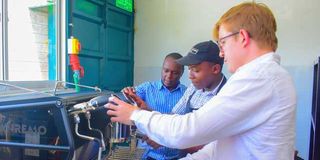
Stean Fasol (left) founder of Stean's Beans, a specialty coffee brand that connects smallholder farmers in East Africa to premium markets in Europe and North America and a colleague.
Photo credit: Pool
Coffee trees require years of care before becoming productive, while fertiliser, labour and processing costs continue rising. Yet incomes fluctuate with international commodity markets over which individual farmers have virtually no control. Recent years have demonstrated just how unpredictable those markets can be. Global coffee prices surged to record highs after adverse weather affected harvests in major producing countries such as Brazil. The following season, improved production forecasts triggered falling prices, exposing farmers once again to sharp swings in income.
For farmers depending on coffee as their primary source of livelihood, such volatility can make long-term planning almost impossible.
Instead of paying farmers solely according to daily commodity prices, the company agrees on competitive prices that remain stable throughout the year.
The approach gives farmers greater confidence to invest in pruning, fertiliser, improved seedlings and better post-harvest handling, knowing what they will earn.
“We want farmers to have income stability. If they know what they will receive, they can plan for the future instead of constantly worrying about market fluctuations,” says Fasol.
The company has also invested in technology to improve transparency. Through its digital platform known as Lipia, payments are made through a cashless system that records transactions while guaranteeing agreed prices.
Beyond simplifying payments, the platform promotes sustainable farming practices and aims to help farmers earn what Fasol describes as a living wage. While technology forms an important part of the company's operations, Fasol insists the real differentiator remains the human relationships built throughout the supply chain.
Every bag of coffee carries with it a story, not simply of geography, but of families, communities and livelihoods.
“We want customers to know where their coffee comes from and who grew it,” he says.
That philosophy also influences how the company markets its coffee. Rather than presenting East African beans as rare luxury products reserved for connoisseurs, Stean's Beans wants specialty coffee to become part of consumers' everyday routines. To achieve that goal, the company launched a second brand known as Kawaida Coffee, which targets entry-level coffee drinkers looking for affordable specialty coffee. The strategy allows the business to serve different customer segments while purchasing larger volumes from East African farmers.
As demand grows across both brands, so too does the company's capacity to source coffee from additional producer groups.
For Fasol, however, exporting coffee from Africa was only part of the mission. He also wanted consumers within coffee-producing countries to enjoy consistently roasted, world-class coffee.
After building a strong customer base in Europe, where the company now roasts between 12 and 14 tonnes of green coffee, he turned his attention back to Kenya.
In 2024, Stean's Beans partnered with artisanal bakery BBROOD Kenya to establish a roasting operation along Magadi Road in Nairobi.
Instead of constructing an entirely new facility, the partnership enabled the company to leverage BBROOD's existing infrastructure while introducing professional roasting standards and equipment.
“The reason I started a branch in Kenya is that I saw a big issue with the consistency of roasting. We already have excellent coffee. What we need are the right tools and processes to make sure every cup tastes exactly as it should.”
Consistency, he says, is what transforms good coffee into a trusted brand. To achieve that standard, the company has invested in high-end coffee equipment including Sanremo espresso machines, Fiorenzato grinders and Puqpress automatic tampers. Equally important has been investment in people.
Every member of the coffee preparation team undergoes professional barista training designed to ensure brewing methods remain consistent regardless of location.
Whether a customer orders a cappuccino in Amsterdam or Nairobi, the company wants the experience to be identical. Its business-to-business clients also receive equipment installation, technical support and barista training, allowing hotels, cafés and restaurants to maintain quality standards long after the machines are delivered. Despite growing demand, operating an international coffee business from East Africa presents significant logistical challenges.
Shipping remains among the biggest obstacles. Coffee destined for Europe can spend months waiting for container availability before finally leaving port.
“Sometimes we wait up to four months before our coffee reaches Europe,” Fasol says.
Those delays affect inventory planning, cash flow and customer deliveries, requiring careful coordination across multiple markets. Even so, the company has continued to expand its client portfolio. Today, Stean's Beans supplies coffee to cafés across Europe while serving hospitality clients that include Marriott properties in the Netherlands and Kenya's Giraffe Manor.
Each new partnership creates additional demand for coffee sourced from East African farmers, reinforcing the company's original objective of creating stronger market access for producers. Looking ahead, Fasol plans to deepen sourcing relationships not only in Kenya and Rwanda but also in Tanzania and the Democratic Republic of Congo.
He also hopes to establish additional roasting hubs across Europe, North America and Asia as consumer demand for specialty coffee continues to grow.
In terms of expansion, rather than pursuing rapid growth at the expense of quality, the company wants to preserve the close relationships it has built with farmers over the years.
“We want our growth to be organic. We want every customer to enjoy their coffee while knowing the face, the name or the story of the farmer who grew it,” he notes.