One evening after work, Mary Maritim opened her freezer and discovered a forgotten packet of cooked beans.
The find solved her dinner dilemma and sparked a larger thought: if ready-to-use beans could ease the pressure off a busy evening, how many other families faced the same challenge of juggling work, children, and preparing healthy meals?
That moment marked the first stirrings of what would become Cherubet Foods, the company she founded in 2007 to produce pre-cooked, frozen grains and legumes for consumers across the country.
Drawing from her experience as a full-time professional and mother, she speaks candidly about the pressures that shaped her approach.
“Balancing a career and family left little room for long cooking sessions. Finding something nutritious without compromising time became essential,” she explains. The convenience food market has expanded alongside urbanisation, with supermarkets dedicating more shelf space to quick meal options for working families.
Workers process pre-cooked grain products in the processing room at Cherubet Company Limited in Nairobi on March 21, 2026. The company is a leading pre-cooked grain food processor in Kenya, promoting value addition and food security through processed food products.
Photo credit: Bonface Bogita | Nation
Beyond standard microwaveable meals, the category now includes a wider range of pre-cooked foods suited to modern lifestyles.
The company relies on naturally sourced ingredients and hygienic processing, free of additives or preservatives, to simplify meal preparation.
Cherubet Foods sources grains and legumes from carefully selected farms employing agricultural practices designed to maintain quality from planting to harvest. The grains are thoroughly tested before processing and then boiled in treated water until soft, achieving a texture similar to home-cooked meals.
“The process follows strict hygiene standards, ensuring that every package leaving the facility meets safety requirements,” Maritim notes. Once cooked, the grains are packed and frozen for distribution to retail outlets nationwide. A distinctive feature of the products is the absence of additives, a deliberate choice that allows consumers to retain control over flavour and seasoning while minimising potential health risks associated with artificial ingredients.
“We want people to experience food that feels familiar, safe and adaptable. We are responding to a growing interest in healthier eating and the need for convenient options that support balanced diets,” she adds. The company’s products include githeri, beans, njahi, muthokoi, peas, mbaazi, and ready-to-drink fermented uji, ranging from Sh120 to Sh280.
They recently launched Cherubet Githeri-on-the-Go, a ready-to-eat meal made from bio-fortified beans and maize. Developed using retort processing technology, it can be stored safely at room temperature and comes in 400g servings priced at Sh70.
The business employs 48 staff who manage operations across farms, processing facilities, and retail distribution. It also collaborates with more than 1,200 farmers and cooperatives, providing guidance on fair pricing, modern farming techniques, and sustainable practices.
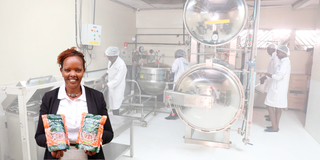
Cherubet Company Limited CEO Mary Maritim displays pre-cooked, packed githeri for sale at the company’s processing facility in Nairobi on March 21, 2026. The company is a leading processor of pre-cooked grain foods in Kenya, promoting convenient and nutritious food solutions.
Photo credit: Bonface Bogita | Nation
The company is a beneficiary of a collaboration between the Pan-Africa Bean Research Alliance and the Kenya Agricultural and Livestock Research Organisation. Through this programme, they buy beans from participating producers, including women’s groups across several counties.
The arrangement supports a consistent supply of produce for processing while providing income opportunities for local communities. Strategic alliances, including work with CIAT, a research organisation specialising in agricultural development, further support these networks by improving inputs and creating livelihood opportunities for communities involved in production.
“These collaborations are intended to ensure quality and sustainability while benefiting those participating in the agricultural process,” she adds, a principle reflected across operations.
Operational challenges persist, even though the products are stocked in more than 150 retail outlets countrywide. “Managing growth while keeping operations efficient is a constant challenge,” she admits.
“We are constantly reviewing systems to ensure quality and reliability without inflating costs.” These constraints have prompted the company to refine production systems and optimise capacity use through improved scheduling, closer monitoring of cold-chain logistics, and more efficient utilisation of processing equipment.
Consumer expectations, she adds, also influence product development, with feedback on portion sizes, packaging, and variety informing decisions to ensure offerings remain practical, reliable, and adaptable.
Analysis of consumer behaviour has revealed that convenience, portion size, and clear labelling are key drivers of purchase decisions. Despite a growing market, the enterprise contends with stiff competition from imported packaged foods and informal vendors, whose lower prices and widespread availability appeal to cost-conscious consumers.
The country’s varied geography presents significant logistical challenges for distribution. “Maintaining an uninterrupted cold-chain supply to remote retail outlets requires meticulous planning, additional resources, and constant monitoring, introducing additional complexity and cost to operations,” she explains.
Education and outreach complement this approach. Farmers receive guidance on safe handling and quality standards, while consumers are provided with practical information on storage, cooking, and seasoning.
Moreover, grains and legumes, staples of the Kenyan diet, provide protein, fibre, and essential micronutrients, retaining both nutritional value and authentic flavour.
This allows households to enjoy culturally familiar meals even amid time pressures. “Building on these foundations, we plan to increase production efficiency, explore new product lines, and expand into regional markets, applying lessons learned in urban centres to reach consumers across East Africa,” she concludes.