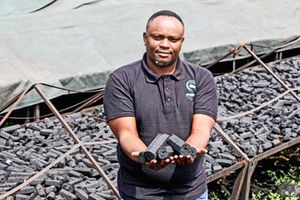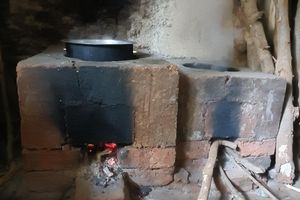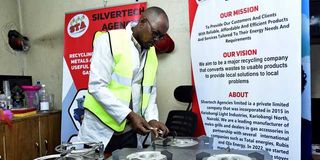
Silver Tech Agencies Limited Founder and CEO Kimathi Murugu demonstrates how the Bio Ethanol Cook Stove works on October 23, 2025.

Most people walk past scrap metal and discarded plastic without a second thought. For Kimathi Murugu, this everyday trash sparked the creation of a business that now supports dozens of workers and provides affordable energy solutions to communities across Kenya.
Kimathi is the founder of Silvertech Agencies Limited, a recycling and clean energy enterprise built on the fact that waste materials can be transformed into functional products for homes and businesses, creating value while tackling some of Kenya’s biggest environmental and energy challenges.
The business was formally established in 2005 as a sole proprietorship and incorporated in 2015. Kimathi started his business with an initial capital of Sh15,000, carefully saved from various casual labour jobs. He then invested the money in designing and creating moulds, a crucial step that laid the foundation for his business.
Today, his is one of the few Kenyan small enterprises combining scrap metal, waste cooking edible oil and plastic waste to manufacture clean cook stoves, house ventilators and LPG grill plates.
“These products are designed for households that have long been underserved by traditional energy providers. I take what is already available and turn it into something useful,” he explains.
In Kenya, over 70 per cent of households still rely on solid fuels such as firewood and charcoal for cooking. According to the Ministry of Energy, indoor air pollution from these fuels contributes to thousands of deaths annually, especially among women and children.
At the same time, the country produces more than 22,000 tons of waste every day. A significant portion of that is plastic and metal that ends up in dumpsites, water bodies and along roadsides.
Kimathi recognised these two problems as connected. Waste could be part of the solution to energy poverty if handled with care and innovation.
“We began by collecting scrap metal to produce accessories for 6kg gas cylinders. These include grill stands, chip cutters and ethanol cook-stoves, often too costly for many in low-income communities when bought new,” he notes.

Silver Tech Agencies Limited Founder and CEO Kimathi Murugu demonstrates how the Bio Ethanol Cook Stove works on October 23, 2025.
He prices his products based on factors such as design, size, and weight. Grill plates range from Sh150 to Sh300, depending on their weight. Ethanol cook stoves are priced between Sh1,000 and Sh3,000, while chip cutters are sold for Sh3,000 apiece.
The business expanded into other forms of recycling. Discarded plastic is now used to produce house ventilators designed to improve airflow and reduce heat in small homes.
The production of a ventilator from discarded plastic begins with collecting and sorting plastic waste to ensure only suitable materials are used. The selected plastics are then shredded into small pieces and thoroughly washed to remove dirt or impurities.
Next, the clean plastic pieces are melted at a high temperature to form a uniform molten material. Finally, the molten material plastic is extruded into a mould cavity, where it is shaped and cooled to create the required ventilator parts. The ventilators are especially useful in informal settlements where poor ventilation contributes to respiratory illnesses.
Used cooking edible oil collected from local eateries is filtered and used as fuel in specially designed clean cook stoves.
“These stoves, made from recycled metal, are cheaper and cleaner than many traditional models and provide a sustainable way to reuse oil that would otherwise clog drains or contaminate soil,” he explains.
As the enterprise grew, so did its challenges. There were equipment limitations, gaps in product testing, and difficulty in accessing new markets. That is when the Kenya Climate Innovation Centre stepped in.
“Through its incubation program, KCIC provided technical training, helped the business formalise its operations, and offered essential financial support. This allowed us to invest in new tools and expand our product line,” he says.
But beyond funding, KCIC’s contribution was strategic. They supported the business in redesigning its products to meet safety and efficiency standards and guided them in engaging with public health and energy regulators.
Through KCIC, the business was introduced to policy makers, investor networks and development agencies. These partnerships helped the company gain visibility and credibility while navigating the public perception challenges that often face businesses working with recycled materials.
“We had the ideas and the energy, but KCIC helped us refine how we work and how we grow. Their mentorship helped us avoid mistakes and focus on what actually delivers value,” he states.
The enterprise currently employs 20 people, mostly youth from the surrounding communities, and can hire up to 50 casual labourers when demand requires it.
Kimathi has created a training program within his workshop to teach metal casting, fabrication, plastics processing and safe stove assembly. Many of the workers were previously unemployed or engaged in informal labour.
The team also works with local groups to collect waste, particularly used cooking edible oil and plastics. This creates additional income streams for community members and helps build local ownership of the business model.
Each of the products made in Kimathi’s workshop is designed with practicality in mind.
“The clean cook stoves are portable and easy to use. They are fitted with adjustable combustion chambers that allow them to use filtered cooking edible oil or other clean fuels such as biodiesel,” he says, adding that this flexibility is important in communities where energy supply can be inconsistent or unaffordable.
The plastic ventilators are low-cost and require no electricity. They can be fitted into walls or rooftops to improve air circulation in small homes or kiosks. Builders have begun adopting them in low-income housing units, especially where heat and poor ventilation pose daily health risks.
The gas accessories are particularly popular among small vendors and households using 6 kg gas cylinders. His products offer a safer and more affordable alternative to the expensive imported parts often found in shops.
“We follow a circular economy model where nothing goes to waste. Metal off-cuts become new products, plastic helps cool homes, and used cooking oil fuels affordable stoves,” he explains.
The model also supports financial sustainability. Using materials that are widely available and often free, the company keeps production costs low and passes those savings on to customers.
“People ask how we keep prices down. It is because we are using what is already around us. We do not need to import parts or buy expensive raw materials,” explains Kimathi.
The next phase for the business is expansion. Kimathi hopes to grow his team and invest in more advanced equipment for plastic processing and oil filtration/purification.
He is currently working with KCIC to strengthen digital marketing and explore bulk supply of clean cook stoves to schools and small restaurants.
Plans are also underway to establish waste collection centres in nearby towns, ensuring a consistent flow of materials while involving more community members in the value chain.
Partnerships remain essential.
“We are exploring collaborations with housing cooperatives, clean energy distributors, and youth organisations to scale production and reach new markets,” he says.
Follow our WhatsApp channel for breaking news updates and more stories like this.