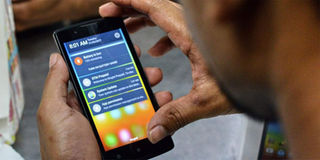
Premature depletion of mobile data bundles and disputed charges were the biggest sources of consumer complaints against telcos in the three months to September, overtaking digital financial services and mobile money disputes.
Data services accounted for 140 of the 479 complaints escalated to the Communications Authority of Kenya (CA) between July and September, representing 29.2 per cent of the total, according to fresh data from the regulator.
Billing and charging of data services attracted 44 complaints, equivalent to 31.4 per cent of all data-related complaints the watchdog received in the quarter.
“Complaints in this category primarily relate to the premature depletion or disconnection of data services before the expiry of their stated validity period, resulting in consumers losing the value of the service for which they have paid,” it added.
The Communications Authority of Kenya.
Photo credit: File | Nation Media Group
“Following investigation and engagement with the respective service providers, the complaints were resolved through various remedial measures, including compensation through credit adjustments, credit notes, refunds for undelivered services, and restoration or reconnection of services following payment,” the regulator said.
CA said it resolved 37 of the 44 billing and charging complaints.
Safaricom and Airtel control the bulk of the country’s mobile broadband market. As of June, Safaricom held 64.4 per cent of mobile broadband subscriptions, compared with Airtel’s 31.9 per cent. Safaricom also commanded 69.8 per cent of the overall mobile subscription market, while Airtel had 26.8 per cent. State-owned Telkom had a paltry 0.6 per cent market share in both mobile and broadband segments.
The rising grievances over data highlight growing consumer concerns over the value and reliability of mobile services in a market the World Bank has previously warned has high data prices compared to regional peers such as Ghana, Nigeria, Rwanda and Zambia.
A comparison of the three firms’ mobile data costs shows that Safaricom and Airtel charge Sh1,000 for 25 Gigabytes (GB) of data valid for 30 days. Telkom charges the same amount for a 15GB bundle. For daily bundles, Sh100 on Safaricom buys a 1.8GB bundle, compared to 2.4GB on Airtel. Telkom offers a 2GB daily bundle for Sh100.
Digital financial services and mobile money, which have previously dominated consumer complaints, accounted for 57 cases in the three months to September, representing 11.9 per cent of the total.
Read: 5G users cross 2 million as demand for faster data accelerates