Most successful community-based organisations (CBO’s) begin with careful planning, funding proposals, and strategic partnerships.
The Fresh Organic Produce Association (FOPA), however, a young CBO based in Nairobi's Mathare area, began with a young man trying to get a travel letter during the Covid-19 pandemic lockdown.
Stephen Musyoka never imagined that his repeated visits to a chief's office in Mathare—one of Nairobi's largest informal settlements—would lead to building an organisation that now employs 13 people, trains hundreds of urban farmers, and feeds his community.
"I was just trying to move my tree seedlings to my rural home," Stephen recalls. "I had no plan to start an organisation. I just kept showing up, kept asking, kept working. Somehow, persistence turned into something much bigger than I ever dreamed," he says
Today, FOPA is Stephen's full-time job and the livelihood of 12 others. It is a thriving enterprise built not on grants or loans, but on waste materials, zero-budget farming techniques, and the simple power of refusing to give up.
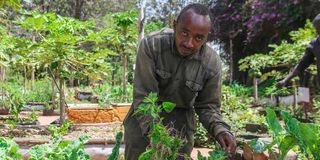
Lemongrass at Fresh Organic Produce Association farm in Kariobangi North on January 8, 2026.
Photo credit: Billy Ogada | Nation Media Group
In his teenage years and early twenties, the 29-year-old planted tree seedlings wherever he could find space—roadsides, abandoned plots, borrowed land. Without a permanent base, his efforts remained scattered. He would plant seedlings in one location, only to have them destroyed or stolen.
"I had no land of my own, so I just kept planting wherever people would let me," Stephen recalls. "I didn't know it then, but that persistence was teaching me everything I needed to know."
When the Covid-19 pandemic hit in 2020, and lockdowns were imposed across the country, Stephen found himself in Nairobi with tree seedlings he desperately needed to transport to his rural home. Movement was restricted. To travel, he needed an official letter from the chief's office.
"I had to go back and forth, explaining my situation, waiting for approvals, and dealing with the bureaucracy. My persistence in going to and from the chief's office is what eventually got me the land where we’re based."
One day, he gathered the courage to ask whether he could plant his seedlings in an idle piece of land nearby. To his surprise, the answer was yes.
Fresh Organic Produce Association farm in Kariobangi North pictured on January 8, 2026.
Photo credit: Billy Ogada | Nation Media Group
At first, Stephen used the plot solely for planting trees. Through 2020 and into 2021, he focused on trees, slowly transforming the empty space into a green area. But something was nagging at him.
The compound sat in an area where hundreds of families lived in densely packed housing with little to no access to fresh food. Every day, he watched neighbours struggle to afford vegetables at the local markets.
"People in Mathare were spending so much money on vegetables that weren't even fresh by the time they reached the markets. Meanwhile, I had this space doing nothing but growing trees. Why not grow food here? Why not turn this into something that could feed the community? And why not teach others to do the same?”
In 2024, while training with Upcoming African Youth Organization (UAYO), a development organisation focused on agricultural skills, Stephen received vegetable seedlings for free as part of the demonstration program.
When the training ended, instead of leaving, he and a small group of committed trainees stayed. They decided to formalise their work and create something permanent. This is when FOPA took shape.
"It wasn't just about me anymore. It was about creating an organisation that could train people, employ people, and feed people."
The CBO was registered with a clear mission: to prove that urban farming could work in informal settlements, that zero-budget methods could generate real income, and that communities could feed themselves if given knowledge and support.
The CBO operates as a complete agricultural enterprise. There are field workers who tend the crops, trainers who teach new cohorts of urban farmers, administrators who coordinate programs, and sales staff who manage the steady flow of customers from the community.
"We don't just show people how to plant," says Stephen. "We teach them the zero-budget philosophy, how to source waste materials, how to build composting systems, how to sell their produce, how to make this a real livelihood."
And the numbers prove the model works: 50 people are lined up to graduate next month after successfully finishing training. Each graduate becomes a potential hub for food production in their own community, extending the reach of urban agriculture far beyond the original plot.
The zero-budget method skips expensive inputs and instead uses waste materials to support plant growth—turning rubbish into resources, and transforming abandoned spaces into productive land. The demonstration, which lies in a 50 by 100 space, uses raised beds made from old car tyres, planters fashioned from discarded containers, and composting stations built from scrap materials.
Bananas at Fresh Organic Produce Association farm in Kariobangi North on January 8, 2026.
Photo credit: Billy Ogada | Nation Media Group
From these materials, he has put up about 16 modern technology gardening types, including multistory, keyhole, micro gardens, and hanging gardens. He has over 10 different types of vegetables, such as onions, lettuce, pepper, radish and a variety of herbs.
"We created waste beds, mixing food waste, cone stalks, and green matter to make compost," Stephen explains. "This turned rubbish into fertile soil. In Mathare, organic waste is everywhere. We collect it, we compost it, we grow with it."
This waste that would otherwise clog drainage channels or be burned in the streets—vegetable peelings, crop residue and grass clippings, is transformed through natural decomposition into nutrient-rich growing medium.
FOPA is now exploring social enterprise models, seeking partnerships with markets and restaurants, and documenting their methods for other organisations to replicate.
"I want to train 1,000 urban farmers through FOPA in the next three years," Stephen says.