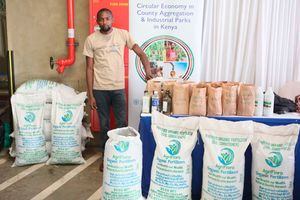
In Africa, the story of the soil is intertwined with the story of its people. For agripreneur Odigo Jason, each handful of waste turned into fertiliser represents a small but powerful act of restoring not just the land, but livelihoods and dignity as well.
Founded in 2020, Harvester Road Organics is a Kenyan agribusiness addressing some of Africa's most pressing agricultural challenges. Initially focused on providing smallholder farmers in Nakuru County with reliable market access and fair prices, the company has since rooted itself in sustainable agriculture.
"Food security, waste management, and soil health are at the heart of what we do. Our vision is to create a regenerative agricultural model that extends far beyond Kenya, "he says.
Odigo says that what started as an effort to improve market linkages for farmers is now a business model focused on regenerating agricultural waste across Africa.
Faced with rising environmental and economic pressures, the company recognised the need for a more integrated approach, one that connects waste management, soil restoration, and farmer empowerment in a regenerative loop benefiting both the land and the people who depend on it. Initially, he focused on aggregating fresh produce, linking smallholder farmers with urban markets, however, like many businesses around the world, the Covid-19 pandemic forced a dramatic shift in operations. Transport restrictions led to post-harvest losses, threatening farmers’ livelihoods.
“Covid forced us to rethink our model. We saw good food rotting on farms and realised that waste itself could become the foundation for regeneration,” he says.
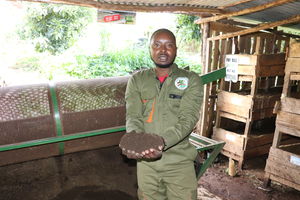
In partnership with InsectiPro Kenya Limited, the company shifted its focus to organic waste collection and bioconversion. They established operations in Solai, Nakuru, where they began rearing Black Soldier Flies (BSF). This partnership involves collecting organic market waste and post-harvest agricultural waste for bioconversion and BSF breeding. The flies consume the organic waste, transforming it into high-protein insect meal and organic frass fertiliser. The fertiliser, branded as Fertigro, is then packaged and distributed to their network of smallholder farmers.
Odigo Jason explains the liquid fish hydrolysate processing steps during an interview with the Nation at the Kenya Industrial Research and Development Institute (KIRDI) Complex in Kibos, Kisumu, on October 24, 2025.
Photo credit: Alex Odhiambo | Nation Media Group
His unique background in agriculture blends hands-on farming experience with global agricultural insights.
A Maseno School alumnus and USDA Cochran Fellow, Odigo reflects the importance of sustainable practices in African agriculture. His fellowship reinforced the belief that sustainability is not just a Western ideal, but a necessity for African farms to thrive.
“Agriculture has always been personal to me. The fellowship taught me that sustainability is a way of life for Africa, not just a buzzword,” he says.
With this in mind, his company champions circularity, ensuring every process and product contributes to a self-sustaining ecosystem. Focusing on organic waste and transforming it into value-added products, the company supports farmers while restoring soil fertility. Waste becomes fertility, fertility becomes food, and food becomes livelihood, completing the cycle.
Food waste from farms is transformed into insect feed. The insects, in turn, produce protein-rich meal for livestock and frass, a nutrient-rich by-product that becomes organic fertiliser for crops. The crops nourish communities, and their residues feed the cycle again.
“Beyond waste conversion, we are pioneering a farmer-led agricultural transformation. Through the Farmer-Led Seed Enterprise (FLSE) initiative, we recruit and train smallholder farmers, particularly women and youth, to produce certified soybean and sunflower seeds,” he says.
This initiative, supported by GIZ (the German Corporation for International Cooperation), enables local farmers to multiply seeds under inclusive contract farming models, thereby improving access to high-quality inputs and generating new income streams. The seed enterprise is a crucial step toward achieving agricultural self-sufficiency.
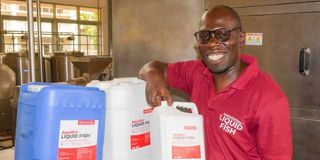
Odigo Jason at the Kenya Industrial Research and Development Institute Complex in Kibos, Kisumu, on October 24, 2025, where they process fish waste into AquaGro Liquid Fish, an organic biofertiliser that promotes sustainable farming.
Photo credit: Alex Odhiambo | Nation Media Group
The company’s registration with KEPHIS (Kenya Plant Health Inspectorate Service) as a Seed Trade Merchant and its licence agreements with KALRO (Kenya Agricultural and Livestock Research Organisation) ensure that its seed production is compliant, research-driven, and nationally recognised.
Odigo has expanded westward, advancing their circular economy approach by developing fish hydrolysate—branded AquGro Liquid Fish—a biofertiliser and biostimulant made entirely from recycled fish waste.
Supported by the Kenya Climate Innovation Centre (KCIC), this initiative exemplifies circularity by turning fish by-products that would otherwise pollute Lake Victoria into high-value agricultural inputs.
Operating at the KIRDI incubation facility in Kibos, Kisumu, the company is putting this vision into practice, creating sustainable solutions that benefit both farmers and the environment. This process starts with collecting fish waste — heads, bones, and trimmings — from fish processors around Lake Victoria. The waste is then minced and mixed with organic acids for controlled fermentation. The fermentation process breaks down proteins and oils into smaller, bioavailable compounds, such as amino acids and micronutrients, while preserving vital nitrogen and phosphorus.
After fermentation, the liquid is filtered, stabilised, and fortified with probiotics and trace minerals to enhance soil microbiome activity. The result is a nutrient-dense liquid biofertiliser that improves soil structure, promotes root development, and enhances nutrient uptake.
“We are producing a premium product that matches international standards. Our fish hydrolysate targets high-value horticulture and floriculture markets, sectors that currently rely on imported biostimulants,” he explains.
This locally produced biofertiliser replaces imports and keeps economic value within the community, creating a sustainable circular system between fisheries, farmers, and food systems.
The business is forging strategic partnerships to broaden its reach and deepen its impact across Africa. A notable collaboration is with the Soybean Innovation Lab (SIL) through the Pan-African Soybean Trials (PAT) program.
These efforts align with Kenya’s National Climate Change Action Plan (NCCAP 2023–2027) and the Africa Food Systems Transformation (AFS) agenda, supported by AGRA.
“Our model provides both environmental and economic benefits. Every litre of fish hydrolysate we produce keeps waste out of landfills and helps restore life to the soil,” he says.
Currently, the company engages 400 farmers, with a target to reach 1,000 across the Western and Rift Valley regions in 2026. It diverts 250 metric tons of waste annually, saving approximately 1,200 tons of CO₂ equivalent each year.
“Across Africa, degraded soils threaten food production and livelihoods, however, our innovative, circular approach to agriculture offers hope for regenerative prosperity. The path to food security begins with soil security, and soil security begins with closing the loop,” he concludes.