Across much of the country, used glass bottles pile up like forgotten relics — discarded and ignored. But in a small workshop tucked away in the backstreets of Dagoretti, Nairobi, the clatter of glass being cut and polished sounds like a battle cry against waste.
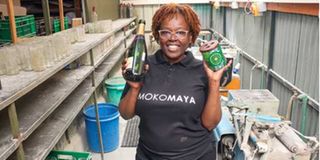
Here, each discarded bottle is pulled from oblivion and forged anew into upcycled, functional creations — sleek, purposeful, and sustainable. MokoMaya, a social enterprise founded by former UI/UX Design teacher and entrepreneur Nyandia Kamawe, breathes new life into glass castaways by combining functional design with environmental activism. A UI/UX Design teacher is a professional who teaches how to create user-friendly and visually appealing digital interfaces and experiences.
During the Covid-19 pandemic, she found herself at a crossroads. After over a decade of teaching in both the US and Kenya, the abrupt shift to lockdown made it clear that it was time for change.
"I made the difficult decision to resign without a clear plan, but with a strong desire to rediscover myself beyond the classroom," she says.
A worker decorates cut glass bottles at MokoMaya Home Décor workshop in Dagoretti, Nairobi on August 6, 2025.
Photo credit: Bonface Bogita | Nation Media Group
Nyandia, freshly out of her job and uncertain about the future, found herself with a few sacks of empty glass bottles she had been collecting over the years. With a Fine Art degree in graphic design and years of creative experience, she turned to creating, using her bottle collection and simple tools to experiment. Starting small with no capital or formal plan, her resourcefulness laid the foundation for MokoMaya. She began sharing her creations on Instagram, which quickly led to an invitation to her first pop-up market.
A major milestone came about when she secured a partnership with a B2B client, bringing much-needed financial stability and validating her business’s potential to close the loop on glass bottle waste. Recognising the need for business acumen to build a sustainable venture, she studied, sought mentorship, and tapped into a supportive community. Her creative eye enabled her to see waste not as a burden, but as a valuable resource. Her venture has since grown into a model that tackles glass bottle waste by turning them into functional products for homes and businesses.
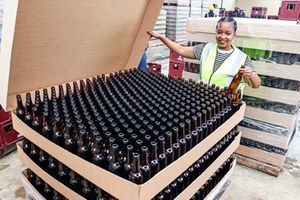
“Often, the bottles find us. We get a call, share our location, and they drop off. It is a simple, organic system that works because we are offering value where waste is a burden,” she says, adding that with donations rapidly increasing, storage has become a challenge, reflecting both the heavy waste burden people carry and their eagerness to contribute to solutions. Beyond informal drop-offs, the company has a formal partnership with East African Breweries Limited (EABL) through its Rudisha program. They run a circular model that intercepts used glass bottles at the source, before they reach dumping sites, upcycles them into new products, and returns them to EABL for redistribution to the original establishments for reuse.
Starting with one employee and growing to nine full-time staff and over 25 others across the value chain, the business initially had no gender-specific hiring policy.
However, the team naturally evolved into an all-female workforce, primarily women from the Dagoretti community. Often hired locally with limited formal education, they receive on-site training, steady pay, and access to essential services, such as banking and national health scheme enrolment, in some cases for the first time.
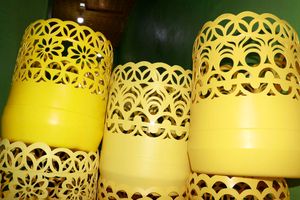
Some of the products made at MokoMaya Home Décor workshop in Dagoretti, Nairobi on August 6, 2025, from glass bottles.
Photo credit: Bonface Bogita | Nation Media Group
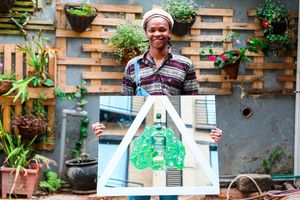
“Once bottles arrive at our workshop, they are sorted, cut, smoothed, and cleaned for safety and hygiene. After polishing, they are decorated. Some hand-painted, others accented with wood or brass, creating unique, functional pieces tailored to clients,” she explains.
Each piece showcases the artisans’ craftsmanship, with quality maintained through clear workflows and ongoing improvements. Safety is ensured by the strict use of protective gear during glasswork.
Its extensive product catalogue features drinkware, serveware, vases, and custom corporate gifts, available online and at select retailers like eCandi, the Giraffe Centre gift shop, and Anselm Kitengela stores, with plans to streamline and refine core lines.
Prices for individual customers range from Sh750 to Sh10,000, while corporate rates vary by order size and customisation. The brand builds visibility through social media, word-of-mouth, and industry events.
Corporate clients, particularly those seeking gifting that celebrates impact, intention, and sustainability, make up most of the business, while the smaller but steadily growing business-to-consumer (B2C) segment contributes 10 to 20 per cent of overall sales.
For Nyandia, lack of funding was never a deal-breaker, but simply an invitation to get inventive and build with what was accessible.
“I only accessed funding for the first time last year, after MokoMaya had grown, become profitable, and I had a much clearer understanding of what kind of support we actually needed,” she notes.
She acknowledges that running a circular economy business in Kenya faces significant challenges. While circular products are gaining traction, understanding and practising true sustainability remains limited.
A drinking glass being polished at MokoMaya Home Décor Workshop in Dagoretti, Nairobi, on August 6, 2025.
Photo credit: Bonface Bogita | Nation Media Group
“True environmental care requires examining a product’s full lifecycle, including hidden impacts like the water-intensive nature of glass upcycling,” she explains, noting that many ‘green’ brands overlook the environmental impact of the process, including those from imports.
Without scrutiny of how products are made and transported, sustainability risks becoming a mere label. Kenya’s beverage sector largely depends on glass packaging, but waste management is weak. With limited eco-friendly options, policy support, and formal training, many small waste innovators rely on online resources amid scarce collaboration opportunities.
Despite her achievements, setbacks remain. In the early stages, building a team was a challenge, and she worked alone for the first three years. Leadership, especially in human resources, was a steep learning curve, prompting her to bring in an HR firm for guidance.
Operational hurdles continue, particularly with equipment. Much of it is locally made, which impacts precision, while more advanced machinery is costly and prone to delays. Scaling operations has proven difficult, as locally fabricated equipment often requires trial and error.
Transporting glass—bulky and fragile—adds another layer of complexity. As demand grows, she realises that their systems need to evolve.
“This makes having clear documentation and streamlined workflows essential for sustainable growth. One misconception I often encounter is that handmade glassware should be cheaper, even though it is usually more durable than mass-produced options,” she says.
Rather than entering new territories, the company is doubling down at home, deepening its presence where opportunity remains untapped. MokoMaya received a climate validation certificate from Europe's Climate-KIC after a thorough six-month review of their production process, which confirmed that their use of upcycled glass reduces raw material demand, water usage, energy consumption, and carbon emissions.
The process also showed positive impacts on resource depletion and ecotoxicity. "This partnership provided tools we could not have afforded otherwise and revealed both the possibilities and the costs," she says.
The company now plans to continuously monitor its production to ensure the highest standards of circularity.
Despite Kenya’s adoption of Extended Producer Responsibility (EPR) policies, glass waste remains a significant challenge due to limited recycling infrastructure and few incentives for reuse.
The business is filling this gap with a scalable, home-grown model that diverts glass bottle waste from landfills, creates jobs, and supports local craftsmanship, offering consumers a sustainable and reliable solution.
“We are exploring collaborations with ecotourism destinations, local restaurants, and interior designers for unique, eco-friendly solutions, while also planning to expand through e-commerce and more corporate partnerships,” she says.